


Your Dog Sniffs You at the Door Because You're the Evening News
That intense once-over when you walk in isn't clinginess, it's your dog reading a scent-newspaper of your entire day. Why they do it, why cutting it short frustrates them, and when sniffing is too much.

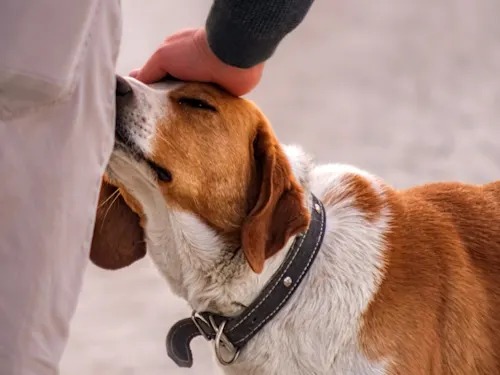
You walk in the door and your dog is on you before your coat’s off, nose working every inch of your pant leg like a detective who’s already decided you’re guilty of something. It’s flattering and a little much. And it raises the obvious question: why the total-body inspection, and why now, when they barely bother the rest of the day?
The answer reframes the whole thing. Your dog isn’t being needy. They’re catching up on the news, and you are the newspaper. Everywhere you went, everyone you touched, every animal that brushed past you, all of it came home written on your clothes and skin in a language your dog reads fluently and you can barely detect.
You come home as an open book
A dog’s sense of smell is estimated to be somewhere between a thousand and a hundred thousand times sharper than ours, and it’s not just raw power, it’s resolution. Dogs can separate a scene into individual odor molecules and identify them one by one. Those molecules land on surfaces, through the air or through contact, and stay put until something washes them away. Which means that when you get back from work, the gym, the grocery store, wherever, you arrive coated in a detailed record of your day.
To your dog, that’s not a smell. It’s a densely written record of the outside world and everything you got up to without them. Your hair, your clothes, your skin carry traces of the animals you were near, the food you ate, even the weather and air where you’d been. The intense sniff-down at the door is your dog reading the day’s edition, cover to cover.
I always tell people to picture their dog opening a newspaper, not clinging to a person. That nose is scanning the headlines of everywhere you’ve been. It’s one of the most natural, information-rich things a dog does all day, and it happens to be aimed at their favorite subject: you.
They’re checking on you, too
It goes deeper than a travel log. When you come home, your dog is also gathering social intelligence: who you’ve seen and what state you’re in. Spend the afternoon near other animals or people and your dog can tell. They can pick up the scent of another dog or cat, a stranger’s perfume, the residue of a place like a training class, and they’ll zero in on the unfamiliar bits to investigate.
They’re reading your emotional weather as well. Dogs are strikingly sensitive to shifts in our body chemistry, including cortisol, which spikes with stress, and oxytocin, tied to bonding and warmth. A rough day or a jolt of excitement changes your scent profile, and your dog notices the change. Part of that doorway sniff is a genuine check-in: are you okay?
And sometimes it’s simply reconnection. Think of how you thumb through your phone to see what you missed, your dog uses their nose the same way to re-familiarize themselves with you after hours apart. Some give a couple of sniffs and move on; others take their time, assembling the full scent-story of your day before they’re satisfied.
Why letting them finish matters
Here’s where a small change in how you think about this pays off. There’s a strong case that you shouldn’t rush your dog through it. Go back to the newspaper idea and take it one step further: you wouldn’t yank the paper out of someone’s hands halfway through the front-page story, then do it again the next day, and expect them not to get irritated. That’s roughly what happens when you drag your dog away mid-sniff. Because scent is their single most natural way of making sense of the world, being cut off partway through isn’t just annoying to them, it’s genuinely disorienting, and it can leave a low hum of frustration behind.
There’s a calming payoff, too. Sniffing is quietly regulating: the act of working a scent lowers a dog’s arousal, bleeds off excitement and nervous energy, and can release feel-good hormones that leave them more settled. Give a dog room to sniff and they tend to be calmer by bedtime. Familiar smells, including yours, are grounding, they help a dog feel safe and secure. So that doorway inspection isn’t just information-gathering; it’s a small act of self-soothing.
When sniffing crosses a line
For nearly every dog, there’s no such thing as “too much” sniffing, and you don’t need to police it. But a few situations are worth watching. If the behavior turns genuinely obsessive, your dog can’t disengage after a long stretch, or if a particular scent triggers distress or aggression rather than curiosity, that’s a different signal.
If your dog reacts negatively to something you’re carrying, the move is to redirect calmly rather than confront. Slowly get up and move away, or toss a toy to break the fixation. Avoid interacting, and especially avoid scolding, which only ramps up their arousal. You can step out of the room or put a baby gate between you, then offer some calming enrichment, a lick mat or snuffle mat, on the other side of the barrier.
Those cases are the exception. Most of the time, the door greeting needs no management at all. As long as it isn’t aggressive or so intense it tips into overstimulation, there’s nothing to fix and nothing to worry about. Take it as the compliment it is, your dog is just thrilled to catch up on the whereabouts of their favorite person.
What newer research adds
The old intuition that “letting them sniff is good for them” now has solid experimental backing. In a well-known study, researchers gave one group of dogs two weeks of nosework games and another group two weeks of structured heelwork, then tested their outlook with a cognitive-bias task. The nosework dogs became measurably more “optimistic”, quicker to approach an ambiguous target, a recognized marker of positive welfare, while the obedience-drill dogs did not. The conclusion was clear: letting dogs use their noses and make their own choices genuinely improves how they feel. So the next time your dog gives you the full pat-down at the door, remember you’re not just tolerating a quirk. You’re handing them a small, real boost to their wellbeing. Let them finish the chapter.
References
- Duranton, C., and A. Horowitz. “Let Me Sniff! Nosework Induces Positive Judgment Bias in Pet Dogs.” Applied Animal Behaviour Science, vol. 211, 2019, pp. 61-66.
- Horowitz, A. Being a Dog: Following the Dog Into a World of Smell. Scribner, 2016.
Leila Torres leads our Living coverage, from home life and travel to the products and rescue stories that come with sharing a life with animals. She edits and writes across the section, with a soft spot for pieces about the bond between people and their pets.
Meet our experts ↗