


Your Dog Isn't Ignoring You. You're Talking Too Fast.
A brain-imaging study found dogs process the slow rhythms of speech, not the fast ones humans track. That's why your dog catches 'good boy' but glazes over during a long explanation, and why slowing down actually helps.

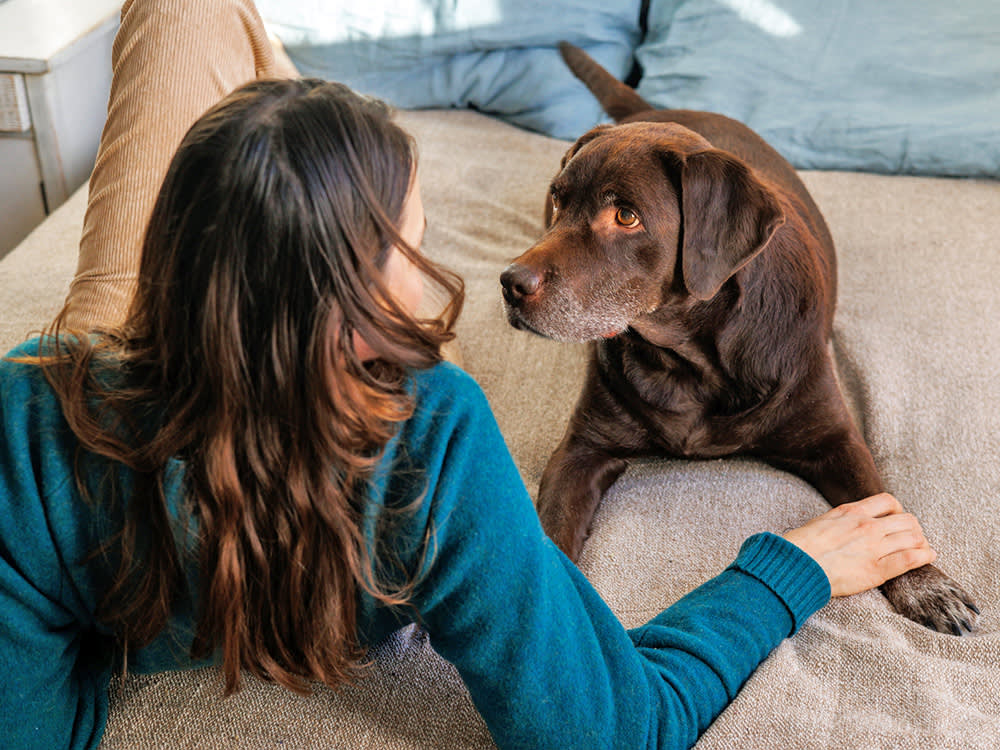
You already know your dog understands some of what you say and misses a lot of the rest. They light up at “good boy” and “walk,” but when you launch into a rambling account of your day, they just blink at you, patient and clueless. It is easy to chalk that up to a limited vocabulary. A brain-imaging study suggests the real bottleneck is something else entirely: speed. Your dog is not built to keep up with how fast humans normally talk, and when you slow down, you are not being silly, you are meeting them where their brain actually works.
The finding reframes a lot of everyday dog talk. That instinct to drop into a slower, sing-song register when you address your dog turns out to be well aimed, and the science says you could lean into it even more. Here is what the researchers found, and how to put it to use.
Dogs and humans run at different speeds
Researchers set out to compare the tempo of dog and human vocal communication. They analyzed the full vocal repertoire of 30 dogs, every bark, growl, howl, snarl, and whine, and stacked it against human speech: 27 people talking to other people across five languages, plus 22 people talking to dogs across five languages.
A clear gap emerged. Humans speak quickly, at roughly four syllables per second. Dogs vocalize far more slowly, at about two sounds per second, half our pace. Interestingly, when people spoke to dogs rather than to other people, they naturally slowed down to about three syllables per second, splitting the difference, though still faster than dogs talk among themselves. In other words, we already downshift for our dogs on instinct; we just do not go far enough.
The brain scans explain why it matters
The tempo difference would be a curiosity if it stopped there. What makes it useful is what the researchers found inside the brain. They ran EEG recordings on both dogs and humans to see which rhythms of speech each nervous system locks onto.
The two species prioritize different frequencies. Dogs best process delta rhythms, the long, slow patterns in speech, the intonation, the pauses, the overall melody. Humans, by contrast, are tuned to theta rhythms, the faster components that carry individual syllables. That is the crux of it: dogs are not equipped to parse the quick, intricate syllable-level detail packed into a normal sentence, but they can catch the gist when the delivery is slow enough to ride those slower rhythms. When you talk at full human speed, the fine-grained content is simply moving too fast for a dog’s brain to track, even if the dog is paying close attention.
What this changes about talking to your dog
The practical lesson is refreshingly simple: slow down, and lean on the slow features of speech. Long vowels, clear intonation, and deliberate pauses are exactly the delta-band cues dogs process best, so a cue delivered slowly and warmly lands better than the same words rattled off. It also validates the way most of us already talk to dogs. That drawn-out “goooood dog,” the exaggerated melody, the pauses, these are not just cute habits; they happen to match how a dog’s brain listens.
It reframes the “ignoring you” problem, too. A dog who does not respond to a fast, clipped command may not be stubborn or distracted; the instruction may have gone by faster than they could process. Give the cue again, slower and more clearly, before you conclude your dog is blowing you off. The researchers behind the work hope that understanding this can help strengthen the bond between people and dogs, and the mechanism is almost sweet: your dog is ready and willing to listen. They just need you to take your time.
The takeaway I give people is to treat your dog like they’re listening on a slight delay, because in a sense they are. Say the cue, leave a beat, and let it land before you repeat it or add three more words on top. Owners who slow their cues down usually tell me their dog suddenly seems ‘smarter.’ The dog didn’t change. The speed did.
What newer research adds
Follow-up work has filled in the picture in a way that corrects one common oversimplification. It would be easy to read the tempo study as “dogs only hear tone, not words,” but newer research pushes back on that. Studies have found that both the content of speech and its prosody, the melody and rhythm, matter to dogs, and that dogs can pick meaningful pieces, like their own name, out of a stream of otherwise irrelevant speech, even when it is spoken in a flat, monotone voice. So dogs are doing more than vibing on your tone; they are extracting real information, just through a slower channel than we use.
The consensus taking shape is that dogs and humans have partly co-adapted their communication. Dogs process language in that slower delta band, humans instinctively slow and exaggerate speech when addressing them, and the “dog-directed speech” we all fall into sits neatly between how humans and dogs each naturally vocalize. That shared middle ground is a genuine communication bridge. The most actionable version of all this remains unchanged and easy to remember: when you want your dog to understand you, slow it down and say it clearly. Their brain will do the rest.
References
- Déaux, E. C., et al. (2024). Dog-human vocal interactions match dogs’ sensory-motor tuning. PLOS Biology, 22(10), e3002789.
- Andics, A., et al. Dog brains are sensitive to infant- and dog-directed prosody. Communications Biology (2023).
- Research on dogs identifying names in monotone/undirected speech, Animal Cognition / Scientific Reports (2025).
- NCCR Evolving Language. “When dogs and humans find a common language.”
Tom Hadley writes about training and behavior, helping owners understand what their pets are trying to tell them. His work covers everyday manners, decoding common behaviors, and the small changes at home that make dogs and cats easier to live with.
Meet our experts ↗Keep reading
 LivingYour Dog Isn't a Character Judge. But Their Cold Shoulder Still Means Something.Sasha Ford · 6 min
 TrainingYour Tears Stress Your Dog Out. A Pet Pig Wouldn't Care.Dr. Nina Kohl · 5 min
 LivingIs Your Dog Really Jealous, or Just Afraid of Missing Out? The Science Is Messier Than the Headlines.Dr. Nina Kohl · 5 min
 Health & WellnessDog Saliva Doesn't Heal Wounds. It Delivers Bacteria.Dr. Priya Nair · 8 min
 LivingA Dog With No Nostrils Became Philadelphia's Most Famous RescueLeila Torres · 6 min
 LivingHis Dog Walks Into the Office at 5 P.M. and Ends the WorkdayJames Okafor · 6 min