


His Dog Walks Into the Office at 5 P.M. and Ends the Workday
Fashion designer Scott Studenberg works from home in Laurel Canyon, which means his French Bulldog Donatella has learned exactly where he sits. She is not asking. She is enforcing.

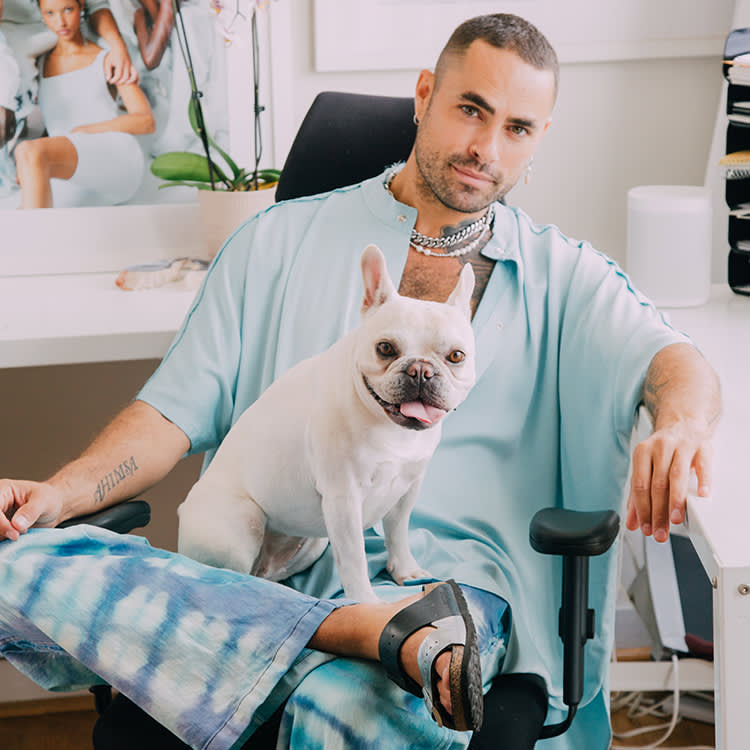
Everyone who works from home with a dog eventually learns that the dog is running a clock. Not a metaphorical clock. An actual, load-bearing, non-negotiable clock, and yours is set to whatever hour the dog decided on months ago without consulting you.
For the designer Scott Studenberg, co-founder of Baja East, that hour is five. His French Bulldog, Donatella, sleeps through the entire working day in Laurel Canyon while he does whatever a fashion designer does in a house with a balcony, which on the day of this conversation includes tanning and taking a phone call simultaneously. Then, at five, she surfaces. She walks into his office, gets on his desk, sits down, and looks at him until he stops.
He describes it as being confronted. He also does not appear to be trying very hard to fight it.
The dog as a hard stop
There is a whole genre of advice about work-life boundaries for people who work from home, and almost all of it is about willpower, which is why almost none of it works. What works is an external constraint that does not care about your deadline.
A dog is the most effective external constraint most creative people will ever have. She is not negotiating. She does not know what a look book is. She has a body that needs a walk and a nervous system that has been alone all day, and the desk is where the problem is, so she gets on the desk.
Studenberg’s workload at the time was not light: a collection to finish, a look book shoot to organize, a new men’s swimwear line to launch, and a collaboration to close out. All of it ends at five, because Donatella arrives and it ends.
The guilt he describes is familiar to anyone who has done this. He calls it neglecting her during the day. It is not neglect. It is the ordinary tension of being one person with a job and an animal who has no concept of one, and the reason the dog gets on the desk is that from where she is sitting, you are simply available and not paying attention.
What she actually is
Donatella is named for Donatella Versace, and Studenberg has clearly been pleased about that decision for five straight years. She is a diva. She does not share. When other dogs approach a person she has claimed, she snarls at them.
She is territorial enough that he has real reservations about bringing another dog into the house, unsure whether a new dog would be submissive enough to keep the peace. That is not a small worry, and it is the correct worry to have. Resource guarding of a person is one of the most common and most under-diagnosed reasons a two-dog household goes badly, and it is much easier to prevent than to fix.
She is also, in his account, a terrible wingman. Asked once to go make friendly overtures to a stranger’s dog at the park, she started a fight instead.
Which brings up the thing that goes unsaid in most charming celebrity dog stories: the dog park is not a neutral setting for a dog like this. Studenberg has figured this out empirically. He cannot be on his phone there. He has to watch every movement. That is not the dog park working. That is a person managing a dog who is not a good fit for it.
The honest version of this advice: a dog who guards her person and escalates at strangers is not being punished by skipping the dog park. She is being spared. Structured playdates with a known dog, which is what Studenberg mostly does now, are the right call, and they are how Donatella still has a social life at all.
Bala
Underneath the comedy is the actual story.
Studenberg had a second dog, Bala, older than Donatella. Bala died in June, after a year-long fight with cancer. She was not a high-energy playmate by the end, and did not entertain playtime the way a young dog would, but she was there, and Donatella was not alone in the house all day while her person worked.
Now she is. And that is where the guilt he mentions actually comes from. It is not about the hours. It is about the room.
The impulse to fill it fast is strong and worth resisting for a beat. A grieving, territorial, only dog is not the ideal candidate for an immediate new sibling, and the introduction that would have been easy with Bala in the house is now a much more careful project. He knows this, which is why he is hesitating.
Both dogs came from breeders. Adoption, he says, is the plan from here, starting with a foster placement to see how it lands, which is genuinely the correct next move for a household in exactly this position. Fostering is the only way to find out whether a specific dog and a resource-guarding Frenchie can coexist without making it permanent before you know.
The cashmere problem
A note on the fashion of it, because it is funny and also a real thing.
Donatella has a wardrobe. A rotating selection of her outfits and harnesses rides around in the back of his car, so the two of them can match on short notice, and he builds her one-off pieces for events and shoots. Baja East once produced a small run of dog onesies, currently a one-off, though he says more pet-wear would follow if the demand showed up.
And she has learned to find cashmere. Put her in any room and she will locate the one cashmere object in it and lie down on it. He accepts full blame. Her beds are lined with cashmere blankets, samples from his home collection, and once you have shown a dog the finer things you cannot un-show them.
Worth noting, since a lot of people are shopping for a flat-faced dog and reading this: soft is fine, warm is fine, but a French Bulldog’s real gear priority is heat management. Brachycephalic dogs overheat fast and cannot cool themselves efficiently by panting the way a longer-muzzled dog can. In Los Angeles, the meaningful purchases are shade, water, a cooling mat, and walks scheduled outside the middle of the day. The cashmere is for her. The cooling mat is for her too, and it matters more.
The larger point
Studenberg went vegan a couple of years ago. The reason he gives is the planet, not the plate, and the same logic has been working its way through his collections: animal byproducts out, snake skins abandoned in favor of snake prints, which he describes as celebrating the animal instead of harming it. The swimwear fabric is spun from recycled plastic bottles, 80 percent of it. Since the pandemic he has been cutting new, seasonal pieces out of old collections, including a full tie-dye run rebuilt from reinvented archive styles.
Donatella, he admits cheerfully, has no interest in any of it. She is interested in herself. And in five o’clock.
Which is, when you get down to it, the whole reason people who work in a demanding creative field end up with a dog. Not for inspiration. For the interruption.
References
- American College of Veterinary Surgeons. Brachycephalic Syndrome.
- American Veterinary Society of Animal Behavior. Position Statement on Humane Dog Training.
- ASPCA. Resource guarding in dogs.
- American Kennel Club. How to introduce a second dog into your home.
James Okafor covers rescue, adoption, and the causes shaping animal welfare. His work follows the people and organisations working to give more pets a home, and the issues owners and advocates care about most.
Meet our experts ↗Keep reading
 LivingADHD Doesn't Make You a Bad Dog Parent. Your Reminder App Does.Leila Torres · 8 min
 LivingYour Dog Doesn't Care About Your Square Footage. It Cares About You.Marcus Webb · 9 min
 TrainingThe One Thing Your Dog's Breed Is Quietly Begging You ForJordan Ellis · 7 min
 TrainingYour Dog Doesn't Miss You the Way You Think. It's Better.Dr. Nina Kohl · 6 min
 TrainingStop Steering. The Walk Is the One Thing Your Dog Should Get to Decide.Dr. Lena Park · 7 min
 TrainingYour Dog Isn't Shy at Your Party. Six Signs They Want Out.Dr. Lena Park · 8 min