


Your Dog Isn't Misbehaving. They're Scared.
The lunging, the barking, the 'stubbornness' — most of it is fear wearing a costume. Once you stop correcting the behavior and start changing the emotion underneath it, an anxious dog gets easier to live with. Nine moves that actually work.

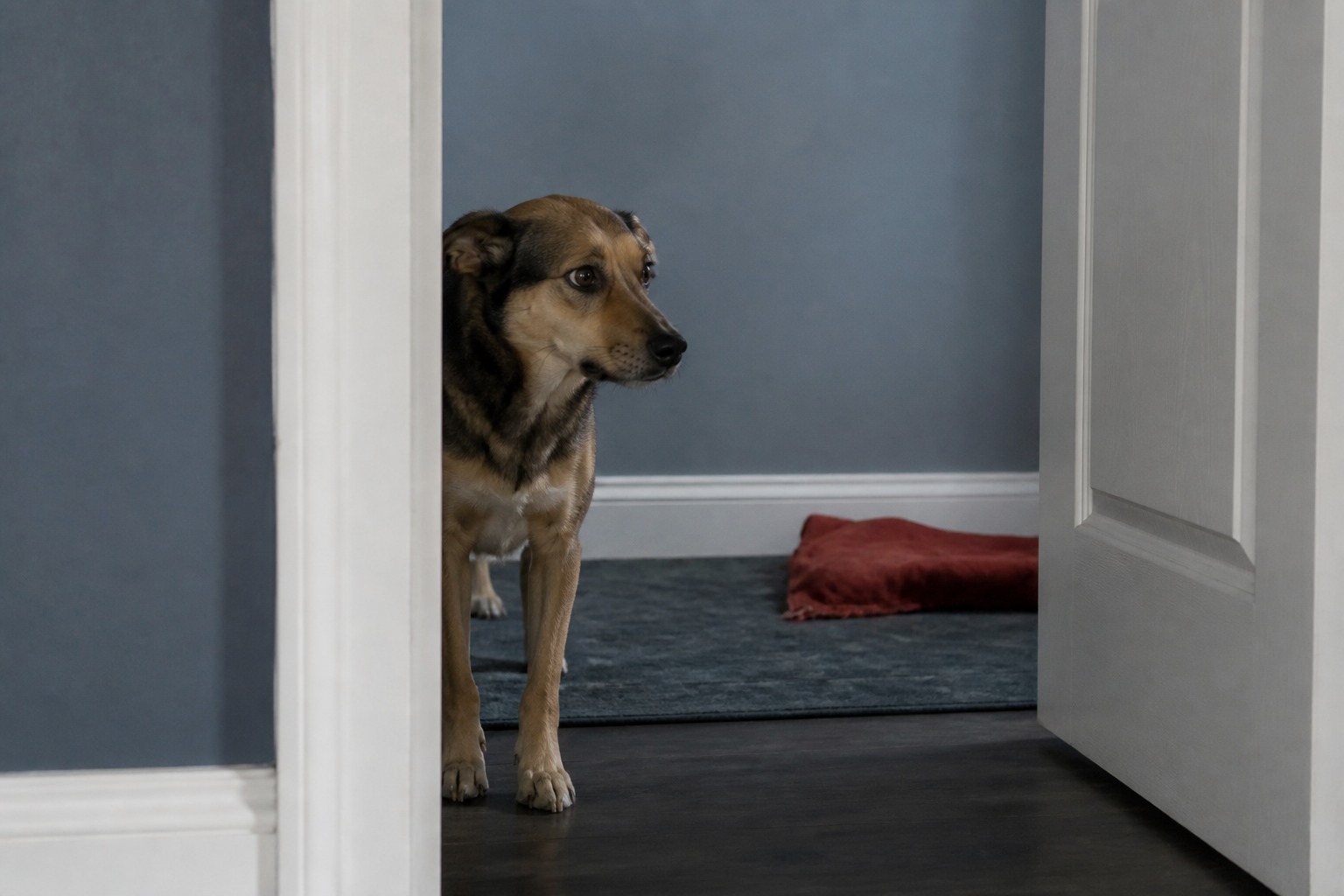
Here is the reframe that changes everything about living with a nervous dog: the behavior you are fighting is almost never disobedience. The dog who lunges at the mail carrier, shreds the couch when you leave, or freezes solid on the sidewalk is not plotting against you. They are scared, and scared dogs do dramatic, inconvenient things to feel safe.
That single shift, from “my dog is being bad” to “my dog is frightened,” is the whole game. Correction and dominance aim at the behavior. They do nothing about the fear driving it, so at best the dog shuts down and at worst the fear gets worse. Change the emotion instead, and the behavior fades on its own. A dog who no longer feels threatened has no reason to bark, bolt, or bite.
For a long time, nervous and reactive dogs were treated as the exception, and their people were expected to apologize for them. That has flipped. Trainers and vets now recognize that a perfectly bombproof dog is the rare one, and that most dogs carry at least one thing they cannot easily cope with, whether it is strangers, storms, other dogs, car rides, or being alone. If that is your dog, you are in the majority, and you have real tools.
First, learn what fear actually looks like
Anxiety rarely announces itself as “anxiety.” It shows up disguised as misbehavior, which is exactly why so many dogs get punished for being afraid. Watch for:
- Barking or howling that won’t quit
- Persistent whining
- Growling, snapping, or lunging
- Heavy panting or drooling when it isn’t hot
- Digging or scratching at floors and doors
- A flat, withdrawn, “depressed” mood
- Licking themselves raw
- Pacing and an inability to settle
- Compulsive chewing on odd objects
- Peeing or pooping indoors despite being house-trained
- Trembling or shaking
Any of these can read as a “bad habit.” Nearly all of them are a stress response. When the behavior clusters around a specific situation, that is your signal to stop training the symptom and start addressing the fear.
The nine moves that actually help
1. Hire a trainer who works with fear, not against it
Modern behavior science is blunt about this: the overwhelming majority of dogs who bark at, lunge at, or fight other dogs and people are doing it out of fear, not a bid to be “pack leader.” A frightened animal who feels cornered will go on offense to end the threat first. Punishing that dog does not make them braver; it just teaches them to hide the warning signs. Look for a trainer who uses positive reinforcement and holds a credential such as CCPDT certification, and steer clear of anyone promising to “dominate” the fear out of your dog.
2. Give other people a heads-up
It feels backwards to advertise your dog’s nerves, but visibility buys you space. A yellow ribbon on the leash, or a harness or bandana that reads “nervous” or “give me room,” tells strangers to keep their distance before they lunge in for a pet. You get to manage the encounter instead of shouting warnings across the sidewalk.
3. Use a muzzle without shame
If your dog is big enough that a sudden lunge could get away from you, a well-fitted basket muzzle is a responsible, kind piece of equipment. It lets you both relax in public because the worst-case scenario is off the table. The old stigma around muzzles is fading, thanks in part to advocacy efforts like the Muzzle Up! Project, which reframes a muzzle as the mark of a careful owner, not a dangerous dog.
4. Find a vet who handles nervous dogs gently
Some clinics still rely on rough, forceful restraint that turns every visit into a trauma your dog remembers next time. It does not have to be that way. Low-stress handling techniques, pioneered by the late Dr. Sophia Yin, can transform how a fearful dog experiences the exam room. If your current vet won’t slow down and work with your dog’s fear, it is worth finding one who will.
5. Read your dog’s body language
Your dog is narrating their comfort level constantly, and the better you get at hearing it, the more trouble you can head off. Pay attention to early stress signals, because of a phenomenon called trigger stacking: stressful events pile up faster than the stress hormones can clear, so something your dog shrugged off last week can tip them over the edge today. Spotting the small signs lets you leave before the big reaction.
6. Build a predictable retreat and routine
This one is not in most anxiety checklists, and it should be. Fearful dogs settle faster when the world is predictable and they always have somewhere to go. Set up a covered crate, a quiet corner, or a back bedroom as a genuine safe zone your dog can retreat to and never be dragged out of. Keep feeding, walks, and downtime on a loose but reliable schedule. Predictability is not exciting, but for an anxious brain it is deeply calming.
7. Stop dreading comfort
You will hear that comforting a scared dog “rewards” the fear. It does not. Fear is an emotional state, not a party trick, and you cannot reinforce an emotion with a reassuring hand. If your dog seeks you out during a scary moment, let them lean in. What actually shrinks fear over time is counter-conditioning, slowly pairing the scary thing with something wonderful, ideally with a trainer’s help.
8. Talk to your vet about medication
The question every owner eventually asks is some version of “should my dog be on something?” For a lot of dogs, the honest answer is yes. Many of the same medications that help anxious humans also help dogs find enough calm to actually learn. Fluoxetine even has a dog-specific, FDA-approved version. Medication is not about drugging your dog into a stupor; it lowers the panic baseline so training can finally take hold. The right starting point is a conversation with your vet, who can prescribe directly or point you to a veterinary behaviorist, meaning a vet with advanced credentials in behavior and medication both, to build a plan around your particular dog. Be far more skeptical of over-the-counter “calming” chews, most of which are untested and lean heavily on the placebo effect for the human buying them.
9. Build a life around the dog you have
It is okay to grieve the dog-park, patio-brunch, agility-star fantasy. Then let it go and find what your actual dog loves. Sniff-heavy walks in quiet places, indoor puzzle games, nose-work classes, or just a calm evening on the couch can be deeply fulfilling for a nervous dog. Forcing a fearful dog to be the outgoing one you pictured tends to backfire, making the anxiety worse and straining the bond you do have.
When it is bigger than training
Sometimes, despite everything, a dog’s fear makes them a genuine danger to you or your kids, or the level of care they need is beyond what your life can sustain. Rehoming to a situation that fits them better is not failure. Training and medication are expensive, and a severely anxious dog can be a years-long commitment. Choosing to place a dog somewhere better suited to their needs is, in some cases, the kindest and wisest thing you can do. You are not a bad person for it.
What newer research adds
The science has quietly moved past the old “alpha” and “dominance” framing, and reputable trainers have moved with it. Reactivity is now understood as a fear and arousal problem, which is why fear-first methods keep outperforming correction-based ones.
On the medication front, there are now genuinely evidence-backed options. Fluoxetine has been available in a dog-specific, FDA-approved form (marketed as Reconcile) since 2007, cleared for separation anxiety when it is paired with a behavior plan rather than used alone. For dogs whose fear centers on loud noises like fireworks and thunder, there is also Sileo, an oromucosal gel that is the first FDA-approved treatment for noise aversion and calms without sedating. Neither is a magic fix, and both belong in a conversation with your vet, but they mean an anxious dog today has real, tested help that did not exist a generation ago.
I tell people to stop asking how to make their dog behave and start asking what their dog is afraid of. The day you treat the fear instead of the symptom is usually the day the ‘bad’ behavior starts to disappear on its own.
References
- Fluoxetine (Reconcile, Prozac) for Dogs — PetMD
- SILEO (dexmedetomidine oromucosal gel), NADA 141-456 — U.S. Food and Drug Administration
- Certification Council for Professional Dog Trainers (CCPDT) — certification standards for positive-reinforcement trainers
- The Muzzle Up! Project — muzzle training and advocacy
- Low Stress Handling — Dr. Sophia Yin
This article covers fear and anxiety, which can be a sensitive topic. If your dog’s anxiety is severe or escalating, please work with your veterinarian or a veterinary behaviorist.
Common questions
Is my dog anxious or just badly behaved?
The two look almost identical from the outside. A dog who lunges, barks, hides, house-soils, or 'won't listen' is very often frightened, not defiant. Fear-driven behavior tends to spike in specific situations (strangers, other dogs, storms, being left alone) and comes packaged with body-language stress signals like a tucked tail, whale eye, lip-licking, or panting. If the behavior tracks with a trigger, treat it as anxiety first.
Will comforting my anxious dog make the fear worse?
No. Fear is an emotion, not a trick your dog performs for attention, so you cannot reinforce it by offering calm reassurance. Petting, soft talk, or simply letting your dog lean on you does not teach them to be more afraid. What actually changes fear over time is counter-conditioning and, when needed, medication.
Can medication really help a fearful dog?
For many dogs, yes. Fluoxetine has an FDA-approved, dog-specific version (Reconcile) cleared for separation anxiety when paired with training, and veterinary behaviorists use several other medications off-label. Medication does not sedate a dog into compliance; it lowers the baseline panic enough that training can finally stick.
Dr. Park is a board-certified emergency and critical care specialist. She reviews our health and safety content for clinical accuracy and contributes guides on recognising urgent conditions. Her focus is helping owners act quickly and correctly when it matters most.
Meet our experts ↗Keep reading
 TrainingYour Shy Dog Isn't Antisocial. You're Fighting Two Hidden Deadlines.Dr. Mara Chen · 9 min
 TrainingThe Tail Chase Is Cute Until You Can't Interrupt ItDr. Amara Solis · 7 min
 TrainingNever Punish a Dog for Showing Teeth. It's the Warning You Want.Dr. Nina Kohl · 8 min
 Training'Overprotective' Is Usually Fear Wearing a Nicer NameDr. Ravi Mehta · 8 min
 TrainingYour Dog's DNA Isn't the Whole Story. The Part You Can Actually Change Is.Dr. Mara Chen · 5 min
 TrainingThe 'Guilty Dog' Face Is Real. Guilt Has Nothing to Do With ItDr. Ravi Mehta · 6 min