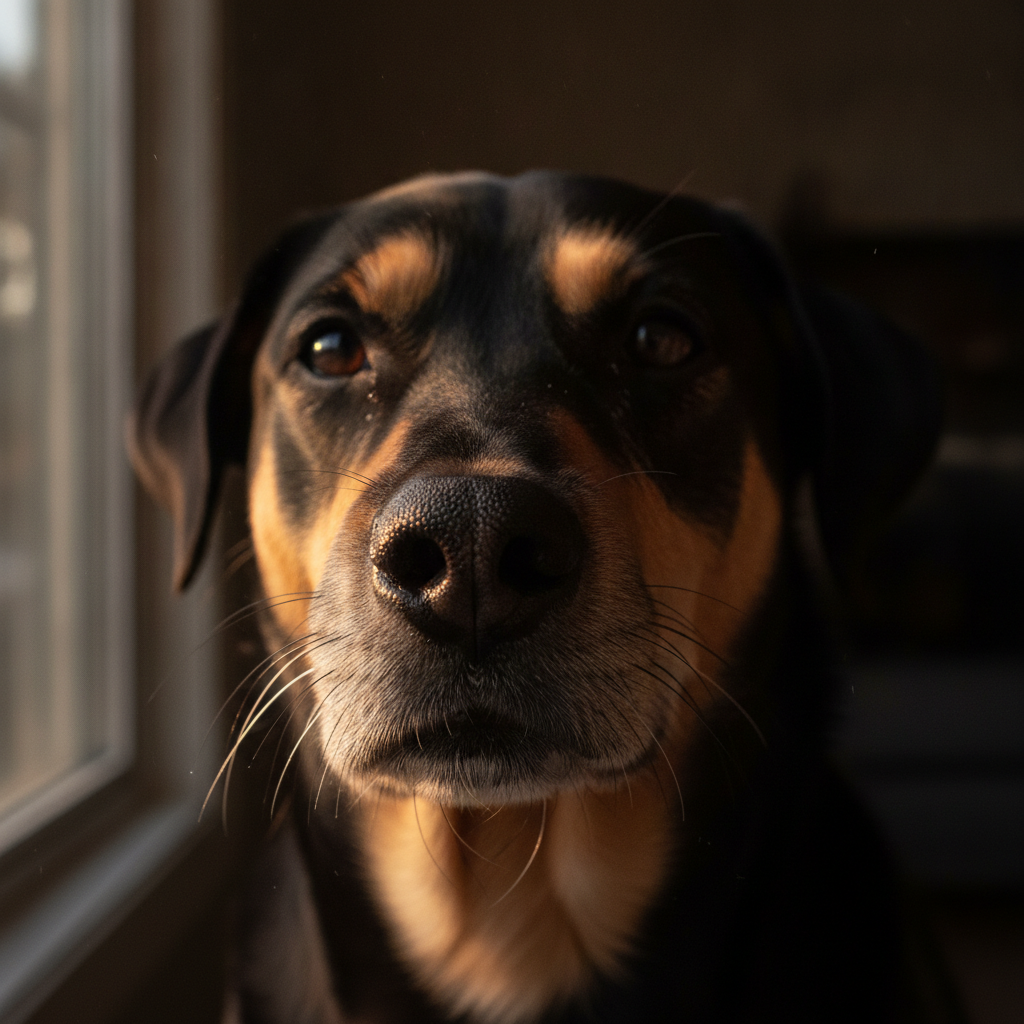
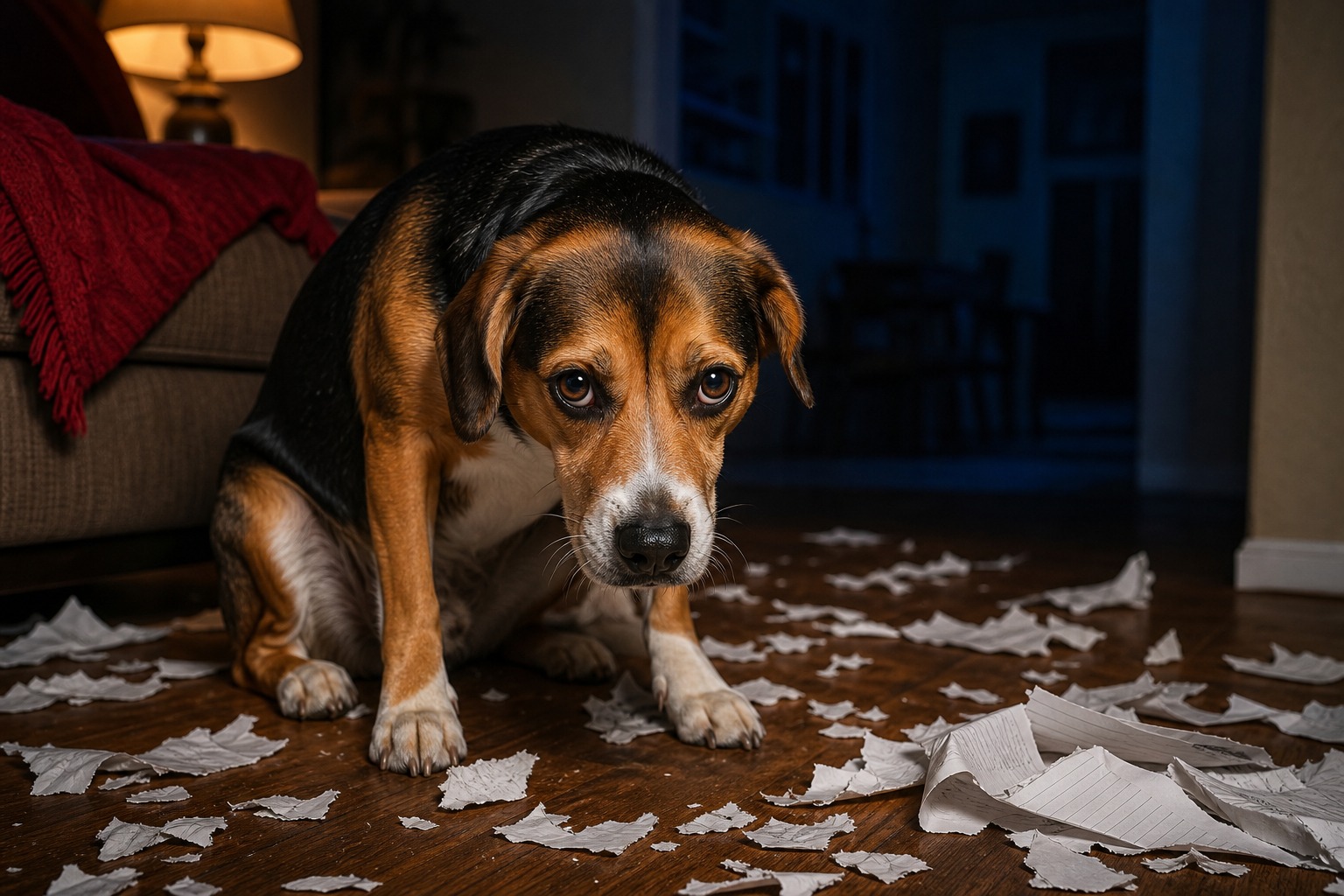
You open the door to a snowstorm of shredded toilet paper, a ruined cushion, or a fresh puddle on the rug, and there is your dog, ears back, head low, eyes doing that pleading thing. Every instinct tells you they know they did wrong. It looks exactly like guilt. It looks like a confession.
It is not. And this is one of those cases where a very natural human read of a dog leads you to do precisely the wrong thing next. The face is real. The behavior is real. But the guilt you are projecting onto it is a story your brain is writing, and if you act on that story, you tend to make the actual problem worse. So let’s take the face apart and see what your dog is genuinely saying, because it turns out to be more useful, and kinder, than “he knew.”
Guilt and embarrassment are more complicated than they look
Start with a distinction that clears most of this up. Psychologists separate primary emotions from secondary ones. Primary emotions are direct reactions to the world: fear, anger, joy, sadness. Dogs clearly have these. Secondary emotions are feelings about our feelings, and they require an extra layer of machinery. Guilt, shame, and embarrassment live in that second category. To feel embarrassed, you have to be able to imagine how you appear to others, judge yourself against that imagined view, and care about the gap. That is a tall order. It means holding a mental model of someone else’s mind, comparing it to your own self-image, and feeling bad about the mismatch.
Embarrassment, in particular, grows out of a fear of social exposure, of not measuring up to a standard, of being seen falling short. So to decide whether a dog can feel it, you would need to answer two questions: Do dogs actually track and care about human social norms? And do they hold themselves to an idealized version of who they should be, the way we do? Dogs live squarely in the present. They are not running that kind of self-audit. Shame itself is a deeply relative idea, shaped by culture, upbringing, and social norms, all things a dog is not weighing when they knock something off a shelf. The advanced chain of reasoning behind real embarrassment, the private worry that you’ve broken some rule you were meant to follow and will be judged for slipping, is largely a human production.
None of this makes dogs lesser, by the way. If anything, we overrate how evolved our own reactions are. A lot of human behavior is more primitive than we like to admit, and we hand ourselves a great deal of credit we have not earned. Dogs are not failing at shame. They are simply built without the specific, rather anxious apparatus that generates it.
So what is the face?
Here is what is actually happening when your dog gives you the hangdog look. They are not reacting to the mess. They are reacting to you. When you walk in, spot the destruction, and your expression hardens, that shift happens in under two seconds, and your dog reads it instantly. They are experts at your body language, far better at it than we are at theirs. The tucked tail, the flattened ears, the averted eyes, all of it is a response to your face changing, not to a memory of the crime.
In most cases the dog does not even connect the current mess to something they did earlier, possibly hours earlier. What they know, right now, is that your face went dark and your body went tense, and that this pattern has historically preceded something unpleasant for them. So they do what dogs do to defuse a bigger, angry social partner: they appease. The “guilty look” is a dog anticipating trouble and trying to head it off with submission, not a dog owning up to a deed they have already forgotten.
“Owners tell me their dog ‘knows he was bad’ because of the look he gave them, and I have to gently take that away from them,” says Dr. Ravi Mehta. “The dog isn’t replaying the crime. He’s reading your thundercloud of a face and trying to make peace with it. What you’re seeing isn’t a conscience. It’s a dog managing your mood in real time, which is honestly a more impressive skill.”
Why the misread matters
This is not just a fun bit of trivia, because the wrong interpretation leads straight to punishment, and punishment here accomplishes nothing you want. If you come home and scold or correct a dog for a mess they made earlier, they cannot connect the discipline to the act. The only lesson that lands is that your homecomings are dangerous. Do that enough and you build a dog who is miserable while you are gone and miserable when you return, braced for a bad mood every time the door opens. You have taught them to dread you without teaching them a single thing about the couch.
Punishment, in general, is a poor teacher. It does not explain what to do instead; it just adds fear. And a fearful dog is not a better-behaved dog. They are an anxious one, which, if anything, tends to fuel more of the destructive behavior that anxiety drives in the first place.
What to do instead
When you walk into a mess, the useful response is deeply anticlimactic. Put your stuff down. Greet your dog calmly, without the glare. Take them out for a walk. Then, later, with a clear head, think about tomorrow rather than today: what would set your dog up to succeed next time? Maybe they need more exercise before you leave. Maybe they need a food puzzle or a long-lasting chew to occupy the lonely stretch. Maybe the mess is really separation-related distress, and if the behavior is persistent and extreme, your vet can help you build a plan, which sometimes includes medication for genuine anxiety. In the moment, the goal is not justice. It is simply keeping your dog feeling safe and secure, because a safe dog is a dog you can actually work with.
There is a broader lesson tucked in here, and it is a generous one. Our own distance from anything resembling a natural life leaves us prone to draping our tangled, self-conscious feelings, guilt, shame, embarrassment, over animals who are living perfectly well without them. It is worth resisting the urge to anthropomorphize, not because it is silly, but because it blinds you to what your dog is really doing and feeling. Take them as they are, and you will read them better.
And honestly, there is something to envy in it. Imagine moving through the world without the weight of embarrassment, without rehearsing how you looked or dreading how you were seen. Your dog does not carry that. When you find the shredded roll of toilet paper and that face looking up at you, the face is not asking for forgiveness. It is asking you to be calm. That is a request you can actually grant.
References
- Horowitz, A. “Disambiguating the ‘guilty look’: Salient prompts to a familiar dog behaviour.” Behavioural Processes, 2009. sciencedirect.com
- American Veterinary Society of Animal Behavior. “Position Statement on Humane Dog Training.” avsab.org