


The Tail Chase Is Cute Until You Can't Interrupt It
Frequency isn't the warning sign. Interruptibility is. The 10-second test that separates a puppy game from a compulsion, plus what research says raises the risk.

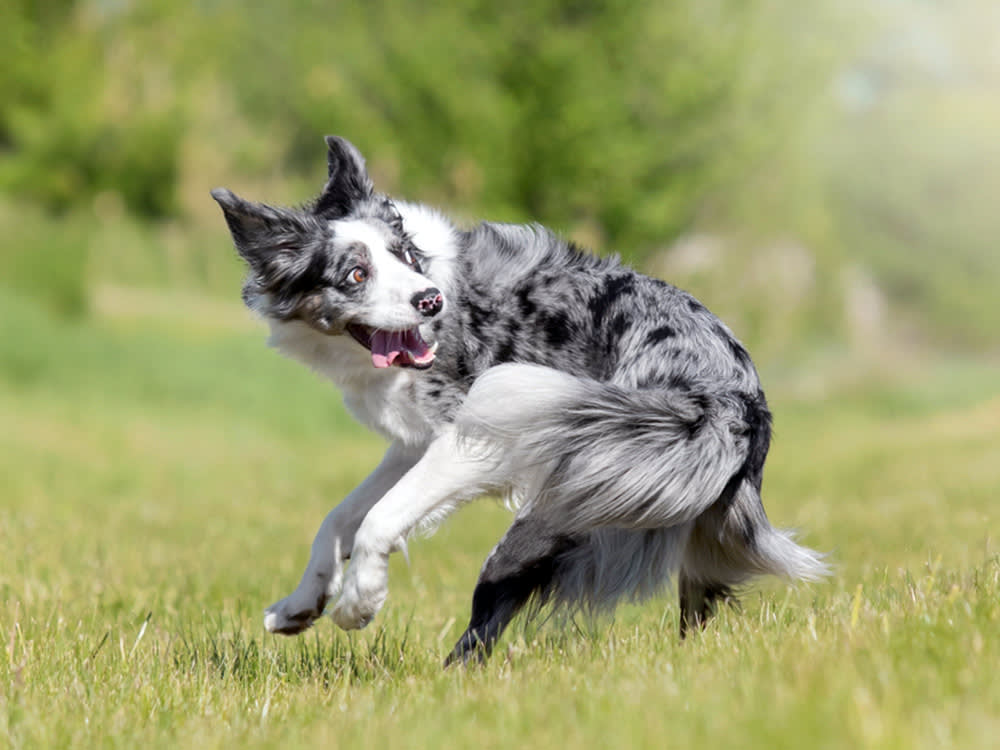
Somewhere in the first few months, most puppies discover that they are being followed. They whip around. The thing whips around too. They try again, faster.
It is one of the funniest things a dog does, and for most puppies, it’s exactly what it looks like: a small animal figuring out where their body ends.
But tail-chasing is also one of the few puppy behaviors that can quietly turn into a genuine disorder, and the thing most owners use to judge it, “how often does it happen,” is the wrong measure. Here’s the right one.
The 10-second test
Next time your puppy starts spinning, try to end it. Not by grabbing them. Just offer something good: a squeaky toy, a treat, a cue they know like “touch” or “sit.”
If they break off, look at you, and take the offer: you have a puppy playing a game. It’s fine. Redirect if you want the spinning to stop, ignore it if you don’t mind.
If you cannot get their attention, if they finish the offer and go straight back to the spin, if they’re spinning for minutes rather than seconds, or if they’re biting the tail hard enough to damage it: the behavior has stopped being a game. That’s the version worth bringing to a vet, and the sooner the better, because compulsive behaviors get more entrenched over time.
That’s it. Interruptibility, not frequency, is the tell.
The line isn’t drawn by how funny it looks, it’s drawn by whether the dog can stop. If I can hand a puppy a toy and the spinning ends, I’m not worried. If the toy hits the floor and the puppy keeps turning, I want to see that dog.
Why normal puppies do it
Because the tail is new. Puppies explore everything, including themselves. A puppy who has just noticed they have a back end will chase it for the same reason they chase a leaf.
Because they have energy and nothing to spend it on. A bored puppy will manufacture entertainment out of whatever’s available, and their own tail is always available. If the spinning shows up mostly in the late afternoon slump or after a long stretch of confinement, that’s an outlet problem. Take them somewhere new and let them sniff. Break out a flirt pole or a snuffle mat. Puppies need to use their brains, not just their legs.
Because you laughed. This is the one people underestimate. Puppies learn fast that certain behaviors summon attention, and attention is currency. If the first three tail chases were greeted by the whole family cheering, you now have a puppy with a party trick. Reinforcement is not fussy about your intentions.
When it’s medical
Some tail-chasing is not chasing at all, it’s an itch or a pain that happens to be located at the back end.
- Fleas. Flea bites cause intense irritation, and a puppy trying to get at the itch will spin, bite at the tail base, and scratch. Check for flea dirt (little black specks that turn rust-red on a damp paper towel) at the base of the tail, and treat immediately if you find it.
- Anal glands. A fishy smell, scooting, and biting or chasing at the tail area point here. Some dogs have occasional trouble, often after a bout of diarrhea when the glands weren’t emptied normally, and some have a chronic issue.
- Neurological causes. Less common, but real. Severe, driven tail-chasing has been documented in association with seizure disorders, and pain at the tail or spine can also drive the behavior.
If the spinning is new, intense, or comes with any skin, smell, or gait change, treat it as medical first and behavioral second.
The behavioral version, and what raises the risk
When tail-chasing is compulsive, it looks like a normal behavior stuck on repeat. It’s frantic, it’s hard to interrupt, and it interferes with the dog’s ability to do ordinary dog things. That is the same shape as compulsive disorders in people, and it’s not a training failure or a personality quirk.
The research here is genuinely useful. A large Finnish study of compulsive tail-chasing, published in PLOS ONE, found a set of patterns that owners can actually act on:
- It usually starts young. Tail-chasing tended to begin before sexual maturity, often in the first months, which is exactly when owners are most likely to film it and least likely to worry.
- Early separation from the mother is associated with it. Puppies who left their mother earlier, and puppies whose mothers cared for them poorly, were more likely to chase their tails. It’s a good argument for not taking a puppy home too early.
- Tail-chasers were shyer. The behavior clustered with a fearful, less confident temperament, which is a hint that the underlying problem is often anxiety.
- Dogs receiving dietary supplements, especially vitamins and minerals, chased less. The study is careful here, and so are we: this is an association, not proof that a supplement fixes anything. Don’t buy a bottle on the strength of it. Do mention it to your vet.
- Neutered females chased less, which suggests hormones play some role.
The behavior also shows up in some breeds more than others, with Bull Terriers and German Shepherds well represented in the literature.
What to do this week
If your puppy is spinning and you can still interrupt them:
- Stay boring. No laughing, no filming, no “what are you doing, silly.” Neutral face.
- Redirect to a legal outlet. A chew, a lick mat, a puzzle feeder, a five-minute training session, or a sniffy walk where they choose the route.
- Check the enrichment budget. Most puppies need more mental work and more sleep than they’re getting. Both.
- Look at the tail. Skin, fur, smell, any raw spots.
- Write down when it happens. Time of day, what preceded it, how long it lasted, whether you could interrupt it. Take that log to the vet if it escalates.
When to call the vet
Right away if the spinning is unstoppable, if your puppy is injuring their tail, if it’s paired with scooting, a fishy odor, hair loss, or skin damage, or if there’s any episode where the puppy seems disoriented, glassy, or unresponsive. And sooner rather than later if a fearful, shy puppy is the one doing the spinning, because that’s the combination the research keeps pointing at.
What newer research adds
The important shift is that compulsive behaviors in dogs are no longer treated as isolated bad habits. In a survey of nearly 14,000 Finnish pet dogs, compulsion clustered with other anxiety-related traits, including hyperactivity and inattention and separation-related behavior. Practically, that means a puppy who spins is often a puppy who is also struggling with something else, and that treating the anxiety, with a proper behavior plan and sometimes medication, does more than any amount of tail management.
The second useful update is about what you can control at the start. The link between early separation from the mother and later compulsive behavior is one more reason to insist on a puppy who stayed with the litter through at least eight weeks, and to be honest with yourself about a breeder or seller who wants them gone sooner.
References
- Tiira, Katriina, et al. “Environmental Effects on Compulsive Tail Chasing in Dogs.” PLOS ONE, vol. 7, no. 7, 2012, e41684. https://journals.plos.org/plosone/article?id=10.1371/journal.pone.0041684
- Salonen, Milla, et al. “Prevalence, Comorbidity, and Breed Differences in Canine Anxiety in 13,700 Finnish Pet Dogs.” Scientific Reports, vol. 10, 2020, article 2962. https://www.nature.com/articles/s41598-020-59837-z
- Burn, Charlotte C. “A Vicious Cycle: A Cross-Sectional Study of Canine Tail-Chasing and Human Responses to It, Using a Free Video-Sharing Website.” PLOS ONE, vol. 6, no. 11, 2011, e26553. https://journals.plos.org/plosone/article?id=10.1371/journal.pone.0026553
- American College of Veterinary Behaviorists. “Compulsive Behavior in Dogs.” https://www.dacvb.org/
Common questions
Why is my puppy scooting on their bottom?
Usually anal glands. If the scooting is frequent, or you notice swelling, a fishy smell, or pain, get it checked rather than trying to express the glands yourself at home.
Should I laugh when my puppy chases their tail?
Not if you'd like them to stop. Puppies repeat behavior that gets a reaction, and a room full of laughing humans is a powerful reward. Stay neutral and redirect to a toy.
Dr. Solis is a board-certified veterinary dermatologist with over twelve years of clinical experience. She advises on skin conditions, allergies, and grooming practices that affect coat and skin health. All dermatology and allergy content at The Pet Times is reviewed by her team before publication.
Meet our experts ↗Keep reading
 TrainingYour 'Stubborn' Dog Is Actually Terrified. Here's What to Do.Dr. Nina Kohl · 10 min
 TrainingAsking Your Dog for Consent Sounds Ridiculous. It Works Anyway.Dr. Ravi Mehta · 8 min
 TrainingYelling at Your Dog Lands in Their Body, Not Just Their EarsDr. Mara Chen · 5 min
 TrainingNever Punish a Dog for Showing Teeth. It's the Warning You Want.Dr. Nina Kohl · 8 min
 TrainingThe Fake-Kidnapping Dog Trend Punishes the Dog, Not the PranksterDr. Nina Kohl · 5 min
 Training5 Reasons Your Dog Follows You Into the Bathroom (One Is Worth Watching)Dr. Nina Kohl · 6 min