
Fleas are near the top of every pet parent’s list of miseries, and the cruelest part of the deal is the timing. You almost never catch them at the start. By the time live fleas are hopping visibly across your dog or your carpet, the population has usually been building quietly for a while. The good news, and the whole point of this piece, is that your dog will telegraph fleas long before you see one, if you know which signals to read and one simple test to run.
So forget trying to spot the bug first. The reliable early tells are on your dog’s skin and in their behavior, and the confirmation is a paper towel away.
The paper-towel test that settles it
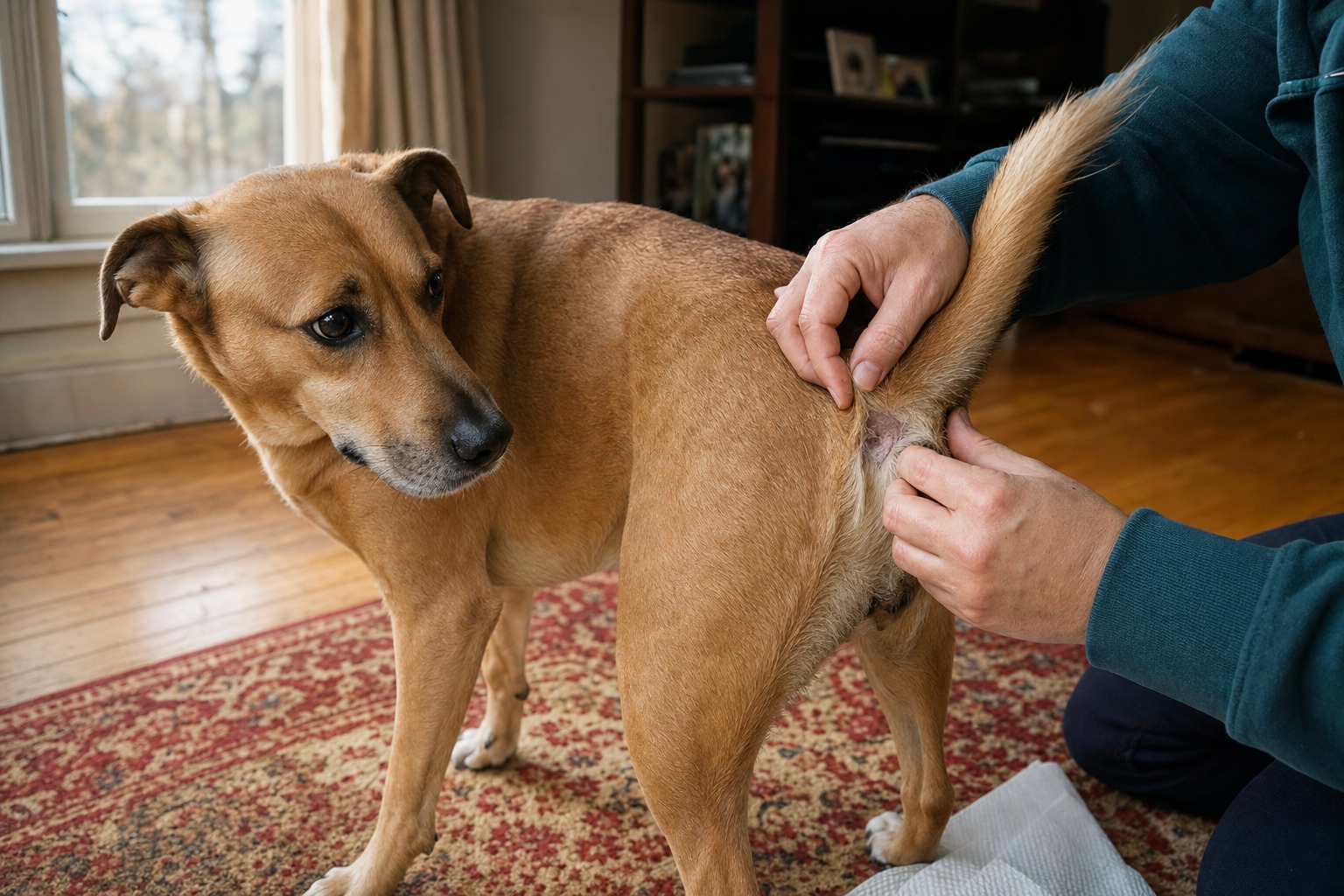
The single most useful sign of fleas is not a flea at all. It is flea dirt, which is a polite name for flea droppings. It looks like fine black dandruff, and you find it by parting your dog’s fur all the way down to the skin, concentrating your search near the tail base, down the spine, and around the groin and belly.
Here is the confirmation trick. Scrape a little of that black grit onto a white paper towel or napkin and add a drop of water. If it smears out into a rusty, dark-red stain, you have your answer. Fleas feed on blood, and their droppings are full of the digested remains, so the red is proof. It is a slightly gross test and a completely dependable one, and it works even when you cannot find a single live flea in the coat.
“Owners come in convinced they don’t have fleas because they never saw one, and I get it, dogs are covered in fur and fleas are fast,” says Dr. Amara Solis. “So I don’t go looking for the flea. I go looking for the evidence it leaves behind. The wet-paper-towel test finds fleas that a naked-eye search misses every time, and it costs you nothing but a paper towel.”
Where to look, because fleas have favorite spots
Fleas are not scattered at random. In minor cases, the action concentrates at the base of the tail, because it is an awkward zone for most dogs to reach and groom, so fleas set up camp where they are least likely to get bitten or licked off. When an infestation gets serious, it spreads, most often to the belly, chest, and neck next, and in heavy cases almost anywhere. At that point individual bites blur together into a mess of irritation from both the bites themselves and your dog’s frantic scratching.
The bites, when you can see them, are small pink or reddish raised areas. But because dogs are covered in hair, you will usually notice the behavior before the bumps.
The full symptom picture
Flea bites are intensely itchy, and a suffering dog tells you in several ways at once.
Physical signs. Expect chewing at the skin, especially around the tail base and rear, and frequent scratching, often using the hind legs to go at the sides, neck, or face. Over time the skin itself can change: patches of redness, hair loss, and small scabs or bumps.
Behavioral signs. Being relentlessly itchy is genuinely miserable, and it shows. Dogs with fleas may turn irritable, agitated, and restless. Waking again and again to scratch wrecks their sleep, and the constant stopping-to-itch can steal the fun out of walks, toys, and even snuggling.
Any of these, and certainly several together, should send you to the tail base with a paper towel.
Why some dogs suffer out of all proportion
Two wrinkles explain why flea misery does not always match the number of fleas you find.
First, some dogs are allergic to flea saliva, a condition called flea-allergy dermatitis. These dogs mount a severe skin reaction to just a handful of bites, which is why a dog can be frantically itchy while you struggle to find any live fleas at all. Second, all that biting and scratching damages the skin barrier, leaving it open to secondary infections, whether bacterial or yeast. Those infections can keep the skin red, inflamed, and itchy even after every last flea is dead. Both are good reasons to get your vet involved rather than just reaching for a shampoo, and both are why year-round prevention beats reacting to an outbreak.
Fleas, or something else? How to tell mites apart
Not every itch is a flea, and matching the pattern to the culprit points you toward the right treatment. Two common mites are the usual confusion.
Demodex mites typically are not very itchy. They cause hair loss and scaly skin changes, but without the intense, frantic scratching fleas produce. Sarcoptes mites, on the other hand, are ferociously itchy, but they announce themselves differently: they start on the sparsely haired parts of the dog, like the ear flaps, elbows, and belly, rather than the tail base, back, and neck that fleas prefer. When the itch and the location do not add up, that mismatch is a clue, and a reason to let your vet take a look.
Yes, they bite you too
If your dog has fleas, assume your home does. Flea eggs and larvae drop off into the yard and settle into flooring, rugs, and carpet, so it is worth checking yourself and your family. On people, flea bites tend to show up as small, itchy bumps around the ankles or under tight-fitting clothing, and the area can redden fast once you start scratching. In people with significant flea allergies, bites can blister, and a severe allergic reaction, with hives, vomiting, shortness of breath, chest tightness, dizziness, or weakness, is a medical emergency that needs immediate care.
One reassurance: there is a type of flea in sandy, tropical and subtropical regions that burrows under the skin to lay eggs, causing serious swelling and pain, but it turns up only rarely in the United States, mostly among people who have recently traveled to those areas. A vet’s honest disclaimer applies here too, we handle dogs, not people, so if you find unexplained bites or skin problems on yourself, see your own doctor, who can sort flea bites from mites, chiggers, or something else entirely.
Treatment is a campaign, not a single strike
Here is the expectation to set before you start: clearing fleas is a weeks-to-months campaign, not a one-and-done treatment. Many products kill adult fleas efficiently, but flea eggs and pupae are remarkably tough, so even after the adults die, the next generation can hatch and re-infest your dog. Winning means treating every animal in the home, washing all bedding and fabrics, and vacuuming frequently to lift as many eggs as possible. Prevention is genuinely the better play, because once fleas are comfortable, they are hard to evict, so keep your dog on a preventive year-round rather than waiting for the next outbreak.
A safety note on preventives
Effective as they are, flea and tick preventives deserve an informed choice. The U.S. Food and Drug Administration has flagged that some products in the isoxazoline class have been linked to neurological reactions in a small number of dogs and cats, including stumbling, tremors, twitching, and seizures. That does not mean these widely used, effective medications are off the table; it means the decision is worth a real conversation with your vet, especially if your dog has a history of seizures. Your vet can weigh your dog’s specific risks and pick the right product.
What’s new since this was written
The flea-control shelf keeps evolving. Newer combination oral preventives now knock out fleas, ticks, and other parasites in a single monthly or even longer-acting dose, which makes staying consistent easier, and consistency is what actually breaks the flea life cycle. At the same time, the guidance on when to protect has shifted: as winters grow milder across much of the country, veterinarians increasingly recommend year-round prevention rather than a warm-season-only approach, because fleas stay active longer than they used to. The FDA’s caution on the isoxazoline class remains in place, so the smart move is the same one it has always been, choose the product with your vet rather than off a store shelf.
When to call the vet
Educating yourself is a great start, but nothing replaces an exam. Tell your vet what you are noticing and bring your dog in promptly. Your vet can confirm the diagnosis, treat any secondary infection, and start a preventive that gives your dog relief and keeps fleas from taking over your home. And if you or a family member develop unexplained skin lesions, or ever show signs of a severe allergic reaction, contact a doctor or emergency service right away. Severe allergies are not something to wait out.
References
- Anderson, Jackie, and Elizabeth Paterek. “Flea Bites.” StatPearls, StatPearls Publishing, 2021. https://www.ncbi.nlm.nih.gov/books/NBK541118/
- Centers for Disease Control and Prevention. “About Fleas.” 2024. https://www.cdc.gov/fleas/about/index.html
- Cornell University College of Veterinary Medicine, Riney Canine Health Center. “Fleas.” https://www.vet.cornell.edu/departments-centers-and-institutes/riney-canine-health-center/canine-health-information/fleas
- Gardiner, John. “Fleas.” UC Davis School of Veterinary Medicine, Animal Health Topics. https://healthtopics.vetmed.ucdavis.edu/health-topics/canine/fleas
- U.S. Food and Drug Administration. “Animal Drug Safety Communication: FDA Alerts Pet Owners and Veterinarians About Potential for Neurologic Adverse Events Associated With Certain Flea and Tick Products.” https://www.fda.gov/animal-veterinary/animal-health-literacy/animal-drug-safety-communication-fda-alerts-pet-owners-and-veterinarians-about-potential-neurologic