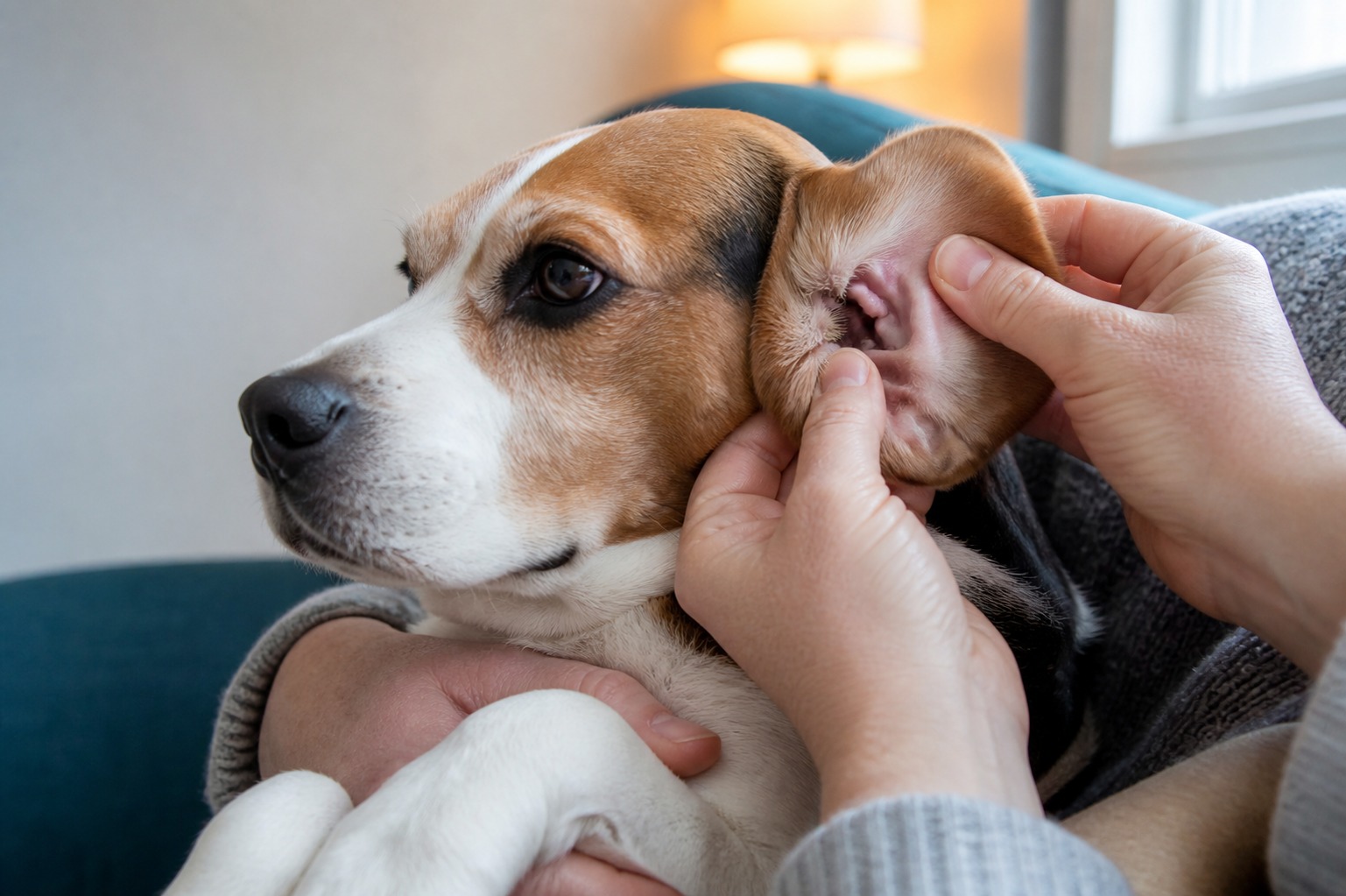
You lean in for a cuddle, get a noseful of something funky coming off your dog’s ear, and your brain files it under one vague category: ear infection, probably. But your nose is a far better diagnostic instrument than that. A dog’s ear can produce at least half a dozen distinct odors, and each one points somewhere different. Sweet and yeasty is not the same problem as sour and foul, and neither is the same as a whiff of pennies. Learning to tell them apart is the difference between catching a problem early and waiting until your dog is shaking their head raw.
The reason ears go bad so readily comes down to plumbing. A dog’s ear canal is not a straight tube like ours. It bends, running down and then turning inward toward the eardrum, roughly the shape of a hockey stick. Wax, oil, dead skin, and debris collect at that bend, and a good head shake is a dog’s main tool for flinging it back out. When the canal is narrow, inflamed, or packed with hair, shaking alone can’t clear it, moisture lingers, and the warm, dark, curved space becomes an ideal place for trouble to grow. Here are the seven things that trouble usually turns out to be, sorted by what they smell and look like.
1. A yeast infection (sweet, musty, bread-dough or corn-chip smell)
This is the classic “my dog’s ear smells weird” culprit. It’s driven by Malassezia, a yeast that lives on healthy dog skin in small numbers and causes problems only when it overgrows. As it blooms, it releases compounds that trigger a strong immune reaction, and the result is intense, maddening itch. People describe the smell in food terms more than any other ear odor: uncooked bread dough to some noses, warm corn chips to others. Over time you may also notice the inner surface of the ear flap growing darker and leathery. Whatever you call the scent, a new sweet-musty note on your dog’s head means the balance in that ear has tipped.
2. A bacterial infection (sour, foul, sometimes with heavy discharge)
Bacterial infections tend to smell sharper and nastier than yeast, and they often come with more discharge and obvious pain. The bacteria arrive from two directions: some are ordinary residents of the skin that overgrow when conditions change, and others come from the environment. Pseudomonas, a particularly stubborn one, thrives in water, which is why dogs who swim a lot run a higher risk. Signs skew toward the dramatic: relentless head shaking, scratching, thick discharge, and a dog who flinches when you touch the ear.
It genuinely matters whether the cause is yeast or bacteria. Many first-line ointments combine a steroid, an antibiotic, and an antifungal to cover all bases at once, but when a vet is chasing a recurring or deep infection, knowing the exact organism steers the treatment and the hunt for what’s driving it.
3. An underlying allergy (the recurring-infection ear)
Here’s the cause the smell alone won’t reveal, and the one people most often miss: allergies. This is the addition that turns a list of six symptoms into an actual explanation, because in a large share of dogs with repeat ear infections, the ear is not the real problem. It’s a downstream symptom of allergic skin disease, whether that’s an environmental allergy (atopic dermatitis) or a food sensitivity. Allergy inflames the lining of the canal, changes the local environment, and rolls out the welcome mat for yeast and bacteria on a loop.
“When an ear keeps relapsing no matter how good the drops are, I stop treating the ear and start asking why it keeps happening,” says Dr. Priya Nair. “Nine times out of ten the answer is allergy, and until we manage that, we’re just mopping the floor with the tap still running.”
The tell is the pattern. If your dog’s ears clear up on medication and flare again a few weeks later, season after season, or if the ear trouble travels with itchy paws, a rashy belly, or licked-raw skin, you are probably treating the fire without touching the fuel. Chronic ear infections are one of the most common ways atopic dermatitis first announces itself. Fixing these dogs means managing the allergy, not just re-treating the ear, and that is a conversation worth starting with your vet if this sounds like your dog.
4. A foreign body (sudden, one-sided odor and frantic shaking)
Dogs can rattle most debris loose, but grass awns are built to defeat them. These barbed grass seeds, foxtails among them, have bristles angled so they only travel one direction: inward. They burrow, they don’t back out, and they cause abscesses and infection wherever they lodge, which vets have pulled from noses, eyes, and even bladders as well as ears. The signature is sudden and lopsided: a dog who was fine an hour ago, now shaking their head like they mean it and pawing at one ear, often after a walk through tall grass. That one calls for a vet, not a home rinse.
5. A hot spot behind or below the ear (musty, weepy, painful patch)
A hot spot is a fast-blooming patch of infected, inflamed skin, and the folds around the ears are a favorite location. It usually starts with moisture plus self-trauma, a dog licking, chewing, or scratching an itchy spot until the skin breaks down and bacteria move in. Dogs with dense undercoats and a history of skin problems are the most prone. The area turns red, wet, and genuinely sore, and it carries its own musty, infected smell. These can appear and worsen within a day, so don’t wait them out.
6. Ear mites (little odor, but a mess of dark, coffee-ground debris)
Ear mites are tiny parasites that infest the canal and the skin around it, and their calling card is visual more than olfactory: a marked uptick in dark brown, crumbly debris that looks like coffee grounds. That gunk is a grim mix of live and dead mites, their waste, wax, and sometimes blood, which can lend a faint metallic note. The debris itself usually isn’t strongly smelly, but the itch is ferocious thanks to the constant motion and irritation. Left alone, mites open the door to a full-blown infection, odor and all. They’re also highly contagious to other pets in the house.
7. Blood (a metallic, penny-like smell)
Most of us know the coppery scent of blood, so catching it near your dog’s ear is understandably alarming. Blood inside the ear is usually tied to significant head trauma and needs prompt attention. Blood around the outside of the ear is often less dire, coming from a severe infection, from a dog scratching themselves raw, or from fly strike, where biting insects feed on the ear tips of outdoor-loving dogs. The bites plus constant head shaking to dislodge the flies can leave the ear edges bleeding.
When a smelly ear becomes an emergency
Most ear odors warrant a prompt, ordinary vet appointment, because infections and hot spots escalate fast and are far easier to clear early. But some signs mean you skip the wait and head for urgent care. Get emergency help if the odor comes with any of these:
- A head tilt or constant head shaking
- Profuse bleeding
- Holding the ears pinned back
- Lethargy
- Unsteadiness or stumbling when walking
- Abnormal, darting eye movements
- Sudden hearing loss
These can signal that a problem has reached the middle or inner ear, where balance and hearing live.
The bottom line
A dog’s ear odor is not background noise. It’s a specific, readable signal, and a change in that signal almost always means something is off. If the smell is mild and the ear looks only a little dirty, your vet may clear it with a cleaning and a home ear wash. If it’s sour, sweet-musty, metallic, or paired with any of the red flags above, book the visit. And if your dog’s ears keep coming back to the same bad place no matter how many rounds of drops you run, ask about allergies, because you may be treating a symptom while the real cause sits one layer down. If you’re ever worried about your dog’s ear odor, talk to your vet sooner rather than later.
References
- Saridomichelakis, Manolis N., et al. “Aetiology of canine otitis externa: a retrospective study of 100 cases.” Veterinary Dermatology, vol. 18, no. 5, 2007, pp. 341-347, https://doi.org/10.1111/j.1365-3164.2007.00619.x.
- Brennan, K. E., and P. J. Ihrke. “Grass awn migration in dogs and cats: a retrospective study of 182 cases.” Journal of the American Veterinary Medical Association, vol. 182, no. 11, 1983, pp. 1201-1204, https://pubmed.ncbi.nlm.nih.gov/6862007/.
- Palmer, Lee E. “Picture This: Management of Canine Pyotraumatic Dermatitis (a.k.a., Hot Spot).” Journal of Special Operations Medicine, vol. 18, no. 2, 2018, pp. 105-109, https://doi.org/10.55460/XCG6-N1DJ.
- “Otitis Externa in Animals.” MSD Veterinary Manual, https://www.msdvetmanual.com/ear-disorders/otitis-externa/otitis-externa-in-animals.