


No Fleas, Still Scratching? 7 Culprits, Ranked by How Likely They Are.
You combed him. Nothing. He is still tearing himself apart. Here is the list a vet actually works through, in the order they work through it.

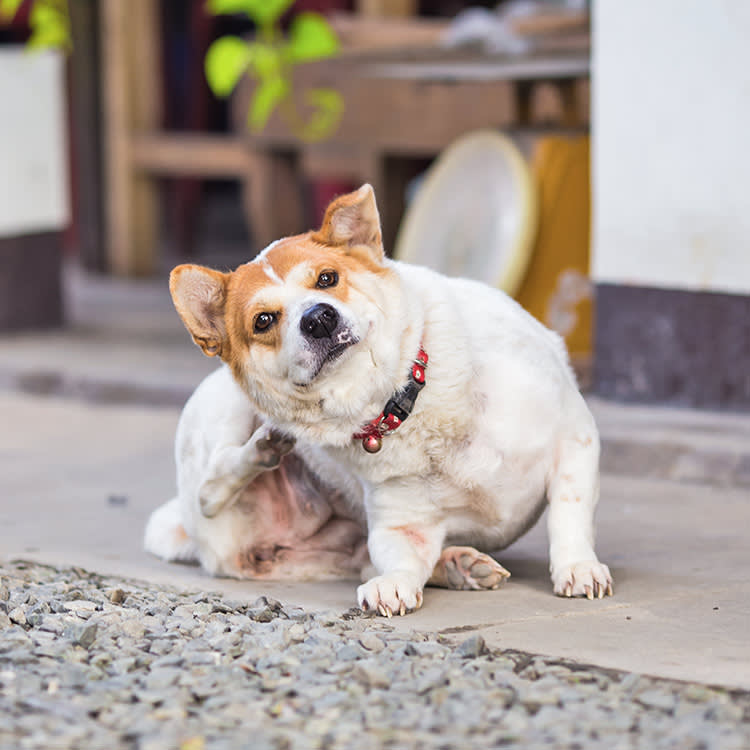
Here is the trap.
Your dog is scratching. You reach for the flea comb, because everyone does, and you find nothing. And because you found nothing, the flea question feels closed, so you start guessing: new food, new detergent, dry air, stress, allergies, something in the yard.
That guessing is the actual problem. Not because your guesses are unreasonable, but because itch is a symptom, not a diagnosis, and a dozen wildly different conditions produce almost identical-looking dogs. A dog with a food allergy and a dog with hypothyroidism and a dog with sarcoptic mange can all present as “itchy, losing hair, no fleas.” You cannot look at them and tell. Neither can your vet, which is precisely why they run tests.
So this list is not organized by category. It is organized by how often each thing turns out to be the answer, which is roughly the order a vet works through it. Start at the top.
First: is this actually abnormal?
Some scratching and some shedding is just a dog being a dog. What moves it into the abnormal column is excess and, critically, bare skin. Shedding does not leave patches. Hair loss does.
And look for the company the itch keeps. These are the flags that turn a nuisance into a vet visit, and several of them point straight at a specific cause:
- Redness or inflammation
- Scaly or crusty patches
- Open sores or hot spots
- Dry, flaky skin
- Thickened or darkened skin
- Pustules or pimples
- Rubbing against hard surfaces
- Restlessness
- Weight loss
- Lethargy
- Loss of appetite
- Red, inflamed ears
- Frequent ear scratching or head shaking
- Vomiting or diarrhea
- Fever
- Swollen lymph nodes
- Symmetrical hair loss, which is very often a hormonal signature
If any of those are riding along with the itch, the visit is not optional. And write down which ones. That list is the most useful thing you can hand your vet.
1. Allergies (this is usually it)
Statistically, if your dog is itchy and there are no fleas, you are most likely looking at an allergy. It splits into two families that behave differently, and the difference is the calendar.
Seasonal / environmental allergy (atopic dermatitis). If the itching flares at a particular time of year, this is your prime suspect. The allergens are the boring ones: pollen from grass, trees, and weeds; mold spores; dust; soil particles.
Food allergy. A diet that never changes produces an itch that never lets up, and that year-round constancy is the tell. The usual offenders:
- Beef
- Chicken
- Lamb
- Pork
- Fish
- Eggs
- Milk
- Cheese and yogurt
- Wheat
- Corn
- Soy
- Chicken fat or beef fat
- Preservatives or additives
Your dog can be allergic to one of those or several. Food allergies are genuinely difficult to pin down, which is why the diagnostic below is such a slog.
2. Skin infections (usually the second problem, not the first)
This is the one people misread most often, and it costs them months.
A skin infection in a dog is almost always secondary. An allergy makes the dog itch, the itching and licking break the skin’s natural defenses, and bacteria or yeast move into the gap. The infection then makes the dog itch more.
The two common types are bacterial and fungal, and they are treated completely differently, so guessing is not an option. But the more important point is this: treating the infection without addressing what caused it means the infection comes straight back. If your dog has been through three rounds of antibiotics for “skin infections” in a year, nobody has found the underlying cause yet.
3. Parasites that are not fleas
You combed for fleas. Good. Now consider everything else, because plenty of parasites cause savage itching and none of them show up on a flea comb.
- Mites, which are the big one here. Sarcoptes scabiei causes sarcoptic mange (scabies), which is intensely itchy and highly contagious to people and other animals. Demodex mites cause demodectic mange, which is not contagious. Ear mites (Otodectes cynotis) are also not contagious to people. Cheyletiellosis, charmingly known as “walking dandruff,” is another mite infestation.
- Ticks
- Lice
- Hookworms, intestinal parasites that can cause skin irritation at the point where they enter
Each of these needs a different treatment and a veterinary diagnosis. Sarcoptic mange in particular is worth ruling out early, because it is miserable, it spreads, and it is very treatable once identified.
4. Hormonal disease (this is where the symmetrical hair loss comes in)
If your dog’s hair is thinning evenly, on both sides, stop thinking about allergies and start thinking about endocrinology. Allergic dogs itch where the allergen touches them. Hormonal disease sheds a dog symmetrically, because it is coming from the inside.
- Hypothyroidism. An underactive thyroid producing too little hormone. Look for symmetrical hair loss, dry flaky skin, a dull coat, thickened or darkened skin, lethargy, weight gain, and cold intolerance.
- Cushing’s disease (hyperadrenocorticism). Excess cortisol, usually from a tumor of the adrenal or pituitary gland. Look for thin skin, symmetrical hair loss, increased thirst and urination, a pot-bellied appearance, and muscle weakness.
- Diabetes mellitus. Insulin deficiency or resistance. Look for thinning hair or a dull coat, and a marked tendency to pick up skin infections, alongside increased thirst, increased urination, and weight loss despite a bigger appetite.
- Addison’s disease (hypoadrenocorticism). Too little cortisol and aldosterone. Look for hair thinning, poor coat quality, hyperpigmentation, occasional itching, and, importantly, vomiting, diarrhea, weakness, and lethargy.
- Less common: alopecia X, sex-hormone imbalances, growth-hormone deficiency, and seasonal flank alopecia.
Hair loss plus lethargy, weight change, or increased thirst and urination is a same-week vet appointment. That combination is your dog telling you the problem is not on the skin.
5. Stress, anxiety, and trauma
Two separate mechanisms, both real.
Trauma is mechanical. Break the skin barrier and you have opened a door to irritation, inflammation, and infection, and you have also given the dog a spot he now wants to worry at with his teeth and tongue, which deepens the damage.
Stress and anxiety are subtler and get dismissed too easily. Over-grooming as a coping mechanism is a well-recognized response to boredom or change: a new routine, a new home, a new absence, a new noise. And the licking is only half of it. Stress suppresses immune function, which opens the door to infection, and it drives cortisol up, which in turn disrupts the hair follicle cycle and slows the skin’s ability to repair itself.
The compounding effect is the cruel part. Stress makes a minor flea problem or a mild allergy feel far worse to your dog, driving more licking, chewing, and scratching, which drives more damage.
6. Nutritional deficiency
Less common in dogs on a complete commercial diet, and worth taking seriously in dogs on home-cooked or unbalanced ones.
Omega-3 and omega-6 fatty acids. Essential fatty acids that support the skin’s lipid barrier, reducing dryness, inflammation, and itch. Deficiency looks like: dry, flaky skin, a dull brittle coat, hair loss, more itching, and more skin infections.
Protein. Essential to the structure of skin and hair. Deficiency comes from low-quality diets or simply not enough intake. Deficiency looks like: hair loss or thinning, brittle hair with slow regrowth, poor wound healing, weak or flaky nails.
Zinc. Critical for skin healing, coat health, and immune function. Deficiency looks like: hair loss around the face, elbows, or paws, and red, scaly, inflamed skin (zinc-responsive dermatosis), with secondary infections.
Selenium. A trace mineral supporting antioxidant activity and skin health. Deficiency looks like: poor coat quality, dry itchy skin, reduced immune function.
Iron. Needed for red blood cell production and for getting oxygen to skin and hair follicles. Deficiency looks like: a dull, thinning coat, and in severe cases weakness or fatigue.
Copper. Contributes to pigmentation and to the structural integrity of hair and skin. Deficiency looks like: loss of pigment (black fur going reddish), thinning hair, and more skin infections.
Vitamins B7, A, E, and D all matter for skin and coat. Deficiency shows up as dry flaky skin, hair loss, a brittle coat, dermatitis or crusty lesions, and increased susceptibility to infection.
7. Contact irritants, including the things you are using to help
This one is not on most lists, and it should be, because it is the cause you are personally in control of.
Dogs react to what touches them. The usual suspects are a new shampoo, a medicated wash used too often, residual laundry detergent or fabric softener in bedding, floor cleaners on the surfaces where they lie, a new collar or harness material, and lawn treatments.
The tell is distribution. Contact reactions show up where the contact happened: the belly and groin (thin fur, close to the floor), the muzzle and chin (bowl material), the neck (collar), the paws (whatever they walked across). If the itch has a shape that matches something your dog lies on, wears, or walks through, that is a lead.
The cruel version of this is the owner who, trying to help an itchy dog, bathes him three times a week in a medicated shampoo and strips the skin barrier bare. Over-bathing makes itchy dogs itchier. Every four to six weeks is plenty, even for a dog with skin disease, unless your vet says otherwise.
Half the itchy dogs I see have two problems: whatever started it, and whatever the family did next. The second one is usually fixable in a week. Tell me everything you have tried, and do not be embarrassed about it. That list is data.
How a vet actually figures it out
Because so many of these look identical, the diagnosis comes from tests, not from staring.
The physical exam and history. Your vet takes a detailed history and does a thorough exam, and this alone often cracks it. An obvious hot spot may be all they need. A good combing may turn up fleas after all, and the case is closed. Sometimes it is that easy. Often it is not.
Skin tests. Most are done in-clinic with your dog awake; some samples go to an outside lab.
- Skin scraping for parasites, infection, or inflammatory conditions
- Cytology, taking skin cells to view under a microscope, looking for infection and inflammation
- Skin culture, sent to a lab to identify the exact bacteria and the antibiotic that will beat it
- Fungal culture, looking for ringworm
- Wood’s lamp, a faster ringworm check, though notably less accurate
- Tape test, collecting surface cells, particularly to find parasites
- Biopsy, a larger sample sent to a pathology lab; requires sedation or general anesthesia
- Fine needle aspirate, pulling cells or fluid from skin or lumps, usually done awake
- Trichoscopy, examining hair shafts for fungal infection, parasites, or structural abnormalities
Allergy tests. If history, exam, and skin tests do not land it, allergy testing is next. Sometimes it is recommended even after a diagnosis, to find the underlying driver, because otherwise the skin condition just becomes chronic. There are three types:
- Patch testing. Candidate allergens are held against the skin under patches, and the vet watches what the skin does. This is the contact-allergy test.
- Serum allergy testing. A blood draw, screened in a lab for antibodies specific to individual allergens.
- Intradermal skin testing. Tiny quantities of candidate allergens go just under the skin, and the vet reads the reaction. This is the one for the environmental allergens behind atopic dermatitis.
The trade-off is worth stating flatly, because it is how you will choose. Blood testing is the cheaper option, your dog stays conscious throughout, and it may turn up food triggers, but it is the less accurate of the two. Intradermal is the more accurate one, and the price is anesthesia, a bigger bill, and no help at all on food.
Blood work. If your dog has symptoms beyond the skin — drinking or urinating more, vomiting or diarrhea, lethargy, weight loss — expect a CBC and a chemistry panel to check organ function, plus a thyroid test. Tests for Cushing’s or Addison’s may be added. Immune function testing, rarely.
Treatment: relief now, cause in parallel
Both tracks run at once. That is the part people misunderstand: taking the itch away is not cheating, and it is not the finish line either.
Medications that only relieve the itch:
- Antihistamines such as Benadryl, for mild relief. Honestly, often not much.
- Steroids such as prednisone, short-term only.
- Apoquel, specifically for allergic itch, given daily by mouth.
- Cytopoint, also for allergies, given by injection, lasting up to eight weeks.
- Zenrelia, a newer daily anti-itch pill for allergies.
Medications that treat the underlying cause:
- Antibiotics for bacterial skin infection
- Antifungals for fungal infection such as ringworm
- Anti-parasitics, topical or oral, for mange
- Hormone therapy, such as levothyroxine for hypothyroidism
- Fatty acid supplements, supporting skin and coat
Topicals: medicated shampoos; sprays and ointments such as hydrocortisone; monthly flea preventatives.
Supplements that may help: omega-3 fatty acids, biotin, zinc.
The food trial, done properly or not at all
With a food allergy in play, you have two routes, and the first is the real one.
- Elimination diet. Pick a protein and a carbohydrate your dog has never met — venison and sweet potato is the classic pairing — and feed nothing else for eight to 12 weeks. If the itch dies down, you add ingredients back one at a time until it flares, and that is your culprit. Nothing else identifies a food allergy this reliably.
- A prescription hydrolyzed-protein diet is the alternative route.
Either way, budget up to three months before you can read the result. And “feed nothing else” means nothing else. One flavored chew, one training treat, one crust of pizza from a child, and the trial is invalid. This is the single most common reason food trials fail, and it is not the dog’s fault.
Grooming, home remedies, and skin care
- Bathe with a hypoallergenic or medicated shampoo, and resist the urge to do it constantly. A wash every four to six weeks is the ceiling, not the floor.
- Brush him every day. It strips pollen off the coat before it can do its work, and it keeps mats from forming over irritated skin.
- Check him over for parasites on a schedule: ticks, fleas, mites, anything clinging on.
- Clean the paws when he comes in, with a damp cloth or a dog-safe wipe. Paws carry the yard indoors.
Home remedies, for comfort rather than cure:
- Oatmeal paste, left on the itchy spot for a quarter of an hour and then washed off
- Coconut oil, a small amount of organic virgin oil on dry or itchy spots
- Apple cider vinegar spray, equal parts vinegar and water on affected areas
- Cool compress, a damp cool towel on the itch
- Omega-3 fatty acids from fish oil
Skin care basics: feed a complete, well-made diet that carries both omega-3 and omega-6; keep fresh water available, since a dehydrated dog has worse skin; use a moisturizer formulated for dogs; and, when the itch is allergic, work with your vet to find the trigger and get it out of his life.
The environment
- Vacuum, and keep the place clean
- Run a humidifier when the air goes dry
- Put the bedding through the wash once a week
- Keep him on a monthly flea and tick preventative, and let your vet choose it
- Get the harsh chemicals out of the rooms he lives in
- Give him shade when he is outside
What newer research adds
The biggest change in canine itch over the last decade is that you no longer have to make your dog suffer through the diagnostic process. Apoquel, Cytopoint, and now Zenrelia give genuinely effective allergic itch relief, and vets are far more willing to start relief on day one while the workup proceeds. There is no clinical virtue in a dog scratching himself raw for six weeks while you wait on a culture.
The second change is in how allergy is understood. Atopic dermatitis is now framed as a skin barrier disease as much as an immune one: the barrier is defective, allergens get in more easily, and the immune system overreacts to what arrives. That reframing is why barrier care, meaning fatty acids, moisturizers, gentle and infrequent bathing, and not stripping the coat, has moved from folk advice to standard adjunct therapy.
And allergen-specific immunotherapy, the same principle as allergy shots in people, remains the only treatment that addresses the cause of environmental allergy rather than the symptom. It is slow, it takes months to work, and in the right dog it can change the trajectory of an entire life. If your dog is on year three of itch-control medication, it is worth a conversation about a referral to a veterinary dermatologist.
References
- Olivry, T., et al. “Treatment of canine atopic dermatitis: 2015 updated guidelines from the International Committee on Allergic Diseases of Animals (ICADA).” BMC Veterinary Research, 2015. https://bmcvetres.biomedcentral.com/articles/10.1186/s12917-015-0514-6
- Hensel, P., et al. “Canine atopic dermatitis: detailed guidelines for diagnosis and allergen identification.” BMC Veterinary Research, 2015. https://bmcvetres.biomedcentral.com/articles/10.1186/s12917-015-0515-5
- Mueller, R. S., & Olivry, T. “Critically appraised topic on adverse food reactions of companion animals: common food allergen sources in dogs and cats.” BMC Veterinary Research, 2016. https://pubmed.ncbi.nlm.nih.gov/26753610/
- Merck Veterinary Manual, “Pruritus in Animals.” https://www.merckvetmanual.com/integumentary-system/pruritus/pruritus-in-animals
- Merck Veterinary Manual, “Mange in Dogs and Cats.” https://www.merckvetmanual.com/integumentary-system/mange/mange-in-dogs-and-cats
- Siam, M., et al. “Alopecia in Dogs: Causes, Incidence and Clinical Signs with Special Reference to Nutritional Alopecia.” Zagazig Veterinary Journal, 2022. https://doi.org/10.21608/zvjz.2022.125735.1175
Common questions
What is mange in dogs?
Mange is a skin condition caused by mites. Sarcoptes mites cause sarcoptic mange, also called scabies, which is highly contagious to other dogs and to people. Demodex mites cause demodectic mange, which is not contagious. Both cause itchy, red, irritated skin with hair loss. Diagnosis is by skin scraping under a microscope; treatment involves oral and topical medications, medicated shampoos or dips, and cleaning the dog's environment, including bedding and grooming tools.
Can I give my dog Benadryl for itching?
Most dogs can take it, but it is one of the weakest options for canine itch and often does very little. Check with your vet before giving it, and do not treat it as a substitute for finding the cause.
How do I stop the itching while we figure out the cause?
Your vet can prescribe an itch-control medication such as Apoquel, Cytopoint, or Zenrelia, or a short course of steroids, to give your dog relief while the diagnostic work happens. Relief and diagnosis run in parallel; neither replaces the other.
Not a substitute for your vet. Our guidance is educational. For urgent symptoms, contact a vet or emergency clinic right away. Editorial standards
Dr. Chen is a small-animal veterinarian who leads health and safety coverage at The Pet Times. She writes and reviews the bulk of our illness, condition, and safety content, translating clinical guidance into clear, practical advice owners can act on at home.
Meet our experts ↗Keep reading
 Health & WellnessThat Crusty Nose Isn't the Problem. It's the ReceiptDr. Amara Solis · 8 min
 Health & WellnessIs That a Tick or a Skin Tag? The One Test That Tells YouDr. Amara Solis · 10 min
 Health & WellnessYour Tick Meds Won't Catch Them AllDr. Lena Park · 6 min
 Health & WellnessBathing Your Dog More Won't Fix the Smell. Finding It Will.Dr. Priya Nair · 8 min
 Health & WellnessThe Fleas on Your Dog Are 5% of the Problem. The Rest Is in Your CarpetDr. Ravi Mehta · 10 min
 Health & WellnessYour Kid's Lice Can't Move Into Your Dog. Here's the Biology.Dr. Amara Solis · 5 min