


Forever Chemicals Are in Your Dog and Cat, Too. Here's What Actually Lowers the Load.
PFAS turn up in pet blood at levels that mirror ours. The science on what they do to dogs and cats is still young, but the household fixes that help are already clear, and none of them require panic.

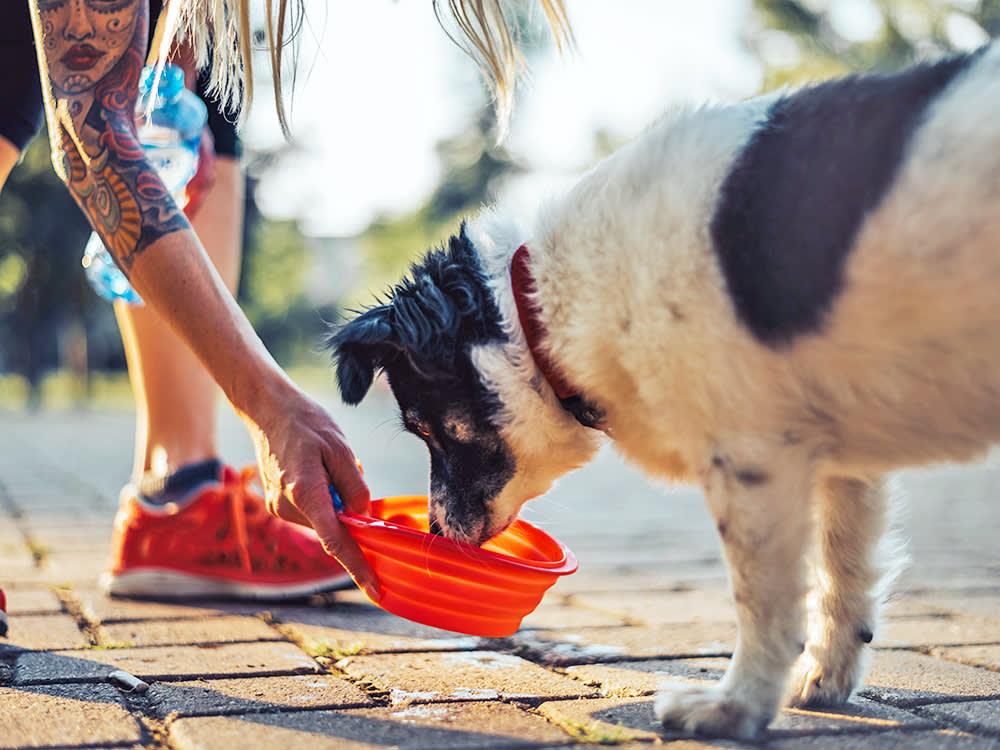
Your dog drinks from the same tap you do, naps on the same treated carpet, and breathes the same household dust. So it should not be a shock that when researchers go looking for “forever chemicals” in pets, they find them, at levels that look a lot like our own. The unsettling part is not that pets are exposed. It is how ordinary the exposure is.
Here is the thing worth holding onto before you spiral: the research on how these chemicals actually affect dogs and cats is still in its early chapters, and the most useful moves you can make at home are cheap, boring, and already well understood. This piece is about separating the real signal from the dread.
What “forever chemicals” actually are
PFAS, which stands for per- and polyfluoroalkyl substances, make up a sprawling family of manufactured chemicals, thousands of them, prized for repelling water, oil, and heat. They coat nonstick cookware, give some cosmetics their slip, and make carpets, jackets, and upholstery shrug off stains. They earned the “forever” nickname because the bonds that make them so useful also make them extraordinarily slow to break down. They accumulate in bodies and in the environment, and they have now been detected in places as remote as Arctic ice cores and deep-sea trenches.
In people, at least some PFAS have been linked to weakened immune response, thyroid and liver changes, kidney disease, certain cancers, and reproductive effects. That human evidence is what has driven the regulatory attention. The pet question is newer, and it is the one most owners have never thought to ask.
The clue came from a farm animal, not a lab
One detail from the history of PFAS research reframes the whole pet conversation. The first loud warning that these chemicals might be dangerous did not come from a person. It came from cattle. A West Virginia farmer noticed his herd falling sick near a manufacturing plant, and the lawsuit that followed forced decades of closer study. Animals, in other words, were the canary. It is a fitting reminder that whatever is circulating in our homes is circulating through our pets, too.
What the pet studies have found so far
Two lines of research stand out. Michigan State University launched a “PFAS in Pets” project that sampled three likely household sources, vacuum-cleaner dust, the water in pets’ bowls, and a little of their kibble, and drew blood from indoor cats and dogs across 28 western Michigan homes. The headline finding, from veterinarian Heather Brake, who led the work: PFAS levels in the pets closely tracked the levels found in people sampled from the same region. Whatever people are picking up, the pets are picking up alongside them.
A separate 2020 study analyzing pet feces in New York found cats and dogs testing positive for 13 of the 15 PFAS measured, roughly 87 percent. Researcher Kurunthachalam Kannan noted that dog waste carried larger amounts than cat waste, and that a pet’s age and sex did not seem to shift the levels much.
What the chemicals do once they are in there is the open question. Early MSU results suggested the effects may echo what is seen in people, with subtle shifts in liver enzymes, thyroid readings, and electrolyte balance, and prior work has hinted at links to hyperthyroidism in cats and cholesterol changes in dogs. But Brake has been careful to keep this in proportion: the changes her team saw were minor and likely would not show up in a pet’s day-to-day health, and the sample was small. A larger follow-up involving more than 300 pets is meant to sharpen the picture.
Right now the honest answer is that we know pets are carrying these compounds, and we know far less about what that means for their health than owners assume. That uncertainty is a reason to reduce the easy sources of exposure, not a reason to lose sleep. I tell clients to fix the water and the dust first and let the researchers catch up on the rest.
A room-by-room way to lower the load
You will never scrub PFAS out of your home entirely, and chasing zero will only make you miserable. The productive framing is to knock down the biggest everyday sources. Here is where the effort pays off.
Filter the drinking water. Even under tightening rules, tap water remains a plausible route into both you and your pet. Pull your local water quality report, or test a private well, to see whether PFAS are a concern where you live. If they are, invest in a filter that is third-party certified to reduce PFAS specifically, and use it for the water in your pet’s bowl as well as your own glass. A generic pitcher marketed for taste is not the same thing.
Stay ahead of dust. Household dust is partly made of tiny bits shed from flooring, upholstery, and textiles, which makes it a quiet PFAS reservoir, and pets spend their lives at floor level nosing through it. You cannot eliminate dust, but wiping down floors and the corners where your pet lounges and plays genuinely reduces what they take in.
Skip the “repels everything” labels where you can. Furniture, rugs, bedding, and clothing sold as waterproof, stain-repellent, or dirt-repellent have often been treated with PFAS to earn those claims. When you are buying something new that your pet will sleep on or lie against, untreated versions are the lower-exposure choice.
Let outdoor pets be outdoor pets. Indoor PFAS concentrations tend to run higher than outdoor ones, so fresh air is a small net win. If your dog enjoys the yard or a long walk, that time outside is doing a little quiet good. Joining them does the same for you.
Be a little choosier about food packaging. Grease- and water-resistant pet food bags can carry PFAS, so sustainably packaged options are worth a look, and the occasional batch of home-cooked treats sidesteps the bag entirely. Just clear any real diet change with your vet first, since a treat swap is one thing and a nutritional overhaul is another.
What’s new since this was written
The regulatory ground under this issue has shifted, and it is worth knowing which way. In April 2024, the EPA finalized the first national drinking-water limits for PFAS, setting an enforceable ceiling of 4 parts per trillion each for the two most-studied compounds, PFOA and PFOS, and adding limits for several others. Water systems were given until 2029 to comply.
Then, on May 18, 2026, the EPA proposed to soften that framework. One proposal would keep the PFOA and PFOS limits but push the compliance deadline out from 2029 to 2031 for water systems granted an exemption, and a second would strip the newly set limits for four other PFAS, including GenX. Public comment on those proposals closed on July 20, 2026, and the EPA has not issued final rules. So the ceiling on what is allowed in your tap water is now sitting on a regulator’s desk, waiting, and the number it lands on may well be higher than the one set in 2024.
The practical takeaway does not change with the politics. Whatever the federal number lands on, a certified home filter puts the decision about your pet’s water back in your hands.
The bottom line
Forever chemicals are in our pets because they are in our homes, and the science on the health consequences is still being written. That is not a reason for alarm, but it is a reason to do the small, unglamorous things, filter the water, manage the dust, favor untreated fabrics, that lower exposure without upending anyone’s life. Advocating for more research helps, too. In the meantime, the best version of caution here is calm and specific, not frantic.
If your pet is showing unexplained symptoms, PFAS are not something to diagnose at home. Bring the concern to your veterinarian, who can look at the whole picture.
References
- EPA Announces It Will Keep Maximum Contaminant Levels for PFOA, PFOS. U.S. Environmental Protection Agency.
- Rescission of Regulatory Determinations for Four PFAS Substances. Federal Register, May 2026.
- Per- and Polyfluoroalkyl Substances (PFAS). U.S. Environmental Protection Agency.
- Wang, Y., et al. “Per- and Polyfluoroalkyl Substances in Northern California Cats: A Possible Link to Cat Hyperthyroidism.” Environmental Science & Technology.
- Ma, J., et al. “Levels of Per- and Polyfluoroalkyl Substances (PFASs) in the Blood of Police and Beagle Dogs from Harbin, China.” Environmental Science & Technology.
- Michigan State University College of Veterinary Medicine, “PFAS in Pets” study.
Common questions
Does a regular water filter remove PFAS?
Not all of them. Look for a filter that is third-party certified to reduce PFAS specifically. A basic taste-and-odor pitcher usually is not enough. Reverse-osmosis and certain activated-carbon systems certified for PFAS are the reliable options.
Should I switch my pet's food because of PFAS?
There is no need to overhaul a diet your vet is happy with. Heavy-duty grease-resistant food bags can be one source, so choosing better-packaged options where you can is reasonable. Talk to your vet before any real diet change.
Not a substitute for your vet. Our guidance is educational. For urgent symptoms, contact a vet or emergency clinic right away. Editorial standards
Dr. Nair is a veterinarian focused on diet and feeding. She covers everyday nutrition, treats, and the many "can they eat this?" questions owners ask, grounding each answer in what is actually safe and sensible for dogs and cats.
Meet our experts ↗Keep reading
 Living'Nobody's Around, It's Fine.' The 30-Second Decision You're Getting WrongTom Hadley · 6 min
 Product Picks'Natural' Pet Care Is a Word Nobody Checks. Read the Back of the Bottle.Dr. Amara Solis · 7 min
 LivingPet-Safe Cleaning Is About How You Clean, Not Just What You BuyNina Vasquez · 6 min
 LivingDon't Vacuum Up That Fur. It Can Soak Up an Oil Spill.Leila Torres · 6 min
 LivingThis Pet Brand Gives Away Every Dollar of Profit. On Purpose.Nina Vasquez · 5 min
 Product Picks7 American-Made Pet Brands Worth Your Memorial Day DollarsLeila Torres · 6 min