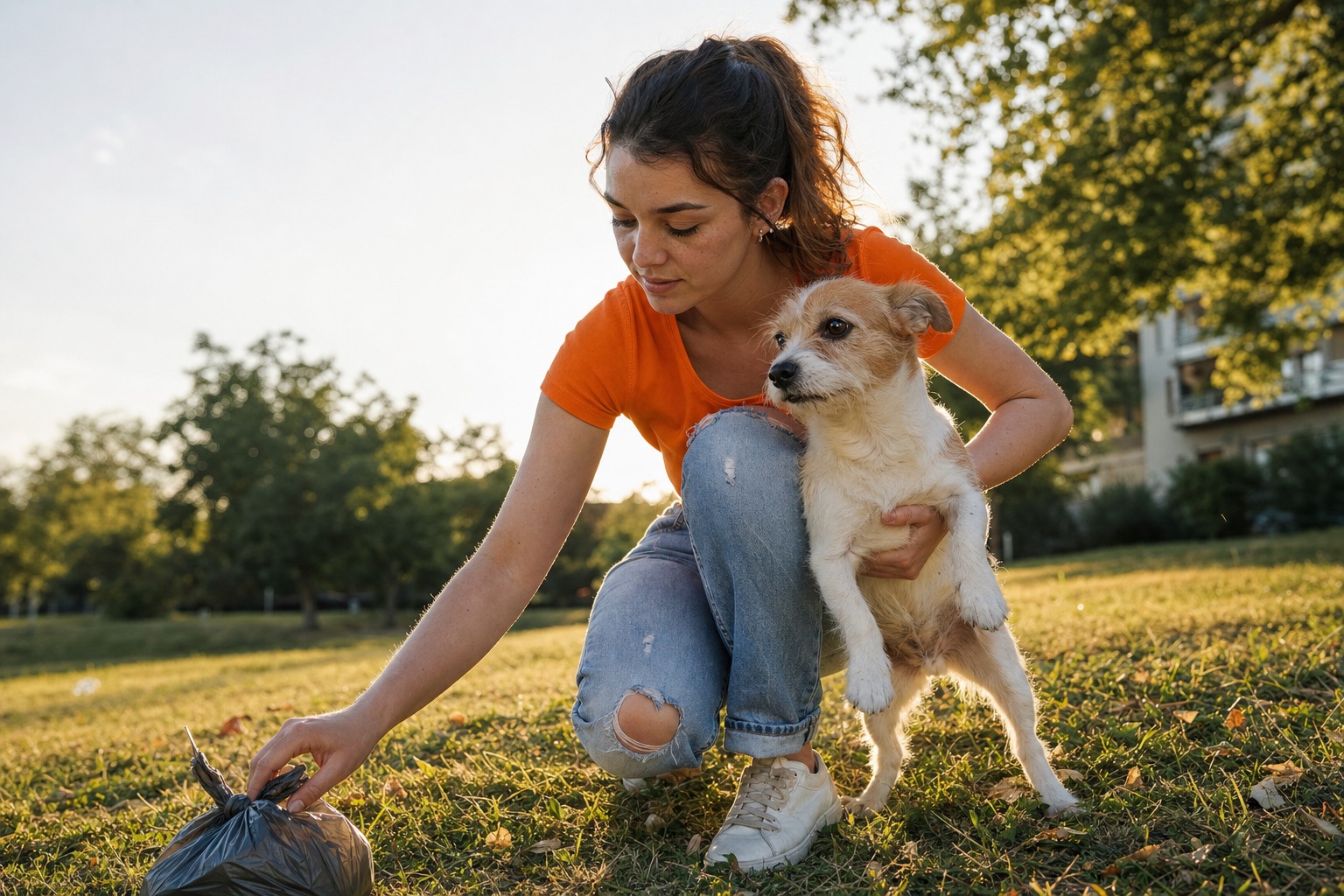
It happens to every dog owner, and usually at the worst possible moment. Your dog picks the least convenient spot imaginable, nowhere near a trash can, and you reach for a bag and come up empty, or your dog produces a surprise second deposit after you have already used your last one. You glance around. The street looks empty. And the thought arrives, fully formed and very persuasive: nobody’s here, it’s fine to leave it.
It is a 30-second decision, and a lot of people get it wrong. Here is the case for why the answer, every time, in every location, is no.
It’s a public-health problem, not just an eyesore
Ruining a stranger’s shoe or their afternoon is the least of it. Dog waste is a reservoir of germs. Research shows it can harbor pathogenic, parasitic, and even antibiotic-resistant organisms. Even a dog who seems perfectly healthy can shed hookworms (Ancylostoma), roundworms (Toxocara), giardia, and other agents behind zoonotic diseases, the kind that jump from animals to people.
The odds of any single pile making someone sick are low, but not zero, and it does happen. The risk climbs for the people least able to fight it off, young children, older adults, and anyone with a weakened immune system, and it climbs again in the high-traffic places where waste is most likely to be encountered, like a city sidewalk. Those parasite eggs can also linger in soil long after the visible mess is gone, which is part of why “it’ll break down” is not the reassurance it sounds like.
“People think of dog waste as gross but basically inert, and it isn’t,” says Dr. Priya Nair. “It can carry parasites that survive in the environment for a long time, and the people who pay for someone else’s shortcut are usually the most vulnerable, a toddler on the grass, someone whose immune system is already compromised. Picking it up is a small act of public health.”
The remote-trail excuse doesn’t hold up either
Surely it is different out in nature, where wild animals go all the time? Not really. The trap is imagining your dog’s waste as free fertilizer for the landscape. Feces are extremely rich in nitrogen and phosphorus, and dumping that concentrated load where it does not belong throws local plant communities out of balance. The plants nearest the pile gorge on the nitrogen and outcompete their neighbors, which can actually reduce the diversity of species in an area rather than helping it.
The damage travels downhill, too. Once all that nitrogen and phosphorus washes into the water system, it can fuel blooms of algae that are toxic to fish and other creatures. Dog and cat waste turns out to be a startlingly big driver of aquatic “dead zones,” stretches of water where algae have consumed the available oxygen and choked off sunlight, leaving conditions below that almost nothing can live in.
The scale is what makes it add up. When researcher Dr. Pieter De Frenne led research measuring how canine waste affects protected nature reserves, he was struck by how significant the impact was, noting that while nitrogen from agriculture, industry, and traffic gets plenty of policy attention, dogs are almost entirely left out of the conversation. His team also found the flip side, and it is the encouraging part: simply picking the waste up removes the overwhelming majority of the phosphorus and more than half the nitrogen, and sharply cuts the disease risk. The single bag in your hand does most of the work.
So what should you actually do with it?
If you were hoping there is a greener disposal method than the trash can, the honest answer, for now, is that there mostly isn’t. Even though waste emits greenhouse gases like methane as it sits in a landfill, the trash is still the disposal route the Environmental Protection Agency points people toward, because the microbes packed into feces make composting it both tricky and risky. That also means “compostable” dog bags are largely a false comfort: dropped in a landfill instead of an industrial composting facility, they degrade as slowly as everything else around them.
A more practical move is to reuse what you already have. The next time you forget your tote and walk out of a store with a plastic bag, keep it for waste duty. Or buy poop bags made from recycled material, like GreenPolly or Hippo Sak. It is not a perfect fix, but it beats adding new plastic to the pile.
What’s new since this was written
The numbers have only gotten bigger and clearer. Recent estimates put annual dog waste in the US in the millions of tons, with the roughly 83 million pet dogs producing on the order of 10 million tons a year, and a 2024 global assessment quantified just how much nitrogen and phosphorus flows into waste streams from the world’s cats and dogs. New research in 2025 tied dog waste directly to bacterial pollution in cities, reinforcing that this is an urban water-quality issue, not just a nuisance. The EPA continues to classify pet waste as a nonpoint-source pollutant, the same category as agricultural runoff.
The other development is about solutions bigger than any one bag. The US Department of Agriculture has likened emerging pet-waste systems to “miniature septic tanks,” and more parks and public spaces are piloting them. Supporting that rollout is the structural fix. But it starts with the same small habit it always did: when the moment comes and the street looks empty, pick it up anyway.
References
- Cinquepalmi, V., et al. Environmental contamination by dog feces: pathogens and public health risk. Veterinary Clinics of North America (2021). https://www.vetsmall.theclinics.com/article/S0195-5616(21)00020-6/fulltext
- De Frenne, P., et al. Nitrogen and phosphorus inputs from dogs in nature reserves. ScienceDaily summary (2022). https://www.sciencedaily.com/releases/2022/02/220207083438.htm
- A global assessment of nitrogen and phosphorus generated in the waste streams of domesticated cats and dogs. Cambridge Prisms: Coastal Futures (2024). https://www.tandfonline.com/doi/full/10.1080/27658511.2024.2415181
- CDC. Zoonotic diseases. https://www.cdc.gov/onehealth/basics/zoonotic-diseases.html
- USDA. Pet waste disposal systems help protect water quality. https://www.usda.gov/about-usda/news/blog/pet-waste-disposal-systems-help-protect-water-quality