The idea that a dog’s tongue is medicine is genuinely ancient. The Egyptians believed it. The Greeks believed it. Plenty of people still believe it, and the phrase “let them lick it, it’s antiseptic” gets repeated in kitchens and backyards every summer.
It is folklore, and it has a body count.
Yes, dog saliva contains some compounds with mild antibacterial activity. That fact is real, and it is the seed the myth grew from. But it sits alongside a much more relevant fact: a dog’s mouth is home to bacteria that can make a human seriously, sometimes fatally, ill. The trade is not close. Nothing in that saliva is doing enough good to justify what else is riding in with it.
What your dog is actually doing
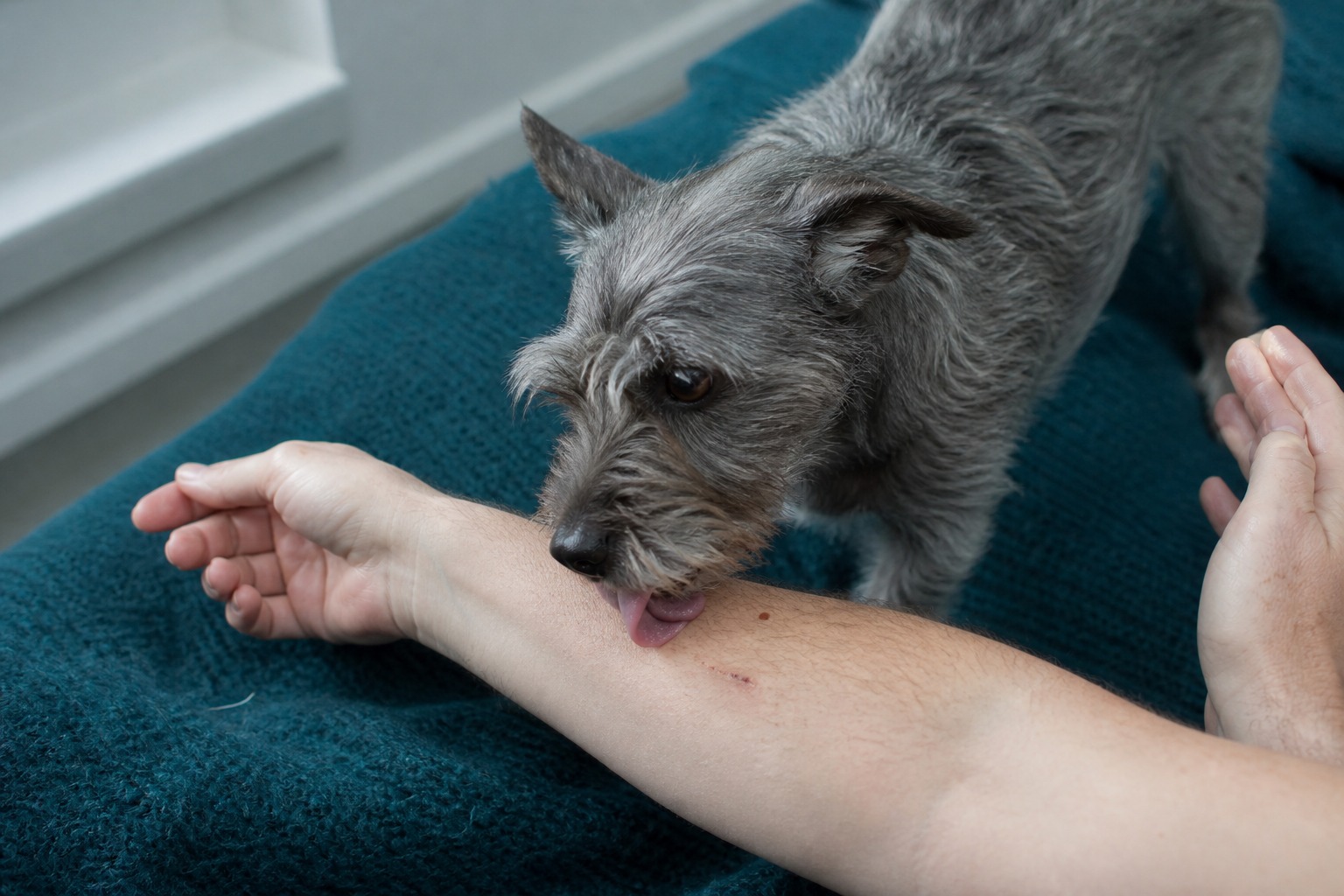
Start with the motivation, because that is where the myth gets its emotional grip. It feels like care. Your dog comes over, focuses on the cut, and works at it with real attention. It is very easy to read that as concern.
The more honest explanation is sensory. Wounds emit volatile organic compounds, the same class of airborne chemistry that lets dogs distinguish your laundry basket from anyone else’s, and to a nose that good, a fresh cut is loud. It is new, it is warm, it is chemically interesting, and it appeared on a body they have already memorized.
Licking is one of a dog’s main tools for investigating the world. So the wound gets licked because it is novel, not because it is being treated.
That is not the same as saying your dog does not care about you. Dogs read our tone, posture, and mood with genuine skill, and there is real research on canine empathic responding. But the specific behavior of tonguing an open cut is a nose-and-mouth investigation, not a nursing instinct wearing a cute face.
There is an instinctive layer underneath it too. Dogs lick their own injuries, and licking does provide short-term relief, in the same way that rubbing your elbow after you crack it on a doorframe interrupts the pain signal. It also drags debris out. As wounds heal and start to itch, the urge to lick actually increases.
“The behavior is real and the motivation is real, and neither one makes the saliva safe,” says Dr. Priya Nair. “I have had this conversation with people who are honestly offended on their dog’s behalf, as though I am accusing the animal of something. I am not. I am telling them what lives in a mouth.”
What lives in that mouth
Two names do most of the damage.
Pasteurella multocida is a common resident of the canine mouth and one of the usual culprits in infections that follow a bite, a scratch, or saliva reaching broken skin.
Capnocytophaga canimorsus is the one that should genuinely change your behavior. It is a gram-negative bacterium found in the saliva of healthy dogs and cats, and it does not require a dramatic bite to get in. Bites, scratches, or saliva contacting injured skin are all documented routes.
When it takes hold, it can escalate from a mild local infection to systemic infection, sepsis, and death, and it can do it fast. Deaths come from shock, disseminated intravascular coagulation, and organ failure.
The risk is not evenly distributed. People without a spleen account for around 60% of C. canimorsus infections, and people with alcohol use disorder, cirrhosis, or cancer are also at elevated risk. But here is the number that undercuts the comforting version of this story: up to 40% of cases occur in people with no underlying immune compromise at all. A systematic review found 128 cases in immunocompetent patients between 2002 and 2019, and sepsis was a frequent complication.
The consequences make the news when they are extreme. British papers reported one such case in the summer of 2025: a retired legal secretary in her eighties cut her leg at home, her granddaughter’s dog licked the cut on a visit, and she died of sepsis. Pasteurella multocida turned up in her tests. It is a rare outcome. It is not a hypothetical one.
The people who need to be strictest
If any of the following describes you or someone in your home, the rule is not “discourage licking,” it is “no licking of broken skin, ever.”
- No spleen, or a spleen that does not work properly
- Immunosuppressive medication, chemotherapy, or an immune-compromising condition
- Diabetes, cirrhosis, or alcohol use disorder
- Very young children, and older adults
- Any wound that is deep, dirty, surgical, or slow to close
For everyone else, the rule is still: clean it, cover it, and do not let the dog at it. Covering the wound is the piece people skip, and it is the one that does the most work.
And should dogs lick their own wounds?
This is the other half of the question, and the answer is more nuanced but lands in a similar place.
Self-licking is a deeply ingrained instinct. Briefly, on a minor surface wound, it can offer some relief and clear a bit of debris. Sustained, it is destructive: it irritates the tissue, delays healing, reopens closing wounds, and drives bacteria into the site. Chronic licking is also how you end up with a lick granuloma, a thickened, ulcerated, self-perpetuating sore that is genuinely difficult to resolve.
So: allowed briefly, monitored always, interrupted when it becomes a project.
Clean the small stuff yourself: a mild soap, warm water, done gently. And do not reach for Neosporin or any other topical ointment without asking your vet first, because dogs lick it straight off and some human topicals make them sick.
For anything more serious, block access. The Elizabethan collar, the cone, is what surgeons send dogs home in after a spay or neuter for a reason: it works. Modern alternatives, fitted recovery suits and pet shirts, cover the site without limiting movement and are far more tolerable for a lot of dogs.
A reasonable middle path for a healing dog: when you are in the room and watching, let them move freely, and interrupt and reward when they go for the wound. When you cannot watch, the cone or the suit goes on. That way you are not fighting the instinct all day, and you are also not undoing a week of healing while you are at work.
Redirect rather than scold. Guide them off the wound with a toy, a treat, or attention, then reward the leaving-alone. Punishment adds stress to a dog who is already sore, and stress drives more licking, not less.
Call the vet for any serious injury. Wounds may need stitches and antibiotics, and your vet can prescribe numbing gels and pain medication that take the edge off the itch and make the whole cone situation easier for everyone.
The bottom line, spelled out
- Your dog licks your wound because it smells interesting, not because they are treating it.
- Their saliva has mild antibacterial compounds. It also has bacteria that cause sepsis.
- The good is small and unreliable. The harm is uncommon but can be catastrophic.
- Clean it, cover it, and redirect the dog. Nothing about that is unkind.
What’s new since this was written
The literature on Capnocytophaga has shifted in one important direction: away from the idea that it is strictly a disease of the immunocompromised. Case reports of severe sepsis and meningitis in previously healthy adults have accumulated, including cases with no bite at all, where the only exposure was saliva reaching broken skin. The CDC’s clinical guidance now emphasizes that while asplenic and immunosuppressed people carry the highest risk, infection in healthy people is well documented and frequently severe.
Practically, that means the old advice, “you only have to worry if you’re immunocompromised,” has not aged well. The current, boring, correct advice is the one your grandmother would have given anyway if she had known what was in there: wash it, cover it, and keep the dog’s tongue off it.
References
- Centers for Disease Control and Prevention. Clinical Overview of Capnocytophaga.
- Butler, T. (2015). Capnocytophaga canimorsus: an emerging cause of sepsis, meningitis, and post-splenectomy infection after dog bites. European Journal of Clinical Microbiology & Infectious Diseases, 34(7), 1271–1280.
- Morandi, E. M., et al. (2017). A small “lick” will sink a great ship: fulminant septicaemia after dog saliva wound treatment in an asplenic patient. International Wound Journal, 14(6), 1025–1028.
- Harvard Health Publishing. Simple steps for avoiding infections from dogs and cats.
- Szánthó, F., Miklósi, Á., & Kubinyi, E. (2017). Is your dog empathic? Developing a Dog Emotional Reactivity Survey. PLOS ONE, 12(2), e0170397.
- The Ohio State University Wexner Medical Center. Diseases dogs can pass to humans.