


Your Cat Isn't Broken. But 3 of These 7 Habits Deserve a Vet Call.
Most of your cat's baffling habits are hardware working exactly as designed. A few are your cat telling you something is wrong. Here is how to sort one from the other.

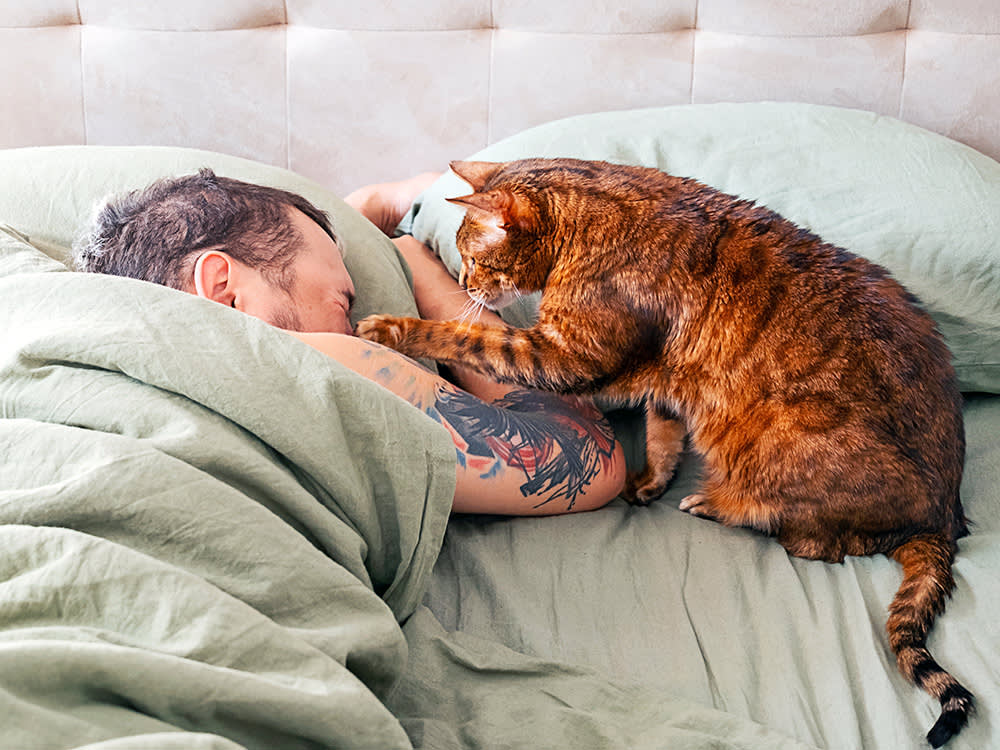
Cats are, by design, a little unnerving. They gape at the air. They yell at a blank wall at 3 a.m. They tear out of the litter box like it insulted them. They ask to be touched and then leave.
Here is the useful thing nobody tells you: those behaviors are not a random pile of quirks. They fall into two piles. Most are hardware running exactly as engineered, and knowing that is a relief. A few look identical to the harmless ones but are your cat’s first, quietest way of reporting that something has changed. The behaviors themselves do not tell you which pile you are in. The pattern does. New, escalating, or out-of-character is the flag. Lifelong and consistent is a quirk.
So sort them that way. Here are seven of the strangest things cats do, what is actually happening, and, for the three that carry a real warning inside them, when to pick up the phone.
1. The open-mouthed stare (a quirk, always)
Your cat sniffs a shoe, a coat, another cat’s blanket, your face, and then stops. Head back, upper lip peeled, mouth ajar, eyes half-closed, radiating what looks like withering judgment.
This is the flehmen response, and it is not a reaction at all. It is a second sense being switched on. Cats have a vomeronasal organ in the roof of the mouth, and holding the mouth open pins scent particles against it so pheromones and chemical signals can be read in far more detail than the nose alone allows.
It looks like disgust and it is closer to a lab result. The face is not an opinion about the smell. It is your cat running the sample a second time, with better equipment.
Nothing to do here. Triggers are usually a strong or unfamiliar scent: a delivery box, laundry, another animal, your shoes. Let them finish.
2. The post-poop sprint (a quirk, with one exception)
Your cat exits the litter box at a dead run and does two laps of the apartment.
There are three plausible reasons and they are not mutually exclusive. Defecation stimulates the vagus nerve, which can produce a genuine jolt of relief and energy. The muscular effort itself is stimulating. And there is an old instinct in there: a small predator who is also prey does not linger next to a scent marker that advertises exactly where they are.
The exception: watch the quality of the exit. A cat celebrating is loose, fast, and looks pleased with themselves. A cat fleeing is a cat in pain. If the sprint comes with straining, crying in the box, repeated trips, or stool that looks wrong, that is not zoomies, that is a symptom.
3. Kneading you like dough (a quirk)
Rhythmic paw-pushing into your leg, a blanket, or a couch cushion, often with a purr and a thousand-yard stare.
The behavior originates in nursing, where kittens knead the mammary gland to stimulate milk flow. Adult cats keep it as a comfort loop, and the paw pads also carry scent glands, so a kneading cat is quietly marking whatever they are standing on as theirs. That includes your thigh. The claws are not an insult. Trim them and take the compliment.
4. “If I fits, I sits” (a quirk, and a genuinely weird one)
The box. The sink. The suitcase. The square of sunlight that is technically not an object.
The obvious explanation is that enclosed spaces are safe and warm, and that is true. But the stranger finding is that the box does not need to be real. In a 2021 citizen-science study published in Applied Animal Behaviour Science, cats sat inside a square outlined in tape, and they also sat inside a Kanizsa illusion, an arrangement of shapes that produces the impression of a square with no actual edges. The cats were responding to a square that did not exist. Their visual system fills in the contour the same way ours does, and then they park in it.
5. Asking for attention, then walking away (a quirk)
The tap on the shoulder, the plaintive look, and then, the instant you reach out, the strategic relocation to the far end of the sofa.
Cats did not evolve as pack animals; they evolved as solitary hunters who are also small enough to be eaten. Both halves of that sentence matter. They want contact, and they want to control the terms of it, because control is what keeps an animal that size safe. Making you come to them, and leaving before the petting gets to be too much, is not a rejection. It is a negotiation.
The practical fix is consent-based petting: offer a hand, let them close the distance, stop before they ask you to. Cats who get to end the interaction tend to start more of them.
6. Drooling while you pet them (a quirk, unless it is not)
A happy, purring cat who leaves a damp patch on your knee is a happy cat. The relaxation runs deep enough that the swallow reflex gets lazy. It is more common than people think, and it is more common in cats who were deeply bonded and well-handled young.
The exception, and it is a real one: drool that arrives without the purr is one of the more reliable red flags in cats. Sudden drooling with bad breath, a dropped appetite, pawing at the mouth, a tilted head while eating, or any labored breathing needs a same-day vet. Dental disease, oral pain, nausea, and toxin exposure all present this way. The rule of thumb: context, not the drool. Drool inside a purr is love. Drool on its own is a symptom.
7. Yowling at nothing (the one that most often means something)
The 3 a.m. monologue into an empty corner. Cat parents joke about ghosts. The real explanation is sadder and much more actionable.
New, repeated, loud vocalizing at nothing, especially at night and especially in a cat past middle age, is one of the most common early signs of feline cognitive dysfunction syndrome, the feline version of dementia. It is not rare and it is badly underdiagnosed. Roughly 28% of cats aged 11 to 14 show at least one behavioral sign of cognitive dysfunction, and that climbs to about 50% of cats over 15.
In a 2020 owner survey of vocalizing senior cats, increased vocalization was reported in over 58% of cats during the day and more than 30% at night. When owners were asked what seemed to be driving it, the two leading answers tied: disorientation (40.5%) and attention-seeking (40.5%), followed by seeking a resource such as food (16.2%), and pain (2.7%).
Read that list again, because it is the whole point. Only one of those causes is a quirk. Disorientation is a brain change. Resource-seeking can mean hyperthyroidism or kidney disease driving hunger and thirst. Pain is pain.
The night yowling is the part people apologize for, and it is usually the part I most want to hear about. It is often the first thing that changes, months before anything shows up on a scale or a blood panel.
Cognitive decline cannot be reversed, but it can be slowed and managed with diet, supplements, environmental changes, and in some cases medication. The other causes on that list are very treatable. Either way, the visit is worth it.
The one-line rule
If a behavior has been true of your cat since you met them, it is who they are. If it showed up recently, got louder, or arrived alongside anything else, it is information. Take the information.
What newer research adds
The old advice on senior cats was mostly “she’s just getting old.” That is the sentence the current research is trying to kill. Cognitive dysfunction in cats is now understood as a real, common, and underdiagnosed syndrome rather than a personality change, and vocalizing is one of its earliest, loudest signals.
The other useful update is about why owners misread it. When researchers asked owners what they thought their cat was yowling about, disorientation and attention-seeking came out neck and neck, which tells you something important: from the couch, a confused cat and a demanding cat look identical. You cannot sort them by ear. Your vet can.
And on the sillier end, the box research is a good reminder that cats are not always doing something deep. Sometimes they are being fooled by a shape. That is allowed too.
References
- Smith, G. E., Chouinard, P. A., & Byosiere, S.-E. (2021). If I fits I sits: A citizen science investigation into illusory contour susceptibility in domestic cats (Felis silvestris catus). Applied Animal Behaviour Science.
- Sordo, L., & Gunn-Moore, D. A. (2021). Cognitive Dysfunction in Cats: Update on Neuropathological and Behavioural Changes Plus Clinical Management. Veterinary Record.
- Sordo, L., et al. (2020). Potential Causes of Increased Vocalisation in Elderly Cats with Cognitive Dysfunction Syndrome as Assessed by Their Owners. Animals.
- American Animal Hospital Association. A compassionate approach to feline cognitive dysfunction.
Common questions
Is it bad that my cat drools when I pet them?
A relaxed, purring cat who drools during petting is almost always fine. Drool that shows up on its own, paired with bad breath, a dropped appetite, pawing at the mouth, or labored breathing, is a different story and needs a vet.
Should I worry when my cat meows at nothing?
Occasional chattiness at an empty hallway is normal. New, repeated, loud vocalizing at nothing, especially at night in a cat over ten, is one of the most common early signs of feline cognitive dysfunction and deserves a workup.
Dr. Kohl is a board-certified veterinary dentist with a particular interest in preventive oral care. She reviews all dental health content at The Pet Times and contributes practical guides on home dental routines, professional cleaning, and oral disease prevention.
Meet our experts ↗Keep reading
 Health & WellnessThe Glow in Your Cat's Eyes Is a Free Eye Exam. Learn to Read It.Dr. Ravi Mehta · 8 min
 LivingYour Cat Has Been Asking for the Same 7 Things. You Keep Hearing 'More Cuddles.'Dr. Priya Nair · 8 min
 TrainingYour Cat Is Not Judging You. Your Cat Cannot Judge You.Dr. Mara Chen · 9 min
 TrainingToilet-Training Your Cat Means Throwing Away Their Health ChartDr. Ravi Mehta · 8 min
 Health & WellnessStop Wrestling Your Cat for Pills. Train Them Instead.Dr. Lena Park · 9 min
 Health & WellnessYes, Female Cats Spray. Spaying Doesn't Always Stop It.Dr. Lena Park · 7 min