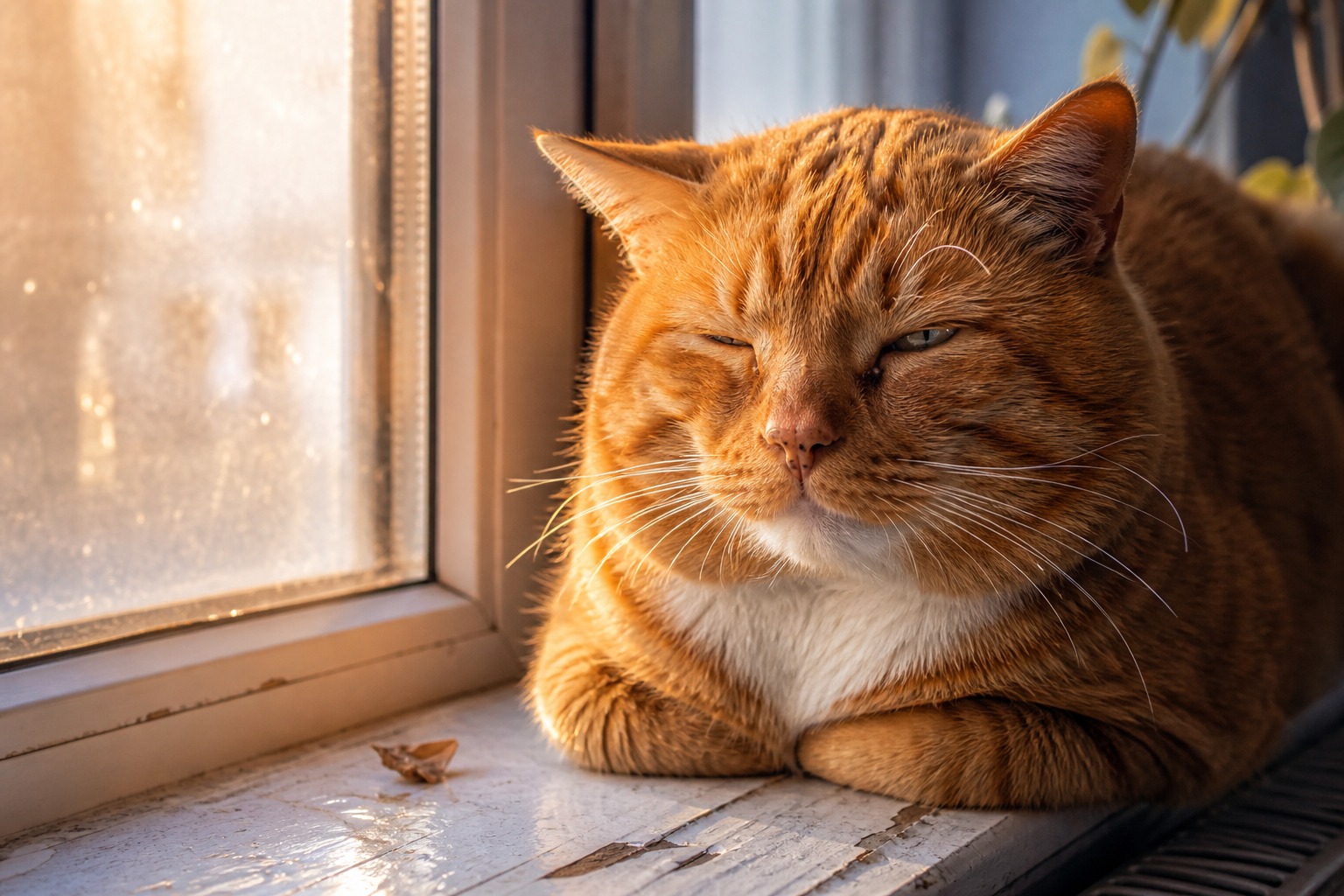
Almost everything people believe their cat is thinking requires a mental apparatus their cat does not have.
Spite requires holding a grudge against a specific individual and planning a proportionate response. Judgment requires a value system you can be measured against and found wanting. Punishment requires a theory of your mind, an intent to change your behavior, and a belief that you will connect the puddle on the rug to your weekend away. Cats are extraordinary animals. They are not doing any of that.
Which is a relief, because the stories we invent about them run overwhelmingly negative. Feline behavior professionals hear the same script from clients constantly: the cat is being difficult, the cat is holding something against them, the cat has decided to make a point. In years of working with cats who supposedly hate their owners, the specialists I have read and spoken with report the same thing. They have yet to encounter a genuinely malicious one.
So here are nine behaviors that get read as attitude, and what is actually happening underneath. One of them is a medical emergency waiting to be missed, and we will get there first.
1. Going outside the litter box
What you think: They’re angry. They’re showing me who’s boss.
What’s happening: Almost always, the setup is wrong. The box is too small, too dirty, too covered, or filled with a litter that feels bad under their paws. A behaviorist once traced a client’s out-of-box problem to a box being cleaned once a week. Imagine flushing your toilet once a week.
But before you buy a bigger box: a cat urinating outside the box needs a veterinary visit. Urinary tract disease and feline idiopathic cystitis are common, painful, and produce exactly this sign, and a blocked male cat is a life-threatening emergency measured in hours. Rule out the medicine, then fix the box.
When it is behavioral, the locations are informative. Cats tend to pick your bed, your clothing, your spot on the couch, bags and luggage that go in and out of the house, and the area by the front door. That is not a coincidence, and it is not an insult. It is associative marking: mingling their scent with yours. To them, those smells are not offensive. They are comforting, and the act is an attempt to strengthen the bond.
And the vacation version, where it happens while you are away or right when you get back? Not anger. Stress. Your cat did not know you were going anywhere. They knew their person vanished, their routine collapsed, and they had no way to know if you were coming back. It is self-soothing. When they do it on your return, they are not settling a score. They are asking to be closer to you, with an extremely limited toolkit for saying so.
“Every year I see cats punished for a behavior that turned out to be a bladder problem,” says Dr. Mara Chen. “If your cat is peeing where they shouldn’t, the first call is to me, not to a pet store. Especially if it’s a male cat and he’s straining.”
2. The slitted eyes
What you think: They’re glaring at me.
What’s happening: Possibly a slow blink, which is a genuine affiliative signal. Possibly they’re tired. Possibly they are relaxed and idly watching the room.
Judgment needs a value system cats do not have. If you feel judged by your cat, you are almost certainly judging yourself and using a nearby face to do it. That is just their face.
3. Purring
What you think: They’re happy. All is well.
What’s happening: Usually yes. But purring is also a self-soothing behavior, and cats purr when they are stressed, injured, or sick. A purring cat at the vet is often a terrified cat, not a delighted one.
Purring is also not a permission slip. A cat can purr while cuddling and still be signaling that they are done: ears back, tail flicking, a paw pushing you away. Ignore those, and the purr can turn into a nip. Not because they are angry, but because you skipped every quieter thing they said first.
4. Showing you their belly
What you think: Free belly rub.
What’s happening: They are showing you they feel safe. That is a compliment about the room, not a request for contact. Some cats enjoy a belly rub. Many will wrap all four limbs around your forearm and explain otherwise.
Take the gesture at face value and leave the belly alone. You will get more of them that way.
5. Biting and swatting
What you think: They’re being a jerk, or punishing me.
What’s happening: In young cats, usually play aggression. They are bored and want to play, and their idea of play involves equipment that hurts you.
The other version is a communication failure, and it is on us. A nip is not an attack. It is the last resort after every quieter signal, the ear flick, the tail lash, the freeze, went unread.
6. Knocking things off the table
What you think: Agents of chaos, hellbent on destroying my nicest things for their own amusement.
What’s happening: Amusement is involved, so you are partly onto something. But the entertainment is not the object hitting the floor. If it were, your apartment would be a crime scene every time you left it.
It is attention. Negative attention beats no attention, and it makes the afternoon less boring. If the shelf-climbing is part of it, they may also just want a higher perch. A tall cat tree or a wall shelf often ends the crockery problem overnight.
7. Fighting with the other cat
What you think: They hate each other.
What’s happening: Often it is rough play. If it is quiet, there is no hissing, and you can interrupt it easily, it is probably fine.
Real conflict between cats is nearly always a fight over something: food, a box, a perch, a warm spot. Solitary hunters by design, they were never built to share, and a house asks them to. The fix is arithmetic, not therapy: more litter boxes, more food bowls, more vertical space, more places to be alone.
8. Scratching the couch instead of the post
What you think: They’re stubborn, or they’re stupid.
What’s happening: Your scratching post is probably flimsy. The couch does not move when they sink their claws into it, and that resistance is the entire point of scratching. A post that wobbles is a post that fails.
Also, not every cat wants to scratch vertically. Some prefer horizontal scratchers, and senior cats with arthritis often strongly do. Offer both, sturdy, and the furniture usually survives.
9. The genuinely weird one your cat does
The behaviors above are the common ones. Your cat also has private habits that no article will explain: sleeping in a paper bag on a hard floor while ignoring the plush bed you bought, sticking a paw in your mouth when you talk, meowing at you until you make eye contact from the litter box.
The temptation is to build a theory. She’s a former feral who considers a cat bed a bourgeois affectation. He has a litter box kink. He wants me to stop talking. Those explanations are fun, and they are almost always wrong, because they are too complicated and too human.
As one feline behavior expert has put it, people routinely ascribe more meaning to a cat’s behavior than can reasonably fit inside a cat’s brain. We do it because we love them, and because projecting our own reasoning onto others is what humans do.
The reframe worth keeping
None of this is a demotion. Cats are not simple, and understanding them is not a matter of lowering your estimate of them. It is a matter of correcting the direction of the error.
Your cat is not scheming. They are communicating a need, soothing themselves, or playing, with a vocabulary that is small, physical, and easy to miss. Once you stop treating them as a tiny furry human with a complicated inner life and a grudge, you start seeing what they are actually doing, and you get much better at answering it.
Which is the whole payoff. Not just fewer misunderstandings, but a cat who finds you easier to live with.
References
- Ellis, S.L.H., et al. “AAFP and ISFM Feline Environmental Needs Guidelines.” Journal of Feline Medicine and Surgery, 2013. https://journals.sagepub.com/doi/10.1177/1098612X13477537
- Carney, H.C., et al. “AAFP and ISFM Guidelines for Diagnosing and Solving House-Soiling Behavior in Cats.” Journal of Feline Medicine and Surgery, 2014. https://journals.sagepub.com/doi/10.1177/1098612X14539092
- Humphrey, T., et al. “The role of cat eye narrowing movements in cat-human communication.” Scientific Reports, 2020. https://www.nature.com/articles/s41598-020-73426-0
- Cornell Feline Health Center. “Feline Lower Urinary Tract Disease.” https://www.vet.cornell.edu/departments-centers-and-institutes/cornell-feline-health-center/health-information/feline-health-topics/feline-lower-urinary-tract-disease