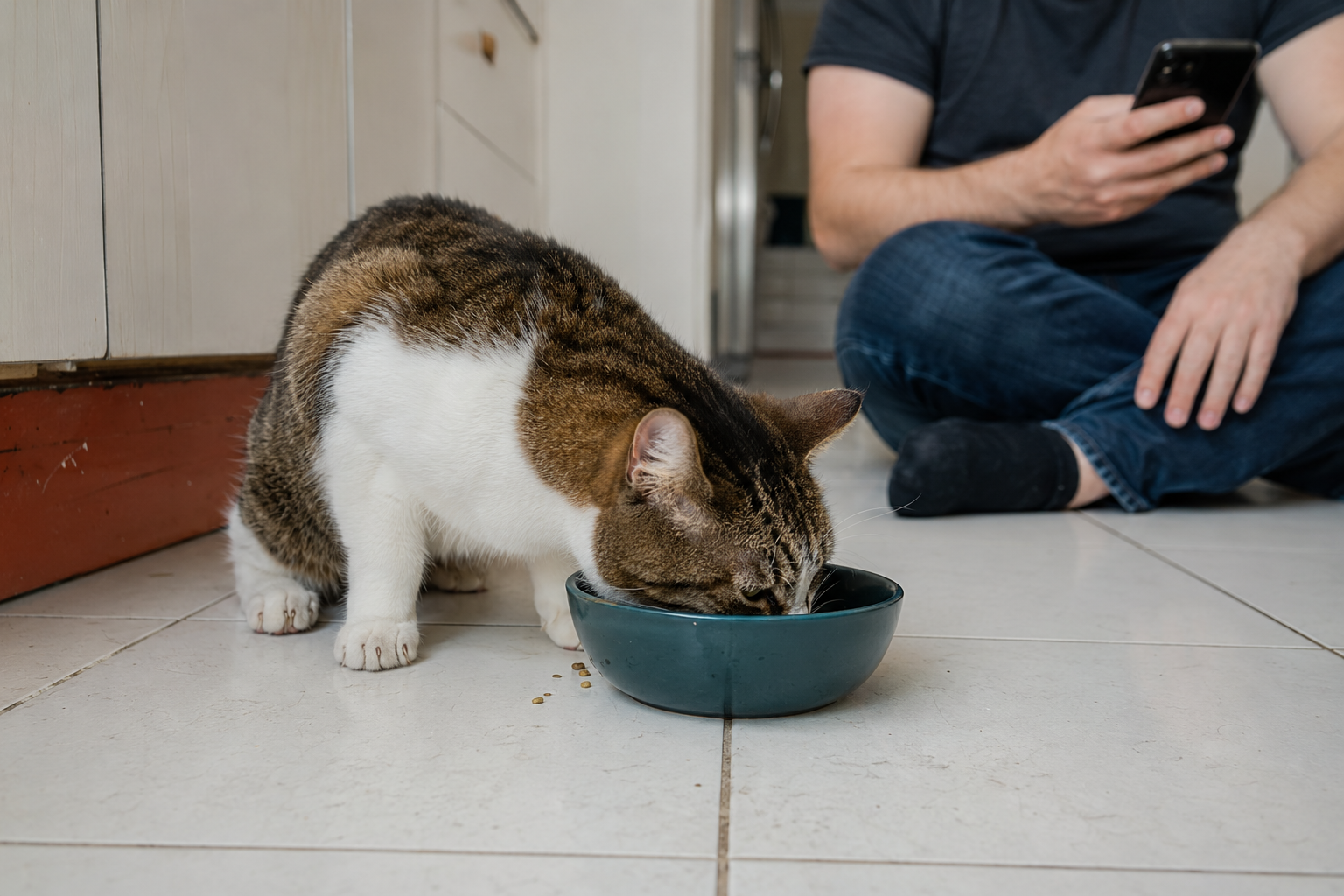
Ask a room full of cat owners what their cat does wrong and you’ll get the same list every time. Pees on the good blanket. Destroyed the arm of the sofa. Screams at four in the morning. Licked a bald stripe down one flank. Vanished under the bed for two days after your friend came over.
Every single one of those is on the clinical list of anxiety symptoms in cats.
That’s the thing worth sitting with. The behaviors that get cats yelled at, rehomed, and surrendered are, more often than not, the behaviors of a frightened animal. And a frightened animal does not respond to consequences. They respond to having the fear addressed. Which means the most useful question is almost never how do I stop this, and almost always what is my cat afraid of, and can I change it?
First, the boring rule that saves lives
Before any of this counts as anxiety, it has to not be a medical problem.
Peeing outside the box is the headline example. It is a textbook anxiety sign, and it is also a textbook sign of urinary disease, which in a male cat can become a fatal blockage in a day. Over-grooming can be anxiety, or it can be fleas, allergies, or pain. A cat who suddenly won’t stop yowling may be anxious, or may have hyperthyroidism, high blood pressure, or failing hearing.
So the order of operations is fixed: vet first, behavior second. Nothing below applies until a physical cause has been ruled out.
The four shapes anxiety takes in cats
Anxiety in cats isn’t one condition. It clusters into four rough categories, and they overlap, but knowing which one you’re looking at changes what actually helps.
Generalized anxiety. The cat is worried regardless of what’s happening. There’s no trigger to point at. They pace, tremble, or vocalize with nothing obviously wrong in the room, and they struggle to properly settle even when the house is quiet.
Separation anxiety. Real, and badly underappreciated. Cats form genuine social bonds, and while plenty of them are content to nap through your workday, some come apart. It gets worse when the departure comes bundled with other disruption: a suitcase appearing, a move, strangers in the house.
Phobias. A specific, learned dread of a specific thing. The usual suspects are the carrier and the vet’s office, car rides, dogs, visitors, and loud noises. Phobias are the most treatable kind, because you know exactly what you’re aiming at.
Social anxiety and cat-versus-cat tension. The one people miss most. Multi-cat households run intricate hierarchies their humans never see. There may be no biting, no screaming, no visible fight at all, and one cat may still be living under constant pressure: blocked from the litter box, edged off the good perch, excluded.
The symptoms, and what each one is really telling you
Excessive vocalization. Some cats are just talkers, and Siamese are the loudest lawyers in the business. What matters is pattern. A cat who reliably starts yowling when a particular thing happens, and won’t stop, is not chatting.
Destructive behavior. Overwhelmed cats can panic or lash out, which is how you end up with a wrecked screen, a scratched hand, or a fight with a housemate cat.
Peeing and pooping outside the box. It looks personal, especially when they hold eye contact while doing it. It isn’t. It’s stress finding an exit. Where and how often it happens gives a behaviorist real diagnostic clues.
A change in grooming, in either direction. Anxious cats can over-groom to the point of barbering off their own fur. They can also stop grooming entirely, which is common in cats under social pressure from a housemate: cleaning yourself means dropping your guard, and they don’t feel safe enough to do it.
Hiding. A scared cat’s plan is to be somewhere the scary thing isn’t, until the scary thing is gone. Closets, under beds, behind the dryer.
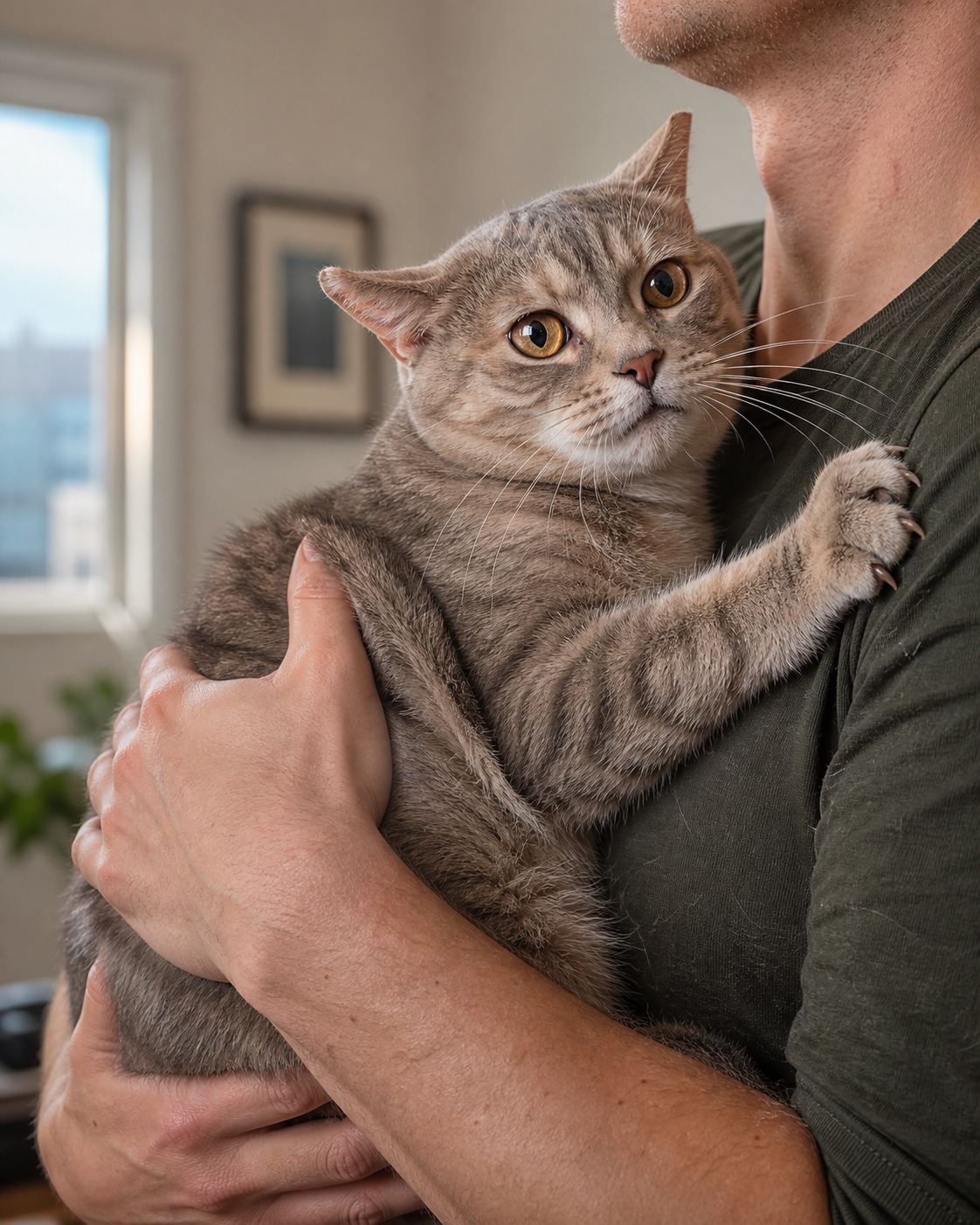
The face and the body. Cats broadcast more than people give them credit for. A relaxed cat carries their ears forward, their eyes soft, their tail up. A stressed cat pulls the ears back, widens the eyes, and tightens the whole posture. It’s an intricate language, balancing friendliness against caution and offense against defense, and most of us are terrible at it right up until we suddenly aren’t.
The things that work, roughly in the order you should try them
Routine
The cheapest intervention, and the most undersold. Feeding, litter scooping, play, and rest at predictable times give a cat a day with a shape. A cat who can predict what happens next has less to brace for.
Enrichment
A busy brain has less room for a stress loop. Rotate toys, teach tricks, use food puzzles, and yes, plain social attention counts. Grooming and gentle petting are enrichment too, with one caveat: check that your cat actually wants to be handled first, or you’ve just added a stressor instead of removing one.
Fix the litter box math
This is where most households quietly fail their cats. The rules:
- At least one box per floor the cat can get to.
- At least one more box than you have cats. Two cats means three boxes.
- Scoop daily, wash weekly. A cat’s nose is not your nose.
- Put them somewhere quiet where the cat feels safe. Almost no cat wants to use the bathroom next to a washing machine mid-spin cycle.
Pheromones
Feline pheromones have been isolated and studied, and synthetic versions are sold as sprays and plug-in diffusers. The evidence is decent enough that they’re a reasonable early step for event-based fear, social tension, and separation stress. They are not a cure, and they will not fix a household that is genuinely short on resources.
Supplements, ranked by how much evidence is actually behind them
This aisle is loud and mostly unregulated, so here is the honest ranking.
- α-Casozepine, derived from cow’s milk protein, has some support for taking the edge off vet-visit stress without sedating the cat.
- L-theanine, an amino acid, has been shown to lower stress measures in cats.
- L-tryptophan shows some promise for reducing bad behavior in multi-cat homes.
- Probiotics with Bifidobacterium longum strain 999 (BL999) are proven to reduce anxiety in dogs and look promising in cats, though the feline evidence is thinner.
- Prescription calming diets bundle several of the above into food, which sidesteps the pill problem. There are anti-stress urinary formulas too, because bladder disease and stress in cats are deeply tangled.
- CBD is the popular one and the weakest one. It has not been properly evaluated for feline anxiety. The dose, the frequency, and the side effects are all unknown. Take that seriously rather than as a formality.
Run any supplement past your vet first, even the ones that sound harmless. “Natural” is not a pharmacological category, and interactions are real.
Medication
If routine, enrichment, and environment aren’t enough, medication is not a failure. It’s the next tool, and your vet will choose based on the shape of the anxiety, not its severity.
- Event-based fear (the carrier, the clinic, thunder, the car) is treated with short-acting drugs: pregabalin, gabapentin, beta blockers, or benzodiazepines.
- Long-running anxiety (generalized, separation) is treated with tricyclic antidepressants or SSRIs, borrowed from human medicine and dosed very differently.
Cat meds are genuinely tricky. Side effects matter, and so does the small logistical nightmare of getting a pill into a cat who has decided otherwise.
“The single biggest mistake I see is treating anxiety like a character defect that the cat should be able to talk themselves out of,” says Dr. Priya Nair. “Nobody waits six months to treat a limp. Waiting six months on a cat who is soaking the duvet every night just gives the fear time to set.”
When to stop managing and call the vet
Book the appointment, and don’t wait, if:
- Your cat is straining in the box, going in tiny amounts, or crying while urinating. In a male cat this is an emergency, not a behavior issue. Go now.
- Your cat has groomed down to bare or broken skin.
- Your cat has stopped eating for more than about a day. Cats do not tolerate fasting; the liver takes damage quickly.
- The anxiety is escalating, not holding steady.
- A resident cat is hiding nearly all day or has stopped using shared spaces at all.
What newer research adds
Two things have moved recently, and both help.
The first is a real drug. In late 2023 the FDA approved pregabalin oral solution, sold as Bonqat, specifically for the acute fear and anxiety cats feel around transportation and vet visits. It launched in the US in 2024 and is the first FDA-approved animal drug containing pregabalin. It’s not a sedative; it’s given about 90 minutes ahead of the trip and can be repeated on a second day. In trials, 77 percent of treated cats improved across two exams, against 46 percent on placebo. Mild sedation, wobbliness, and lethargy were the reported side effects. It is prescription-only for a reason, so this is a conversation with your vet, not an internet purchase.
The second is that cat separation anxiety finally has numbers behind it. In a questionnaire study of cat owners, about 13 percent of cats met at least one criterion for a separation-related problem. Among those cats, the most reported behaviors were destruction (about 67 percent), excessive vocalizing (63 percent), and peeing indoors in the wrong places (60 percent), with apathy, aggression, and agitation close behind. The risk went up for cats with no toys and no other animal in the house. Which is a hopeful finding, because both of those are things you can change this week.
A 2025 review of the field makes the broader point: fear, anxiety, and stress are now recognized as among the most common behavior problems cats have. Not an exotic diagnosis. The default one.
References
- de Souza Machado, D., et al. (2020). Identification of separation-related problems in domestic cats: A questionnaire survey. PLOS One, 15(4), e0230999.
- U.S. Food and Drug Administration. FDA Approves Pregabalin Oral Solution for Alleviating Anxiety Associated with Transportation and Veterinary Visits in Cats.
- American Association of Feline Practitioners. AAFP Feline Behavior Guidelines.
- Barrios, C., et al. (2025). Tools for the Approach of Fear, Anxiety, and Stress in the Domestic Feline: An Update. Veterinary Medicine International.
- Davis, H., et al. Effect of Bifidobacterium longum 999 supplementation on stress-associated findings in cats with feline herpesvirus 1 infection. Journal of Feline Medicine and Surgery.
- American Veterinary Medical Association. New drug calms cats during transportation, veterinary visits.