


You Can't Train Your Dog in a Moving Car. Start in the Driveway.
A moving car is the worst classroom in the world: triggers arrive at 40mph, you can't control the distance, and you're driving. The fix is to never train there. Plus the medical cause everyone mistakes for reactivity.

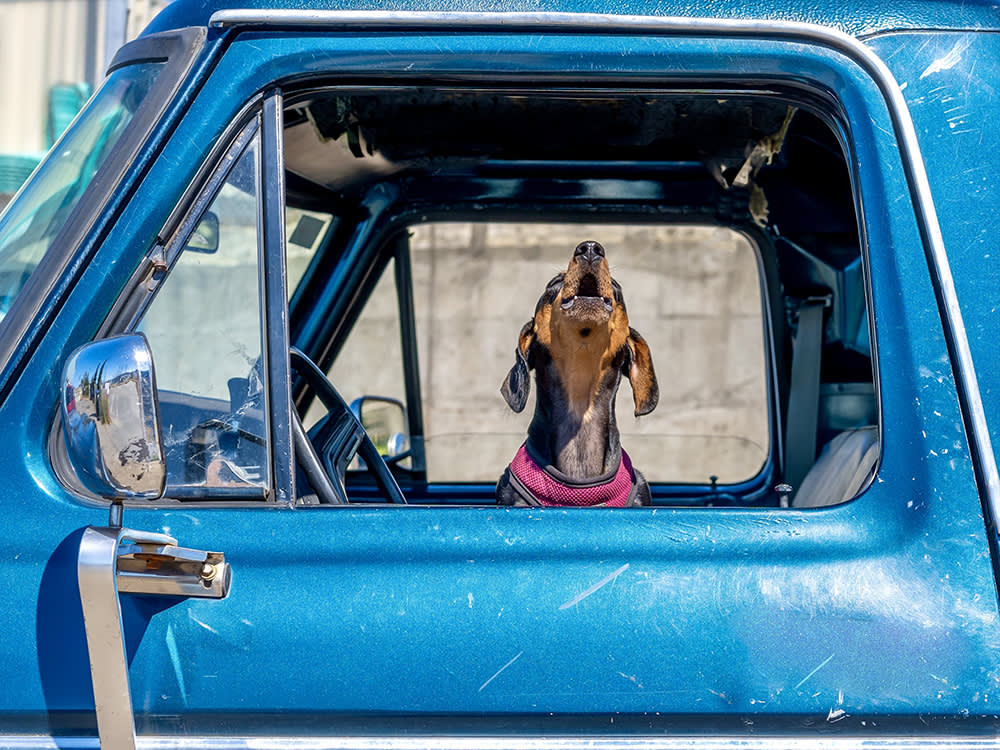
Some dogs are fine everywhere and lose their minds in the car. Others are reactive on walks and then become something else entirely behind glass: louder, wilder, harder to interrupt.
There’s a reason a car is worse, and understanding it tells you exactly what to do.
A moving car is a machine for delivering triggers at maximum intensity with zero control. A dog on a walk who spots another dog can look away, slow down, arc around, sniff the ground, or leave. Every one of those is a coping strategy, and a car removes all of them. Your dog is strapped in a box, the trigger appears with no warning, arrives at closing speed, and vanishes before anything can be resolved.
Then it happens again. Then again.
And here’s the part that determines everything else: the barking works. The dog barks at the cyclist, and the cyclist disappears, because you drove past at thirty miles an hour. From the dog’s perspective, that’s a hundred per cent success rate. There is no more powerfully reinforced behavior in the world than one that works every single time.
Which leads to the central instruction of this piece, and it’s the one most people get wrong:
Stop training in a moving car. You cannot win there.
First: rule out the thing that isn’t behavior at all
Before any of this, one medical question, because it’s the most commonly missed cause of “car problems” and the fix is completely different.
Is your dog carsick?
Motion sickness in dogs is very common, particularly in puppies and adolescents, whose vestibular systems are still maturing. It causes nausea, and nausea in a car produces exactly the behavior people diagnose as anxiety or reactivity: restlessness, whining, panting, pacing, and barking.
The tells:
- Drooling. This is the big one. Excessive, ropey drool in the car is nausea until proven otherwise, not excitement.
- Lip-licking and repeated swallowing.
- Yawning. In this context it’s a nausea sign, not tiredness.
- The dog is worse on twisty roads and better on straight ones.
- The dog is fine in a stationary car and only deteriorates once you’re moving.
- Vomiting, obviously.
If that’s your dog, no amount of counter-conditioning will fix it, because there’s nothing to counter-condition. There’s a dog who feels sick. Talk to your vet: there is a licensed anti-nausea medication for motion sickness in dogs (maropitant, sold as Cerenia), it works well, and it changes the whole picture. Many dogs then become normal, quiet passengers.
Also worth knowing: a dog who felt sick in the car ten times has now learned that the car makes them feel awful, so the anxiety is real even after the nausea is treated. In those dogs you treat the nausea and then do the training below.
Almost every week I have an owner describing a car-reactive dog, and when I ask about drooling, they say oh yes, he soaks the seat. That is not a training problem. That is a dog being quietly nauseated for the length of every journey, and barking about it. We can treat the nausea in an afternoon. The trainer can’t.
Now the actual protocol
If it’s genuinely behavioral, this is the sequence. It is slow, it is boring, and it works.
Step 1: Identify the trigger precisely
Not “he barks in the car.” Which things, exactly?
All people, or only men? All dogs, or only ones that bark first? Motorbikes? Only motorbikes that overtake? Cyclists? Kids? Trucks specifically? Everything that moves fast?
Watch for a week and write it down. You cannot build a training plan against a vague enemy, and most owners discover the list is much shorter and much more specific than they assumed.
Step 2: Find the payment
Then find the single best thing your dog will take in a car. This has to be genuinely high value, chicken, cheese, hot dog, roast beef, not their normal kibble. In an aroused, stressed dog, ordinary treats do not register.
If your dog won’t eat in the car at all, that’s a data point: they’re over threshold already, and you’ve started too close.
Step 3: Train in a parked car. Only in a parked car.
This is the whole method.
Park somewhere you can control the distance to the trigger, which usually means the far end of a car park, a quiet street, or the corner of an industrial estate. Then you and your dog simply stay put in the parked car, engine off, and wait.
A person appears in the distance. The instant your dog sees them, before any barking, you start feeding, and you talk in a warm, silly, upbeat voice. You keep feeding as long as the person is visible. The moment the person is gone, the food stops and you go quiet.
Person appears → food and happy talk. Person leaves → nothing.
Repeat this a hundred times.
Four rules that make or break it:
- The food is not a reward for good behavior. It’s not contingent on anything. Your dog does not have to sit, or look at you, or be quiet. You are not training an obedience behavior, you are changing what a cyclist means. If your dog barks and you withhold the food, you’ve broken the association you’re trying to build. Feed anyway.
- Distance is your only real control. If your dog is barking, you are too close. Move further away. Keep moving further away until the dog can see the trigger and still eat. That distance is your starting line, and it’s usually much greater than people expect.
- Timing is everything. The food must arrive after the trigger appears, not before, and as close to instantly as possible. The trigger predicts the food. That’s the entire mechanism. If you feed first, you’ve taught nothing.
- Stop before they crack. Five to ten minutes. End while your dog is still doing well.
The thing you’re waiting for, and it will come, is the moment your dog sees a person and then looks at you, expectantly. That’s the association forming. That’s the whole game.
Step 4: Close the distance, slowly
Once your dog is relaxed and looking at you for their chicken, make it harder by one notch. Park a little closer. Or choose a harder trigger, someone walking a dog, someone jogging.
If the barking comes back, you moved too fast. Go back a step. Nobody is in a hurry.
Step 5: Only now, add motion
And when you do, bring a second person. One drives, one feeds. Trying to counter-condition and drive at once is unsafe and ineffective, and it’s the point at which most people’s training collapses.
Keep the first moving sessions extremely short, a few minutes, and drive somewhere deliberately boring, an empty road, an industrial park at the weekend. A long drive through town on day one will blow through your dog’s threshold in ninety seconds and undo weeks of work.
Meanwhile: management, which is not cheating
Training takes months. You still have to drive to work.
So while you train, stop the rehearsal. Every unmanaged car journey is another repetition of the barking, another success for it, and it makes the training slower. Management isn’t giving up. It’s protecting the work.
- Block the view. This is the single most effective intervention and the most underused. If the dog can’t see the trigger, there is nothing to bark at. A crate with a cover over it, a solid barrier, or window shades. Many dogs are dramatically calmer in a covered crate, and it’s safer in a crash.
- A ThunderCap or similar does something cleverer: it doesn’t blind the dog, it blurs and dims the view so shapes are visible but detail isn’t. That’s often enough to keep a dog under threshold. Introduce it at home, with treats, long before it goes in the car.
- Put the dog somewhere with a worse view. The footwell of the back seat, or a crate on the floor, is a very different visual experience from the window.
- Give them a job. A stuffed frozen toy or a long-lasting chew that they only ever get in the car. A dog who’s working on a Kong is a dog who isn’t scanning.
- Teach a settle at home first, on a mat, then transfer it to a parked car in the driveway, then to a car that’s running but not moving, then to a short drive. Each step gets its own week.
Safety note worth stating: a loose dog in a car is a projectile in a crash and a hazard to the driver. A crash-tested harness or a secured crate is not a nice-to-have.
What newer research adds
Two things have shifted, and both are practical.
The first is that the veterinary profession now takes canine motion sickness and car anxiety seriously as a medical problem, not just a training one. There is a licensed anti-nausea drug for it, and situational anti-anxiety medication is increasingly used for dogs who genuinely cannot cope with the car, sometimes short-term while the training does its work. Historically owners were told to just get on with it, and a lot of dogs spent years being quietly miserable. If your dog is distressed in the car, that is a legitimate reason to ask your vet about medication, and asking does not mean you’ve failed at training.
The second is that the humane-training consensus has hardened. Professional veterinary behavior bodies now state plainly that aversive methods, shouting, spray collars, shock, prong corrections, are associated with worse outcomes and increased fear and aggression, and should not be first-line. In a car this matters especially: punishing a barking dog in a confined space, next to the trigger they’re already worried about, teaches them that the sight of a cyclist reliably predicts something unpleasant from you. You will suppress the noise and worsen the feeling.
The bark is a symptom. Go after the feeling.
FAQ
Why is my dog so much worse in the car than on a walk? Because a car removes every coping strategy a dog has, delivers triggers at speed with no warning, and then makes the barking “work” every time, since you always drive past.
My dog drools and pants in the car. Is that anxiety? It might be nausea. Excessive drooling is the classic sign of motion sickness in dogs, and it’s very treatable. Ask your vet before assuming it’s behavioral.
Should I tell my dog off for barking in the car? No. Punishment in that moment pairs the trigger with something unpleasant and tends to make the underlying fear worse, even if it suppresses the noise. Change what the trigger predicts instead.
Does covering the crate actually help? Often dramatically. If the dog can’t see the trigger, there’s nothing to react to, and it stops the behavior being rehearsed while you train. It’s also safer in a crash.
How long does this take? Weeks to months, done properly. The parked-car phase is the bulk of the work, and rushing to a moving car is the most common reason people fail.
References
- “AVSAB Position Statement on Humane Dog Training.” American Veterinary Society of Animal Behavior. https://avsab.org/wp-content/uploads/2021/08/AVSAB-Humane-Dog-Training-Position-Statement-2021.pdf
- “Motion Sickness in Dogs.” VCA Animal Hospitals. https://vcahospitals.com/know-your-pet/motion-sickness-in-dogs
- Ziv, G. “The effects of using aversive training methods in dogs — A review.” Journal of Veterinary Behavior, 2017. https://www.sciencedirect.com/science/article/abs/pii/S1558787816301526
- “AVSAB Position Statement on Positive Veterinary Care.” American Veterinary Society of Animal Behavior. https://avsab.org/resources/position-statements/
- “Traveling with Your Pet.” American Veterinary Medical Association. https://www.avma.org/resources/pet-owners/travel-and-your-pet
Dr. Mehta is a board-certified veterinary nutritionist who evaluates pet food formulations, ingredient quality, and the science behind dietary trends. He writes and reviews all nutrition content at The Pet Times, including our food rankings and feeding guides.
Meet our experts ↗Keep reading
 TrainingAggression Is Not Dominance. It's a Request for Distance That You Missed.Dr. Mara Chen · 11 min
 TrainingYour New TV Is Half the Reason Your Dog Won't Stop Barking at ItDr. Nina Kohl · 8 min
 TrainingYour Dog Isn't Aggressive at the Door. He's Scared, and the Door Makes It Worse.Dr. Mara Chen · 4 min
 TrainingYour Dog Nibbles You Like Corn on the Cob. Two Experts Disagree About What to Do.Dr. Nina Kohl · 8 min
 TrainingYou Didn't Cause Your Dog's Leash Reactivity. Here's How to Manage ItDr. Amara Solis · 7 min
 TrainingStop Letting Your Dog 'Say Hi' on the LeashDr. Priya Nair · 5 min