If your dog turns into a barking, lunging tornado the second another dog appears on the sidewalk, the first thing to hear is this: it is not proof that you failed. The name of the original version of this piece was practically a confession, “did I cause my dog’s behavioral problem?”, and that question haunts a lot of good owners. The answer, almost always, is no. And the reason matters, because owner guilt tends to make walks tenser, and tension is fuel for reactivity.
So let’s reframe the whole thing. Leash reactivity is not a moral verdict on your training. It is mostly a predictable collision between how dogs are built and what a leash does to them. Understand that collision, and the path forward stops being about willpower and starts being about distance, timing, and reading your own dog.
What leash reactivity actually is
Leash reactivity is when your dog overreacts to a trigger while on leash. The trigger can be anything they have a negative association with, other dogs, people, cars, bikes, and the reaction usually looks like lunging, barking, or growling. Some dogs flip the other way and try to flee the thing that upsets them. Either way, the common thread is a big emotional response to something that, off leash, they might have handled with a sniff and a shrug.
That last point is the key to everything. The leash is not incidental to the problem; it is often the cause.
Why the leash is the real culprit
Dogs do not greet the way humans do. Given the choice, they prefer to approach at an arc rather than head-on, give each other space, circle, sniff, and then decide whether to play or politely disengage. A leash erases all of those options. It puts your dog in a kind of cage: movement restricted, choices removed, and greetings forced into a straight-on, face-to-face posture that dogs find rude and stressful. From your dog’s point of view, they are being marched directly at a stranger with no way to manage the encounter naturally.
That pressure expresses itself in a few different flavors, and knowing which one you are dealing with shapes your response. Some dogs get protective, bristling when a strange human or dog gets close to their beloved person. Some get frustrated: they actually want to say hello, but the leash blocks them, and the thwarted excitement boils over into barking and lunging. And some are simply scared, and the leash interrupts the flight response that would otherwise let them create distance, so the fear has nowhere to go but outward. None of those are your fault. All of them are workable.
The one idea that makes training work: threshold
Here is the concept the whole method hinges on. Every reactive dog has a threshold, a distance from the trigger inside which they lose it and outside which they can still think. The entire goal of training is to work below that threshold, where your dog can see the trigger without tipping into a reaction. Try to teach a dog who is already over threshold, mid-lunge and flooded with adrenaline, and you are wasting your breath; they cannot learn in that state.
So you start far away. Far enough that your dog notices the trigger but stays calm. Then you change the emotional meaning of the trigger from that safe distance, and only close the gap as your dog stays relaxed. Over many sessions, the distance shrinks. That is the arc of the work.
The plan, step by step
Build a new association. This is counterconditioning, and it is the core of the whole thing. Carry high-value treats you reserve only for these outings, the good stuff your dog rarely gets otherwise, and pair the appearance of a trigger with those treats. The sequence matters: trigger appears, treat happens. Over time, the trigger starts to predict something wonderful instead of something scary, and you specifically reward any moment your dog notices the trigger and then chooses to disengage and look back at you.
Refocus attention before the fixation locks in. When you see your dog start to lock onto something, interrupt early, before the stare turns into a lunge. Change direction, step behind a parked car to break the sight line, or make a novel sound like a squeaky toy. The aim is to redirect that attention back onto you and keep your dog under threshold.
Manage your own energy. Dogs read us closely, and a tense, breath-holding, leash-cranking human broadcasts alarm. Keep your body loose, your voice calm and warm, and praise your dog softly for checking in with you. Your steadiness is part of the treatment.
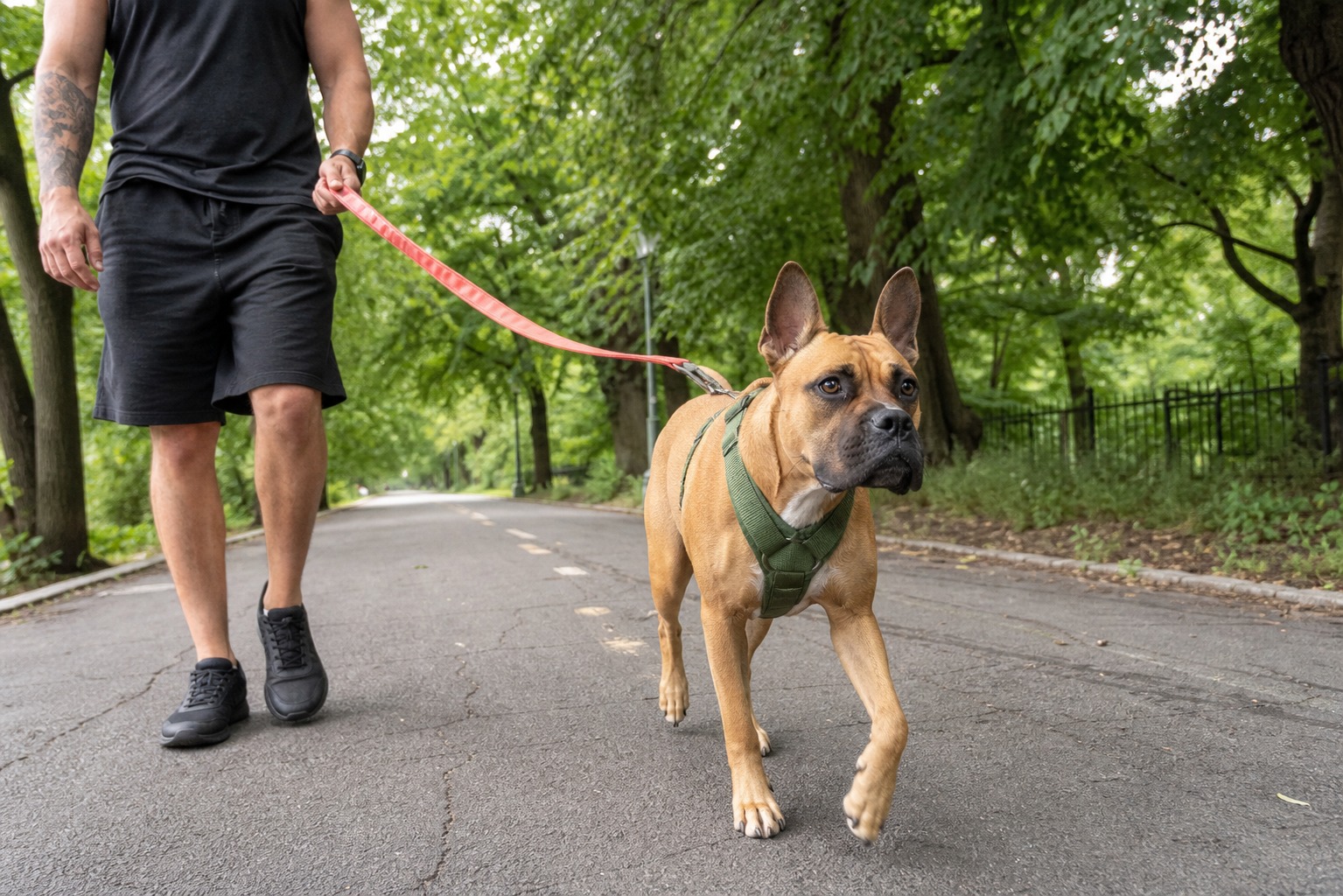
Use the right equipment. Get gear that gives you smooth control without hurting your dog: a well-fitted harness and a standard, fixed-length leash. Never yank, drag, or choke your dog into compliance, because pain and pressure just add another bad association to the exact situation you are trying to make positive. And never use a retractable leash. They offer essentially zero control, jam at the worst moments, and put your dog, and anyone within range, at risk.
Keep investigating the trigger. Ask why this particular thing sets your dog off. Do they feel vulnerable, exposed, protective of you, or simply startled by things appearing too fast? The better you understand the root, the more precisely you can manage it, whether that means more distance, different routes, or avoiding certain high-traffic times entirely.
Go at your dog’s pace, and get help when you need it
The most common mistake is rushing. Each dog moves at their own speed, and progress is not linear. If your dog starts throwing stress signals, whale eye, a closed mouth, a stiff body, a hard stare, you have moved in too close, too fast. That is not a setback to push through; it is information. Back up to a comfortable distance and try again there. Keep the routine going as long as it takes, and expect the timeline to be measured in weeks and months, not days.
And know when the job is bigger than a solo project. If the reactivity is severe enough that neither you nor your dog can enjoy a walk, bring in a qualified force-free trainer or a veterinary behaviorist sooner rather than later. That is not admitting defeat; it is the same as calling any other specialist for a problem outside your expertise.
“So many owners walk in apologizing, convinced they broke their dog,” says Dr. Amara Solis. “I tell them the reactivity was almost never their doing, but the recovery absolutely can be. Once we stop trying to punish the barking out of a scared dog and start building distance and good associations instead, the walks change faster than people expect.”
What newer research adds
The evidence has gotten clearer on one thing in particular: the tools that promise a fast fix tend to make reactivity worse. Reviews of aversive training methods, prong and shock collars, leash corrections, intimidation, link them to increased fear, stress, and aggression, which is the opposite of what a reactive dog needs. The current consensus among behavior professionals is firmly on the side of reward-based, below-threshold work, exactly the approach above. If a method’s logic is “make the trigger scarier,” modern behavior science says walk away from it.
There is also a growing appreciation for the role of overall stress load, sometimes called trigger stacking. A dog who had a rough morning, a startling noise, and a missed nap is running on a shorter fuse before you ever leave the house, and the same trigger that was fine yesterday tips them over today. The practical upshot is that managing your dog’s baseline, enough rest, sniff-heavy decompression walks in quiet places, and not stacking hard outings back to back, does real work, and reinforces that the goal is a calmer dog, not a blamed owner.
References
- Ziv, Gal — “The Effects of Using Aversive Training Methods in Dogs: A Review,” Journal of Veterinary Behavior, 2017
- American Veterinary Society of Animal Behavior — Position Statement on Humane Dog Training
- Fear Free / Overpeck, K. — Understanding and Managing Leash Reactivity (ASPCA behavior resources)
- China, L., Mills, D.S., Cooper, J.J. — “Efficacy of Dog Training With and Without Remote Electronic Collars,” Frontiers in Veterinary Science, 2020