


Your Little Dog Isn't Peeing More Because of a Tiny Bladder. It's a Bluff.
Small dogs really do pee and mark more than big dogs, and the plumbing is only half the reason. Research suggests little dogs use urine as a size bluff, aiming higher to seem bigger than they are. Here's what's normal and how to manage the schedule.

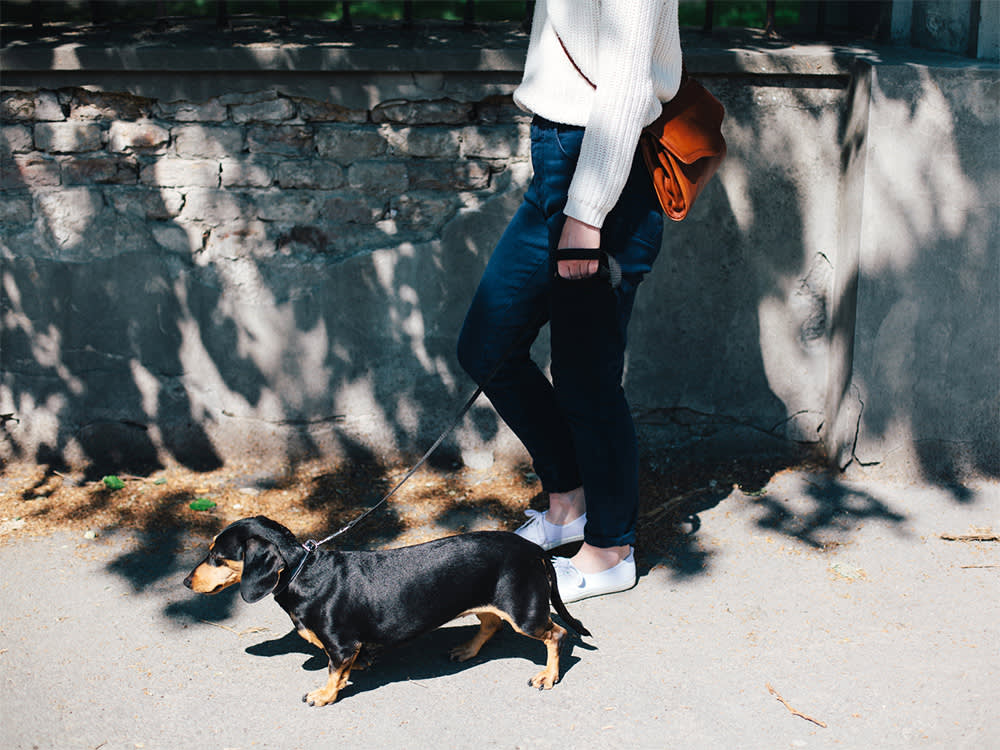
If you have ever walked a small dog, you know the routine: a few steps, a sniff, a squirt, repeat, seemingly forever. It is easy to assume the explanation is obvious, that a little dog has a little bladder and therefore has to go constantly. That is true, but it is the least interesting part of the answer, and on its own it is incomplete. The more surprising reason your Chihuahua treats every mailbox as a fresh appointment is social, not mechanical. Small dogs appear to use urine as a bluff, a way to look bigger and tougher than they actually are.
Once you see marking as communication rather than plumbing, the whole behavior makes more sense, and so does how to manage it. Let’s start with the science that reframes it.
The size bluff: what the research actually found
Scent marking, releasing small amounts of urine in specific spots, is one of the main ways dogs talk to each other without meeting face to face. That indirect quality is the key. Marking lets an animal broadcast information, who they are, that they were here, without the stress, energy cost, and injury risk of a direct standoff. And in a species where body size closely tracks who wins a physical encounter, that indirect channel matters most to the smallest animals, the ones least likely to come out ahead in person.
Researchers wondered whether little dogs exploit this. Betty McGuire, a behavioral ecologist at Cornell University, and her students studied adult shelter dogs and found something telling: the smaller the dog, the higher the angle at which it lifted its leg, aiming its mark higher up a vertical surface than its own height would suggest. Since other dogs read the height of a mark as a rough proxy for the size of the dog who left it, a small dog aiming high is, in effect, lying about how big it is. An earlier 2016 analysis of shelter dogs pointed the same way: smaller dogs, males, and dogs with longer shelter stays all aimed their pee at specific targets more often, a sign they were marking on purpose rather than simply relieving themselves. Small dogs, it turns out, are not peeing more by accident. They are working the room.
The plumbing reasons are real too
The social story sits on top of some straightforward biology, and all of it stacks in the same direction:
- A smaller bladder. Less storage means more frequent trips, exactly as you’d guess. This one really is just physics.
- A faster metabolism. Small dogs run hot, burning energy quickly relative to their size, which produces more waste to clear.
- More marking. As above, little dogs simply use urine as a message more often than big dogs do, so more of their output is communication, not just emptying.
- Age, sometimes. If your small dog is small because it is still a puppy, youth adds its own frequency on top. Puppies pee more than grown dogs regardless of breed.
Owners come in worried that constant peeing means something is wrong, and usually it’s the opposite, it’s a perfectly normal small dog being a small dog. What I actually want them watching for is a change: a dog who suddenly goes far more or far less than their own normal, or strains, or has accidents out of nowhere. The baseline frequency isn’t the red flag. A shift away from it is.
So how often is normal?
There is a lot of individual variation here, the same way there is among people on a road trip. At the absolute floor, a dog needs to urinate three to four times a day. A typical dog goes five or six times, up to eight is common, and many appreciate an extra chance after each meal. Small dogs, unsurprisingly, live at the busier end of that range.
Holding capacity works out roughly like this. Adult dogs can generally last six to eight hours between breaks, though most will naturally go every four to six during an active day, and many can stretch to eight or nine hours overnight when they’re resting. Seniors need to go more often as they age. Puppies follow a handy rule of thumb: at rest, they can hold it about as many hours as they are months old, plus one, so a four-month-old might make five hours, but only if they haven’t just tanked up on water, eaten, or played hard, all of which shorten the window.
Managing the schedule kindly
Some dogs, especially little ones, simply can’t hold it as long as we’d find convenient, and it’s worth remembering they can’t help it any more than we can. It’s much kinder to let a dog go a bit more often than they strictly need to than to push them to the edge of their limit every day. Keep a consistent rhythm of outdoor trips, and if you want to gradually lengthen the gaps, do it slowly, and never so much that your dog seems desperate.
Diet and medications can influence urinary frequency in dogs of any size, and some medications specifically increase it. If your small dog’s schedule seems tied to a new food or drug, or if anything about it changes suddenly, that’s a conversation for your veterinarian rather than a guessing game at home.
The bottom line: frequent peeing in a small dog is usually not a problem to fix but a feature to plan around. Between the modest bladder, the quick metabolism, and that clever little size bluff, your dog going out often is simply your dog being fluent in a language you can’t smell. Which, if you think about it, is a pretty good excuse to leave work on time.
References
- McGuire, B., et al. “Scent marking in shelter dogs: Effects of body size.” Applied Animal Behaviour Science (2016)
- Cornell EEB: “Small dogs aim high” — McGuire scent-marking research
- Learn, A., et al. “Differences in completeness of house-training between dogs based on size.” Journal of Veterinary Behavior (2020)
Common questions
Is it normal for a small dog to pee a lot?
Yes. Small dogs urinate more often than large dogs, and they also scent mark more. A smaller bladder, a faster metabolism, and a stronger drive to mark all push their frequency up. A sudden change in how much or how often they go, though, is worth a vet visit.
How long can a small dog hold its pee?
Adult dogs can generally hold it six to eight hours and often longer overnight, but most naturally go every four to six hours during the day. Puppies can manage roughly their age in months plus one hour at rest. Small dogs sit at the shorter end of these ranges.
Do small dogs take longer to potty train?
Often, yes. Because they can't hold it as long and go more frequently, small dogs have more opportunities for accidents, so house-training can take more patience and a tighter schedule.
Dr. Solis is a board-certified veterinary dermatologist with over twelve years of clinical experience. She advises on skin conditions, allergies, and grooming practices that affect coat and skin health. All dermatology and allergy content at The Pet Times is reviewed by her team before publication.
Meet our experts ↗Keep reading
 TrainingA Laser Pointer Isn't a Toy. It's a Job Your Dog Can Never Finish.Dr. Nina Kohl · 7 min
 TrainingThe Dog That Bites Your Kid Isn't the One on the SidewalkDr. Mara Chen · 8 min
 TrainingThat Stare Into the Empty Corner Has a Boring ExplanationDr. Nina Kohl · 6 min
 TrainingBelly Up Isn't Always 'Rub Me.' Read the Rest of the Dog.Dr. Priya Nair · 7 min
 Health & WellnessDog Saliva Doesn't Heal Wounds. It Delivers Bacteria.Dr. Priya Nair · 8 min
 TrainingYour Dog Rolling in Poop Isn't Camouflage. That Theory Barely Holds Up.Dr. Nina Kohl · 7 min