


Your Mind Is Rehearsing the Goodbye. Here's How to Stop Living There
Anticipatory grief isn't mourning too early. It's your mind running drills on a loss that hasn't happened. The work is redirecting that rehearsal back into the time you still have.

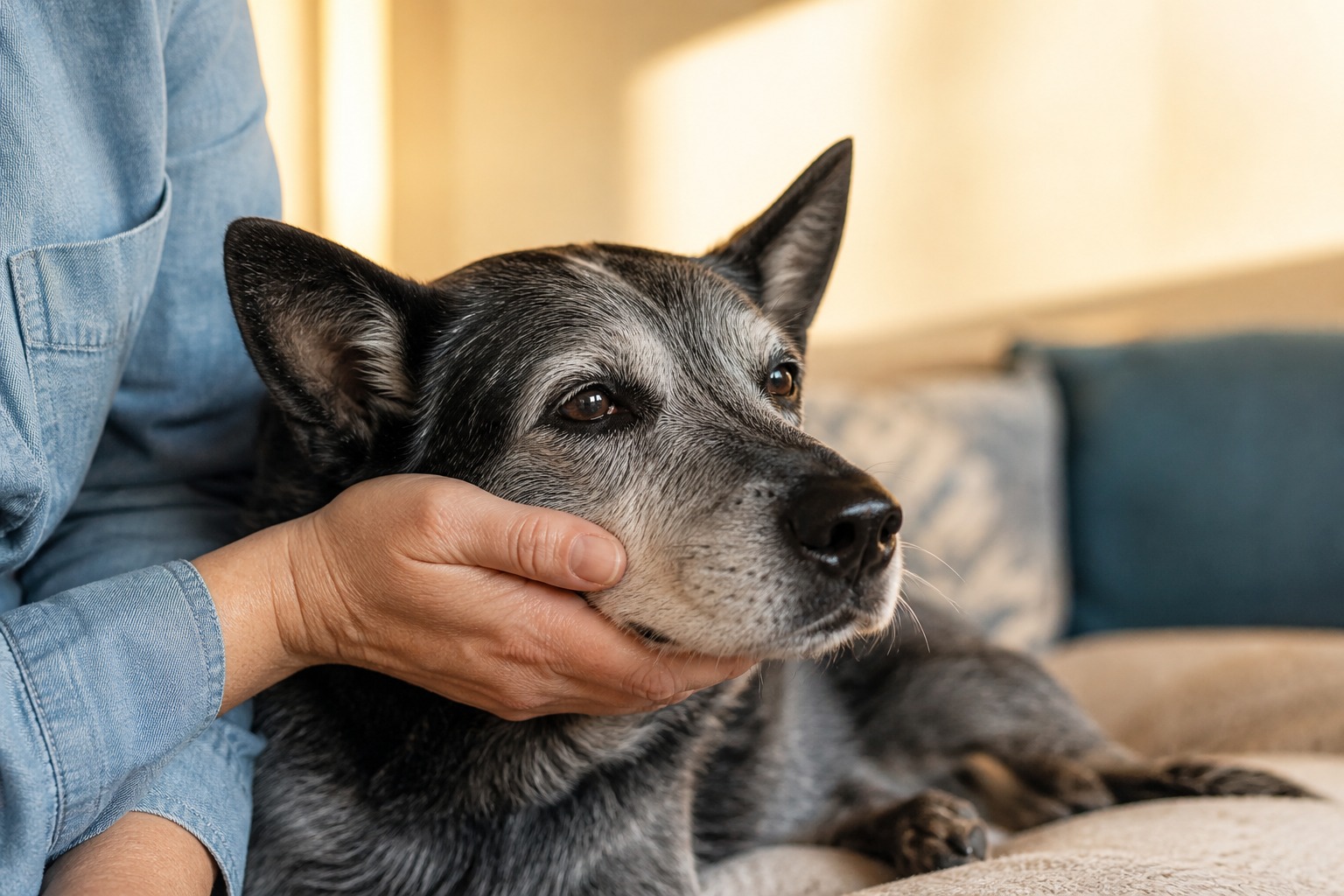
It usually ambushes you. Your dog’s walk has quietly gotten shorter. An old photo surfaces and you do the math on how many years have already gone by. And suddenly you are somewhere in the future, picturing the empty spot by the door, the collar in a drawer, the silence. The scene is invented. The ache is not. This is anticipatory grief, and the strangest part is that your pet is right there, asleep on the couch, fine, while a part of you is already at the funeral.
Most advice treats this as grief that showed up early, something to validate and wait out. That framing is true but incomplete, and it misses the move that actually helps. Anticipatory grief is less premature mourning than it is rehearsal: your mind running drills on a loss it knows is coming, trying to prepare you. The problem isn’t that the rehearsal happens. It’s that it’s easy to start living in the rehearsal, in the imagined future, instead of the real present where your pet is still here to be loved. The goal isn’t to shut the rehearsal off. It’s to keep returning from it.
Why your brain rehearses a loss that hasn’t come
Anticipatory grief is well documented and entirely normal. It can show up for anyone with any pet, but it clusters around aging animals and those with declining health, where the ending feels visible on the horizon. What makes it uniquely disorienting is that it asks you to hold two opposite truths at once: gratitude that your pet is here, and dread that they won’t always be.
People expect grief to be a single feeling, but anticipatory grief is a tangle of them at the same moment. Sadness and worry sit right next to genuine joy and purpose. Caregivers will tell me they had the best afternoon with their dog and cried through half of it. That contradiction isn’t a malfunction. It’s what loving something mortal feels like up close.
That research-backed point is worth sitting with: studies of people caring for seriously ill or aging dogs find that heightened contentment and a sense of purpose often arrive alongside heightened worry, not instead of it. The good and the grief are braided together. Expecting to feel only one is what makes people think something is wrong with them.
Step one: let it be there, then redirect it
The first instinct, talking yourself out of the feeling because the pet is “still fine,” backfires. Suppressed grief doesn’t dissolve; it leaks. The healthier first move is permission: if you want to cry, cry; if you’re angry that time is finite, be angry; notice the fear without judging yourself for it.
But permission alone can tip into rumination, where you marinate in the imagined future for hours. So pair it with a redirect. Each time you catch yourself in the rehearsal, the empty house, the last vet visit, deliberately bring your attention back to the animal in the room. Not as a platitude, but as an action: get on the floor with them, learn the gray hairs on their muzzle, make a specific good memory today instead of pre-mourning its absence.
A few small, concrete habits make that redirect easier to actually do:
- Build a “now” ritual. A daily walk you both love, a photo a day, a few minutes of contact with no phone in your hand. Routine pulls attention out of the future and into the body in front of you.
- Make memory on purpose. A paw print, a video of them doing the thing only they do, a short note about who they are right now. These give the mind a place to put love besides dread.
- Name the feeling out loud. “I’m doing the rehearsal again.” Labeling it shortens it, and reminds you it’s a thought about the future, not the present itself.
The aim is to spend the time you have in it, so that later you remember showing up, not just dreading.
Step two: know when it’s more than grief
Here is the part the standard “it’s all normal” advice leaves out, and it matters. Anticipatory grief is healthy. Depression is not the same thing, and the two can be told apart.
Anticipatory grief moves. It comes in waves, and between the waves there is still room for laughter, connection, and ordinary life. Depression tends to sit still and stay: a persistent flatness, a loss of interest in things that usually matter to you, hopelessness, and an inability to picture any future at all, not just a future without your pet.
Watch, too, for caregiver burden if your pet is chronically ill. Research finds that a substantial share of people caring for a seriously sick pet experience real caregiver strain, and heavier caregiving load tracks with more anxiety, more depression, and lower quality of life. The medication schedules, the cleanups, the constant vigilance, the financial weight, these wear a person down in a way that is separate from the grief itself.
If your sadness is unrelenting rather than wave-like, if it’s collapsing your sleep, work, or relationships, or if caregiving has hollowed you out, that’s the signal to bring in a professional. As one guideline puts it plainly: anticipatory grief is normal; clinical depression needs support. Reaching out early isn’t an overreaction. There’s no too-soon for adding someone to your corner.
Step three: don’t grieve in isolation
Anticipatory grief is lonely in a particular way, because the loss hasn’t “counted” yet, so people often don’t think to offer support. You may have to ask for it. Build a small circle you can be honest with: friends and family, a pet-loss support group, or a counselor. What you need from them is mostly patience, the room to say the same fears out loud as many times as it takes, without anyone rushing you toward acceptance.
There’s a poignant wrinkle here. Research on grief support has found that people often felt more soothed by their animals than by other humans, because the animal never got tired of the same sad story. Which means a grieving pet parent is also bracing to lose a piece of their own support system, the very creature who would normally comfort them through something this hard. That’s part of why this grief cuts deep, and part of why the humans around them need to lean in rather than wait to be asked.
If you’re the friend on the outside of this, the most useful thing you can do is simple and hard: let them talk about it, even the same worry for the hundredth time, without steering them toward “at least” or “when the time comes.” Presence beats advice here every time.
The reframe worth keeping
Anticipatory grief is proof of the bond, not a problem with it. It will keep pulling your mind toward a future that hasn’t arrived; that’s what minds do with things they love and fear losing. Your job isn’t to stop the rehearsal. It’s to keep walking back from it, into the room where your pet is still breathing, still yours, still able to be loved out loud today. Spend the time there. That’s the part you’ll be glad you didn’t miss, and the part no imagined goodbye can take from you.
This is a sensitive topic, and if you’re finding the weight of it hard to carry alone, please consider reaching out to a mental health professional or a pet-loss support line. You don’t have to wait until after to ask for help.
References
- Cacciatore, Joanne, et al. “What Is Good Grief Support? Exploring the Actors and Actions in Social Support after Traumatic Grief.” PLOS ONE, vol. 16, no. 5, 2021. https://doi.org/10.1371/journal.pone.0252324.
- Spitznagel, Mary Beth, et al. “Caregiver Burden in the Veterinary Dermatology Client: Comparison to Healthy and Cancer Caregivers.” Veterinary Dermatology, 2019. https://onlinelibrary.wiley.com/doi/10.1111/vde.12696.
- Bussolari, Cori, et al. “Self-Compassion and Resilience in Adults Mourning the Loss of a Companion Animal.” Anthrozoös, 2021. https://www.tandfonline.com/doi/full/10.1080/08927936.2021.1898215.
- “Anticipatory Grief.” Association for Pet Loss and Bereavement. https://www.aplb.org/anticipatory-grief.
Common questions
Is it normal to grieve a pet who is still alive?
Completely. It is called anticipatory grief, and it is a recognized, healthy response, especially when a pet is aging or chronically ill. It does not mean you are giving up on your pet or being morbid. It means you love them and your mind is bracing for a future loss.
How is anticipatory grief different from depression?
Anticipatory grief comes and goes and still leaves room for joy and connection with your pet. Depression is more constant: persistent hopelessness, loss of interest in things that usually matter, and an inability to picture any future. If sadness is unrelenting and is shutting down your daily life, that is a sign to seek professional support.
What helps with anticipatory grief over a sick or aging pet?
Redirect the worry into present-tense connection: deliberately make and savor good moments now, name the feelings instead of suppressing them, watch for caregiver burnout, and lean on people or groups who let you talk it out without rushing you.
When should I get professional help for anticipatory grief?
There is no too-early. Reach out if your sadness is constant rather than coming in waves, if it is collapsing your sleep, work, or relationships, or if caring for a sick pet has left you hollowed out. Adding a counselor or pet-loss support line to your corner is never an overreaction.
Sara Lim leads our Product Picks coverage, testing and comparing the things pets and their owners actually use. From everyday essentials to home-and-style finds, she focuses on honest, useful recommendations rather than hype.
Meet our experts ↗Keep reading
 LivingYour Dog Dies and Work Gives You Zero Days Off. That's Starting to Change.Jordan Ellis · 5 min
 Living5 Latinx-Owned Pet Brands Worth Your Money Every Month, Not Just OneLeila Torres · 4 min
 Health & WellnessWhether Pet Insurance Covers the Vet Depends on One Question: Why Are You There?Leila Torres · 7 min
 LivingThis Bright Yellow Bus Is Basically Uber, but Every Passenger Has Four LegsNina Vasquez · 4 min
 LivingYou Don't Have to Adopt a Dog to Get the BenefitClaire Sutton · 6 min
 Health & Wellness'You'll Just Know' Is the Cruelest Advice in Pet Care. Ask These 12 Questions Instead.Dr. Lena Park · 10 min