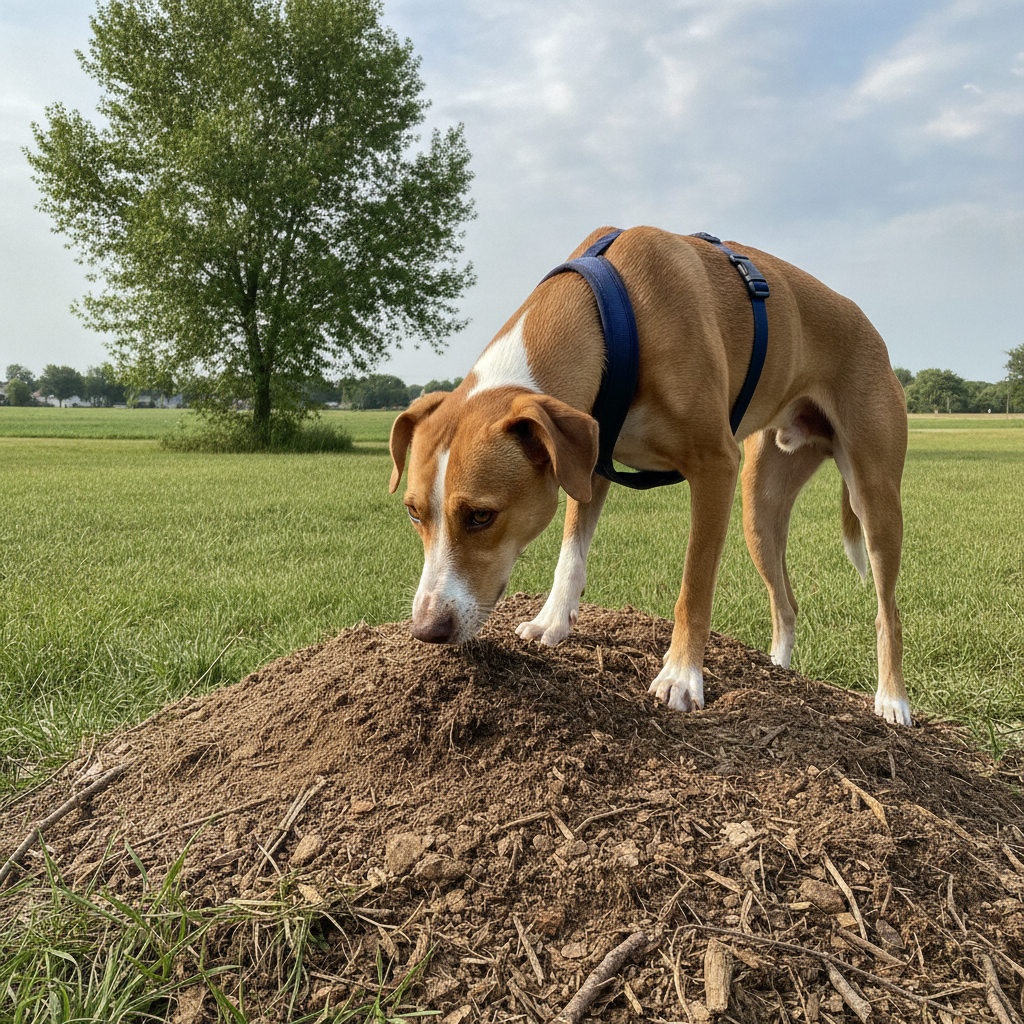
There is a specific kind of morning that dog parents know well: you watch your dog scramble halfway up a snowbank, a curb, or a tree root, position themselves with real intent, and poop from the highest point they can reach. Then you get to fetch it back down with a thin plastic bag over your hand. It looks like pure eccentricity. It isn’t. Your dog is doing something deliberate, and there’s a name for it.
The behavior is called middening, or poop-marking, and the important thing to understand up front is that the elevation is not the point. Your dog is not chasing an altitude record or a better view. They are choosing a spot where a message will carry, and height happens to make a message carry well. Once you see it that way, the habit stops looking weird and starts looking like what it is: your dog posting to a bulletin board that only dogs can read.
Poop is mail, and your dog is picky about the mailbox
Dogs treat the outdoors as a shared message system. Sniffing a lamp post or a patch of grass is how they read who has been through, when, and in what state, which is why the ritual gets described as checking their “peemail.” Marking is how they reply.
We usually associate that reply with urine and a lifted leg, but feces works as a marking tool too, and arguably a louder one. The scent that makes a poop-mark meaningful doesn’t come from digested food. It comes from the anal glands, two small sacs on either side of the anus that release a secretion every time a dog goes.
“Those anal-gland secretions are basically a scent signature,” says Dr. Nina Kohl. “They can carry information about a dog’s identity, sex, and rough size, so when your dog leaves a deposit somewhere prominent, they’re not being gross. They’re signing their name where they know it’ll get read.”
Placement is where dogs get strategic. A mark tucked in tall grass gets buried and missed. A mark set on a wall, a tree base, a fence line, or the crown of a snow pile sits out in open air, where the scent disperses over a wider area and stays detectable longer. If your dog can leave that mark somewhere other dogs already stop to sniff, better still: the message lands in a spot the audience is guaranteed to check.
The height itself sends a second message
There’s a reason dogs reach up rather than just picking a busy corner. Scent left higher off the ground can act as a rough proxy for the size of the animal who left it. A taller mark implies a taller dog, and a dog trying to seem like the biggest presence in the area has every reason to aim high. It’s the same logic behind a leg lifted as far up a hydrant as it will go.
That’s also why the same posts get hit again and again. Dogs revisit prominent spots partly to refresh their own message and partly to lay their scent over another confident dog’s, the canine version of covering a rival’s flyer with your own. In a neighborhood with a lot of dogs, a single fence post can be a heavily contested piece of real estate.
Some dogs are far more into it than others
Marking of any kind shows up more in male dogs, and more in dogs who are unneutered or unspayed, because it’s tied to the hormones that drive territorial signaling. But plenty of females midden, and spayed or neutered dogs still do it. The best predictor usually isn’t breed or sex, it’s temperament. A pushy, socially opinionated small dog will often out-mark a mellow large one. Size has nothing to do with the size of the opinion.
Context matters too. Marking tends to spike when a dog lands somewhere new, or when an unfamiliar dog starts leaving scent nearby. Your dog is essentially updating their profile to say, clearly, that they were here.
When the habit is worth a closer look
Most middening needs no intervention at all. It’s normal, healthy communication, and trying to stamp it out entirely is both difficult and beside the point. There are two situations, though, where the behavior is worth reading more carefully.
The first is a sudden change in volume. A dog who abruptly starts marking far more than usual may be reacting to stress, a new animal in the environment, or a shift in the household. The marking isn’t the problem so much as the signal that something in their world changed.
The second is physical. If your dog seems to strain to position on a slope, consistently favors one side, or looks stiff getting up and down from an elevated spot, the awkward angle may not be about communication at all. Dogs with arthritis or a healing injury sometimes shift their posture to protect a sore joint, and that can change how and where they go. There’s no evidence dogs deliberately pick angles to make the act easier, so a dog who suddenly seems to be working around discomfort is worth a vet’s eyes.
What newer research adds
The picture of dogs as sophisticated chemical communicators keeps getting stronger. Work on canine olfaction in recent years has reinforced that scent-marking is a genuine signaling system, not random habit: dogs adjust where and how they mark based on who else is around and what they’re trying to convey, and they pay close, structured attention to the marks of others. Studies of urine-marking have found dogs preferentially aim higher and return to socially “busy” spots, exactly the pattern owners see with poop-marking.
The practical takeaway hasn’t changed, though. If your dog is eating, moving, and behaving normally, their insistence on cresting the tallest snowbank on the block is not a quirk to fix. It’s a normal dog doing normal dog diplomacy, in the one language they have. You just happen to be holding the bag.
References
- Kokocińska-Kusiak, A., et al. “Canine Olfaction: Physiology, Behavior, and Possibilities for Practical Applications.” Animals, 2021. https://www.ncbi.nlm.nih.gov/pmc/articles/PMC8228080/
- Wells, D. L., and Hepper, P. G. “Prevalence of urine marking in the domestic dog.” Applied Animal Behaviour Science. https://www.sciencedirect.com/science/article/abs/pii/S0168159100001336
- McGuire, B. “Scent marking in shelter dogs: Effects of body size.” Applied Animal Behaviour Science, 2016. https://www.sciencedirect.com/science/article/abs/pii/S0168159116301630