


Your Dog Isn't Lonely. Point a Camera at Them and Find Out.
Barking when you leave feels like heartbreak. Half the time it's boredom, and the fix for one makes the other worse. A cheap camera and a stuffed toy tell you which dog you have.

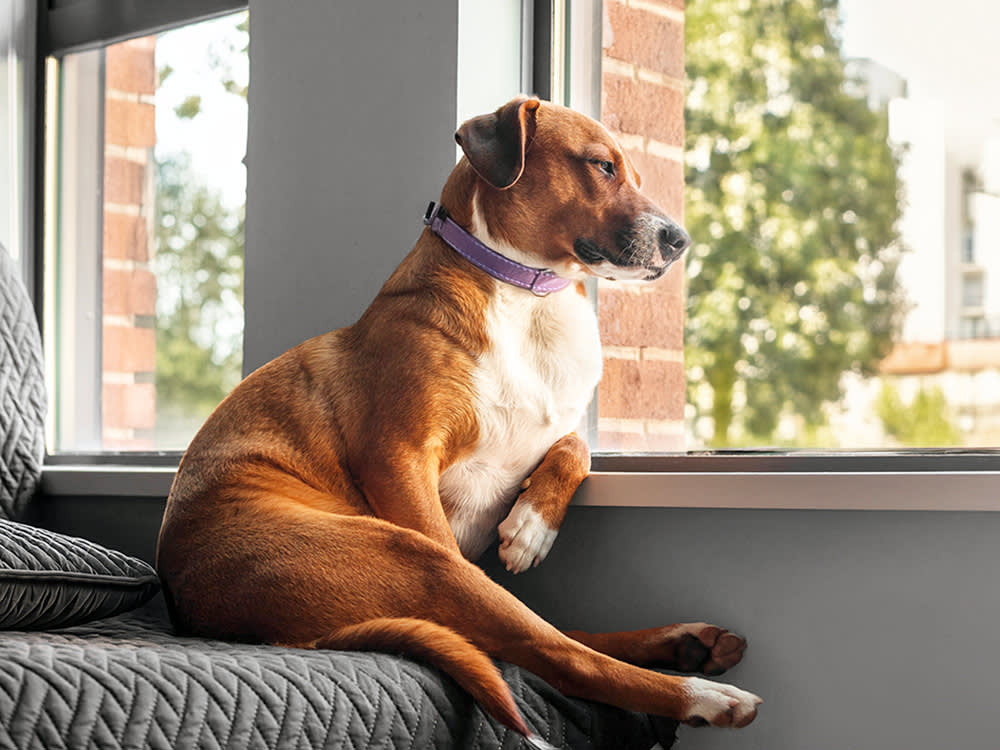
Your dog barks the second the door closes. You hear it from the hallway, you feel terrible, and you conclude your dog is lonely.
Maybe. But here is the thing almost nobody does before rearranging their life around that conclusion: they never actually look.
The test that settles it
Set up a camera. Any camera, an old phone propped on a shelf will do. Before you go, leave out a few things your dog genuinely likes: an interactive toy, a food puzzle, a long-lasting chew.
Then leave, and watch the footage later.
What you are looking for is not the barking. It is what happens after the barking. A dog who is bored will make some noise, then get up, investigate the puzzle, work on it, get bored of that, and go to sleep. A dog in real distress will not touch any of it. Food goes untouched. Favorite toys go untouched. They stare at the door, or pace, or pant, or dig at the exit, and they do not settle at all.
That distinction, will they eat and play or won’t they, is the single most useful thing you can learn about your dog this month.
People come to me certain their dog has separation anxiety, and the video shows a dog who barked for ninety seconds and then slept for four hours. That is a completely normal dog. The barking at the door is the goodbye, not the whole story.
The reason this matters so much is that the two problems pull in opposite directions. Boredom is solved with more stimulation. Genuine separation distress is a fear response, and piling on more activity does not touch it. Treat one like the other and you will spend six months and a lot of money going nowhere.
Six things a struggling dog actually does
Loneliness is a human word, and it is worth being precise about that. A dog left alone does not sit on the couch, sigh, and think I am lonely. But the distress of social isolation is real, and it comes out sideways. Watch for these.
Destruction. The classic version is ripping through a closet and dragging out shoes. It often escalates from agitation into genuine mayhem, and the damage tends to cluster around exits and windows in an anxious dog rather than being scattered randomly like a bored dog’s chewing.
Restlessness they cannot switch off. The loop looks like this: down for a moment, up again, over to the window, a lap along it, back to the bed, two minutes, up again. The severe version is continuous wandering that tips over into running. A dog wearing a track into your floor is a dog who cannot settle, and settling is exactly what a content dog does with an empty afternoon.
Vocalization that does not stop. Not a couple of whines. Whining or barking essentially non-stop.
Total inability to rest while you are gone. A dog with separation anxiety often cannot sleep without their person. They spend the time staring at the door or behaving fearfully. This is the one the camera catches best.
Accidents in the house. A house-trained dog urinating or defecating indoors is telling you something is wrong. Rule out the medical explanations first, then look at the emotional ones.
Losing their mind at the sight of another dog. This one is a genuinely strong signal, and it is underrated. A dog who pulls hard on the leash toward another dog, tail going, whole body straining, looking like they will burst out of their skin to get to them, is a dog whose need for canine company is not being met.
Loneliness and boredom are not the same problem
They can look identical from the outside and they are different experiences. This is exactly why the surveillance matters, and it is why the follow-up question is not “how do I fix this” but “which of these two things am I fixing.”
If the camera shows a dog who eats, plays, and sleeps: you have a bored dog, or possibly a perfectly fine dog who just objects to doors closing. Enrichment is your answer.
If the camera shows a dog who will not eat their favorite chew and never stops moving: you have a distress problem, and enrichment alone will not solve it.
Fixing the bored dog
Give them something hard to do. Food puzzles, snuffle mats, and frozen stuffed chews turn twenty minutes of eating into forty minutes of work. Mental effort tires dogs out far more efficiently than distance does.
Let them chew, properly. Gnawing is close to instant anxiety relief for a dog, and fifteen to twenty minutes a day of it is a reasonable target. It is good for their teeth as a bonus.
Good options include rawhide strips, rolls, and sticks; bully sticks, with caution around puppies; cow and pig ears; and sweet potato chips, celery sticks, or carrots. Avoid plastic and nylon, along with anything hard enough that you would not want it dropped on your own knee. Cooked bones, antlers, and hooves crack teeth.
Get them out of the bubble. This is the most commonly missed one. If your enrichment plan is “I let them out in the yard,” you have not done much. The yard is a holding pen. It is part of the same bubble as the house, with the same smells they have already read a thousand times. Putting the leash on and going somewhere, anywhere new, is a different category of experience for a dog.
Sort out the dog-on-dog time. Some dogs want you. Some want other dogs, and there is no substitute you can personally offer. Other dogs can play with your dog in ways you physically cannot. They can grab each other’s ears and drag each other through the dirt. You cannot do that, and some dogs badly want it done.
Fixing the distressed dog
This is a different job, and it deserves a professional. Separation-related distress is a fear response, not a training failure or a spite problem, and it responds to a graduated desensitization plan rather than to more toys.
The one thing to be careful about: do not assume more social contact is automatically the fix. Daycare and dog walkers are the standard recommendation, and for many dogs they are excellent. But they only work if your dog actually likes them.
The way to check is to ask. If daycare staff report that your dog cried the entire time, or sat in a corner and refused to interact with the people or the other dogs, then daycare is not the solution for that dog. It is another stressful thing happening to them. Ask for an honest report rather than assuming a tired dog is a happy one.
Same with a dog walker: it helps enormously if your dog is receptive to humans outside their family, and it does very little if they are not.
What newer research adds
The most useful shift in this area is the growing recognition that “separation anxiety” has been used as a catch-all for several different problems that need different treatments. Behaviorists now separate out dogs whose distress is genuinely about being apart from a specific person, dogs who panic about being confined regardless of who is home, dogs with a generalized anxiety that shows up most obviously when alone, and dogs who are simply under-exercised and bored.
The practical consequence for you is that the camera is not optional. Every one of those categories produces barking at the door, and the treatment plans diverge sharply after that. A behaviorist’s first question will be what the dog does when you are not there, and arriving with the footage saves you weeks.
The second shift worth knowing is around medication. For dogs with severe separation distress, current practice increasingly pairs behavior modification with anti-anxiety medication from the start rather than holding drugs back as a last resort, on the reasoning that a dog in a state of panic cannot learn. If your dog is in that category, it is a conversation worth having with a vet rather than one to feel guilty about.
The bottom line
Before you cancel your plans, rearrange your life, or buy a second dog, spend one afternoon watching footage of your own living room.
If your dog eats the chew and falls asleep, they are fine, and they could use a harder puzzle and a longer walk. If your dog will not touch the chew and never sits down, that is real, it is not naughtiness, and it needs a professional rather than a bigger toy box.
Same bark at the door. Completely different dog.
References
- American Veterinary Society of Animal Behavior. “Position statement on humane dog training.”
- de Assis, L. S., et al. “Developing diagnostic frameworks in veterinary behavioral medicine: disambiguating separation-related problems in dogs.” Frontiers in Veterinary Science, vol. 6, 2020.
- Sargisson, R. J. “Canine separation anxiety: strategies for treatment and management.” Veterinary Medicine: Research and Reports, vol. 5, 2014, pp. 143–151.
- American College of Veterinary Behaviorists. “Find a behaviorist.”
Dr. Kohl is a board-certified veterinary dentist with a particular interest in preventive oral care. She reviews all dental health content at The Pet Times and contributes practical guides on home dental routines, professional cleaning, and oral disease prevention.
Meet our experts ↗Keep reading
 TrainingYou Don't Win Over a Scared Dog. You Become Safe and Boring.Dr. Lena Park · 9 min
 TrainingYour Dog Isn't Shy at Your Party. Six Signs They Want Out.Dr. Lena Park · 8 min
 TrainingA Grumpy Dog Isn't Misbehaving. They're Telling You SomethingDr. Amara Solis · 6 min
 TrainingYour Dog Doesn't Need a Bad Memory to Be Terrified of the VacuumDr. Priya Nair · 9 min
 TrainingThe 'Velcro Dog' Is Sweet Until It Isn't. Know the Difference.Dr. Ravi Mehta · 7 min
 TrainingYour 'Stubborn' Dog Is Actually Terrified. Here's What to Do.Dr. Nina Kohl · 10 min