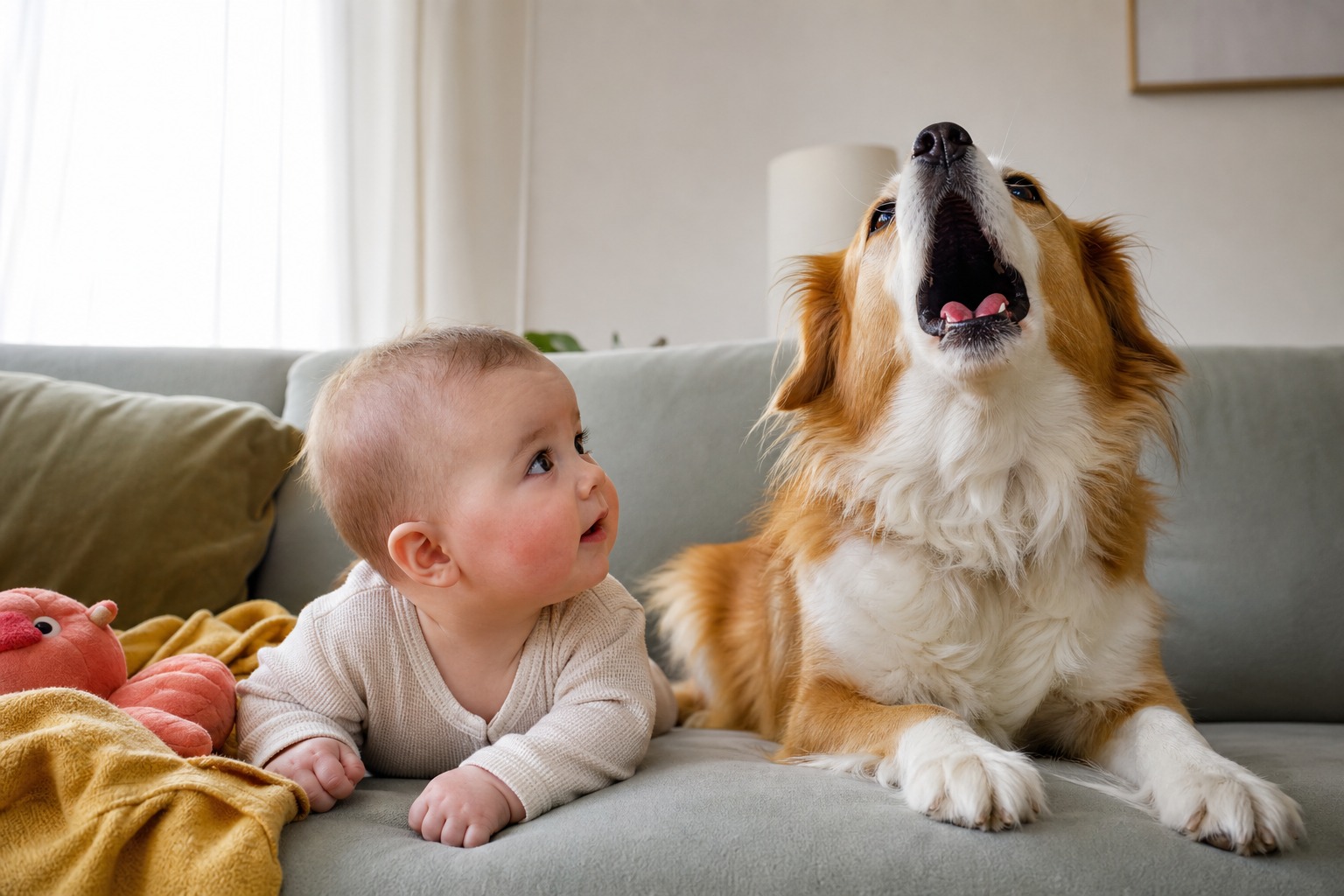
Bringing a new baby home upends everyone’s world, and that includes the dog. Suddenly there is a small, loud, unpredictable creature in the house, and one of the more startling things a new parent notices is that when the baby cries, the dog howls. If that is happening in your home, you are in good company. There is an entire genre of videos of dogs and babies wailing in duet, and what makes them so shareable is that the dog’s howling sometimes seems to calm the baby down, as if the dog were stepping in to help.
It is a lovely story. It is also almost certainly not what is going on. The truthful answer is that we usually cannot know for certain what any individual dog is thinking, and that the most likely explanations have less to do with empathy than with sound.
Why we can’t just read the dog’s mind
When you watch one of these clips, you are seeing a few seconds stripped of all context, and context is everything in behavior. To really interpret what is happening, you would need to know whether this dog and this baby usually act this way or whether it was a one-time fluke, what actually soothes that baby when no dog is involved, and what other noises set that particular dog howling. Without those pieces, any confident interpretation, sweet or otherwise, is a guess dressed up as an answer.
“People desperately want the dog to be comforting the baby, and I understand why, it’s a beautiful idea,” says Dr. Lena Park. “But dogs howl for lots of reasons that have nothing to do with sympathy. Before I’d call it empathy, I’d want to rule out the much simpler explanation: the cry is a long, loud, high sound, and howling is what plenty of dogs do in response to long, loud, high sounds.”
The likelier explanation: it’s the sound
Dogs howl for all sorts of reasons, stress, a desire to alert you, and, tellingly, as a reply to any drawn-out, loud sound, which is why so many throw their heads back at sirens, certain songs, or a wailing infant. A baby’s cry is engineered by evolution to be impossible to ignore, pitched to arrest the attention of every human within earshot, so it is no surprise it grabs a dog too. Howling is also socially contagious in canines: it is a group behavior wolves and dogs use to answer one another, so a dog joining a crying baby may simply be doing what dogs have always done when a pack-mate makes a long vocalization. In that light, the dog is not commenting on the baby’s feelings. The dog is answering a call.
The honest menu of possibilities
Because certainty is off the table, the useful thing is to hold several explanations at once. Why the baby might settle when the dog sounds off:
- The howl is soothing, and the baby genuinely enjoys it.
- The baby likes loud noise in general, and a howl qualifies.
- The howl startles the baby out of the crying jag.
- Pure coincidence: the baby was already winding down, and the dog had nothing to do with it.
Why the dog joins in at all:
- Social instinct, treating the wail as a group howl worth answering.
- Learned behavior, having noticed that howling tends to be followed by the crying stopping.
- Discomfort, preferring not to be near the noisy newcomer and voicing it.
- A call for backup, wanting a human to come handle the situation.
Any of these could be right in a given household, and a completely different reading could be the true one. The point is not to pick a winner but to resist the tidy sentimental story.
When howling becomes a problem
Most baby-and-dog howling is harmless and fades as everyone adjusts to the new normal. But if the howling is constant, escalating, or paired with signs your dog is genuinely stressed by the baby, pacing, avoiding the room, trembling, that is worth addressing rather than filming. The approach is gradual and boring, in the best way: pair the baby’s presence and sounds with good things for the dog, give the dog a calm retreat away from the noise, keep their routine as stable as you can amid the chaos, and never leave a dog and an infant together unsupervised regardless of how sweet the duet looks. If it does not settle, a certified behaviorist can help you sort out whether you are dealing with an over-vocal dog or a stressed one, which are two very different problems with two very different fixes.
This piece covers dog behavior around infants; always supervise interactions between dogs and babies, and consult a veterinarian or certified behaviorist if your dog shows signs of stress or aggression.