


Your Dog Isn't Being Rude to Strangers. They're Scared.
A dog who loves you but panics at new people isn't stubborn or badly behaved. Stranger danger has three roots, and the fix is the opposite of what most people try.

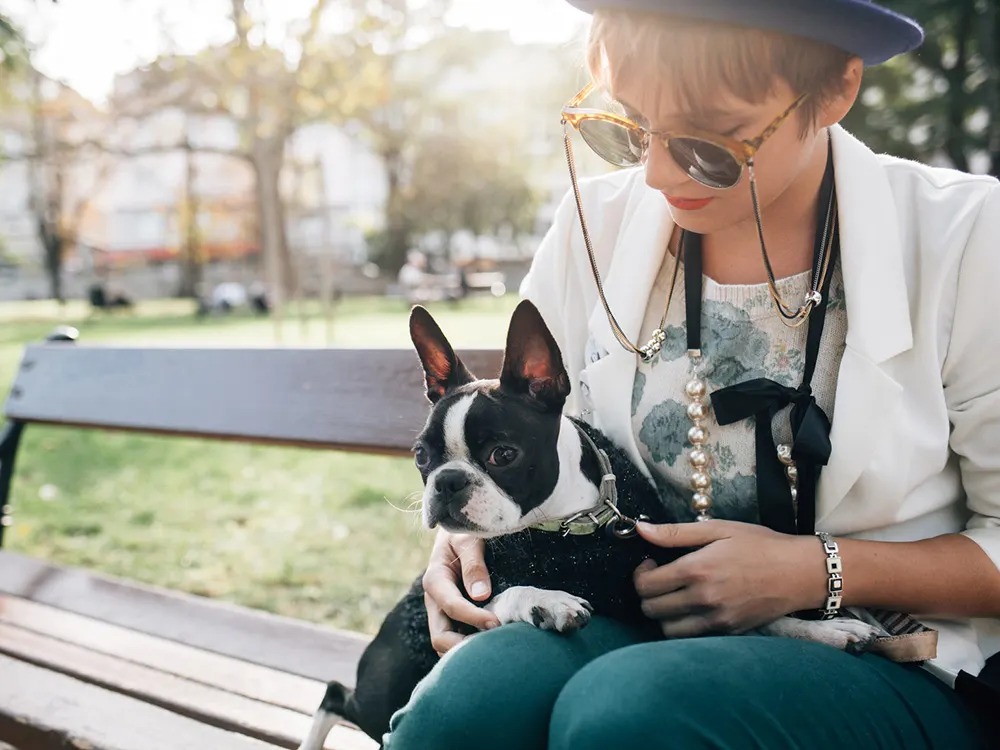
Here is the single most useful thing to understand about a dog who is sweet with you and wary of everyone new: it is not defiance, and it is not bad manners. It is fear. And once you see the behavior as fear rather than attitude, almost everything about how to help falls into place, including why the most common instinct, pushing the dog to “just say hi,” makes it worse every single time.
Plenty of dogs sort the world into two groups, familiar people and unfamiliar ones. Many happily move new people into the familiar column within minutes. But some dogs cannot make that jump easily. Strangers stay strangers, and every unfamiliar person is a source of stress. Trainers call this “stranger danger,” and it is common, in part because it has more than one cause.
Three roots, often tangled together
Dogs end up fearful of new people for three main reasons, and a given dog may have one, two, or all three in their history.
Genetics set the baseline. Some dogs are simply wired to be cautious of anything new, and others are wired to embrace it. Fearfulness travels down the family line. Breed two anxious dogs and the odds tilt toward anxious puppies, and there are whole lineages with a reputation for coming apart around people. Genes do not fully determine how a dog turns out, life experience layers on top, but they load the dice.
Inadequate socialization is the big preventable one. “Socialization” here is a technical term, not just “being social.” It means walking a puppy through as many different experiences as you can manage inside one narrow developmental window, which opens around three weeks and has largely shut by fourteen. During that period, a puppy’s brain is primed to learn that new things are safe, and a few positive encounters with different people teach that lesson almost effortlessly. Miss the window, and the dog can still learn it later, but only with far more work, and often never as completely. A helpful analogy is language: learn one as a young child and you become a native speaker; learn it as an adult and you can get fluent, but rarely without an accent. Puppies have a comparable window for social skills, including comfort with strangers.
Trauma is the third path. If a dog links people to something painful or terrifying, stranger danger can take hold, whether from a long history of mistreatment or a single bad moment. Sometimes the association is almost accidental, a new person happens to be standing there when a door slams, and the fear attaches to the person rather than the noise. And yes, some dogs are genuinely abuse survivors who keep fearing people even in a safe new home, because the trauma outlasts the abuser. It is worth knowing, though, that assuming abuse is usually wrong: poor socialization and genetic wariness are far more common explanations than cruelty.
Owners often tell me their dog ‘knows better,’ as if the fear were a choice. It isn’t. To that dog, a stranger is a genuine alarm, and every time we force an interaction, we prove the alarm right. The whole treatment rests on flipping that, on making new people reliably predict good things instead of pressure.
Learning to read the fear
Fearful dogs tell you they are afraid, but you have to know the language. Watch for a body trying to look smaller: crouching low, head down, ears back, tail lowered or tucked, back rounded. More specific signals include a closed mouth, the corners of the lips pulled back, tongue flicks, a furrowed brow, yawning, or dilated pupils. Others shake, pant, drool, or leave faint damp prints across the floor, because a dog’s sweat glands are in the feet. A dog who cannot stop moving, or cannot lie down and stay down, is telling you the same thing. And fear does not always look timid, some frightened dogs whimper and hide, while others growl and bark. The bark is not the dog being “tough”; it is the same fear pointed outward.
There are patterns to what sets these dogs off. Men frighten them more reliably than women do, and the effect sharpens if the man is tall, bearded, or speaking from somewhere down in his chest. Then there is the business of carrying: give a stranger a backpack, an armful of groceries, a chair, a rake, a broom, even a clipboard, and the same person becomes a different and worse proposition. Anything that edits a human face reads as a threat too, so add sunglasses, hats, and full masks like Halloween costumes. Interestingly, surgical masks rarely bother dogs, a quirk many trainers noted during the pandemic. When a fearful dog is also aggressive, the biting often follows a predictable script: more reactive toward strangers when close family is present, and most likely to bite when someone reaches for them, pets them, startles them, or turns their back.
The counterintuitive fix
Helping a fearful dog takes patience, gentleness, compassion, and sometimes a professional, ideally a Certified Applied Animal Behaviorist. But the approach comes down to two moves, and the first is the one people resist.
Protect the dog from what they cannot handle. Do not force the issue. Never push your dog to approach someone they fear, and never let the person approach the dog. The popular idea of proving “nothing bad happens” backfires, because to your dog, something bad did happen: they felt fear. Every forced interaction is another bad experience that deepens the problem. So even when you personally see no reason for the fear, respect it and keep your dog out of situations with people who scare them. Advocacy, not exposure, is step one.
Then expand the comfort zone slowly. Real progress comes from changing the underlying emotion, and the tool for that is classical counterconditioning: pairing the scary thing (strangers) with something the dog loves (chicken, steak), but presenting the strangers at an intensity too low to trigger fear in the first place. A person far away, or sitting down, may be below that threshold. One person is easier than several. You pair stranger-plus-treat enough times that the dog starts to expect something delicious whenever a stranger appears, and the emotional response shifts from dread to anticipation. Only then do you gradually raise the difficulty, closer distances, then two people instead of one, always staying under the threshold where fear kicks in.
That is the entire logic, and it is why the pushy approach fails and the patient one works. You are not teaching your dog to tolerate strangers through willpower. You are teaching their nervous system that new people mean good things. If your dog has stranger danger, the most important thing to hold onto is that it is common and it is improvable. Plenty of people have helped their dogs cross that line from fear to friendliness, and with the right approach, so can you.
This article covers canine behavior. For a dog who growls, snaps, or bites out of fear, work with a qualified behavior professional, since fear-based aggression carries real safety risks.
References
- Serpell, J. A., and Y. Hsu. “Effects of Breed, Sex, and Neuter Status on Trainability in Dogs.” Anthrozoös, 2005.
- Puppy socialization guidance: Croney Research Group, Purdue University Center for Animal Welfare Science.
- Rogers, M., and E. Anderson. Puppy Socialization: What It Is and How to Do It. 2021.
Dr. Park is a board-certified emergency and critical care specialist. She reviews our health and safety content for clinical accuracy and contributes guides on recognising urgent conditions. Her focus is helping owners act quickly and correctly when it matters most.
Meet our experts ↗Keep reading
 TrainingSending Your Dog to Its Crate as Punishment Ruins the One Room That's TheirsDr. Amara Solis · 7 min
 TrainingThe Tail Chase Is Cute Until You Can't Interrupt ItDr. Amara Solis · 7 min
 TrainingYour Dog Between Your Legs Is Either a Cuddle or a Cry for HelpDr. Mara Chen · 6 min
 TrainingYour Dog Isn't Throwing a Tantrum. That Word Is Hiding the Real ProblemDr. Nina Kohl · 7 min
 TrainingYour Shy Dog Isn't Antisocial. You're Fighting Two Hidden Deadlines.Dr. Mara Chen · 9 min
 TrainingYelling at Your Dog Lands in Their Body, Not Just Their EarsDr. Mara Chen · 5 min