


Your Dog Between Your Legs Is Either a Cuddle or a Cry for Help
The spot between your legs is a den your dog built out of you. Whether it means love or panic comes down to a few seconds of body language, and reading them right changes how you should respond.

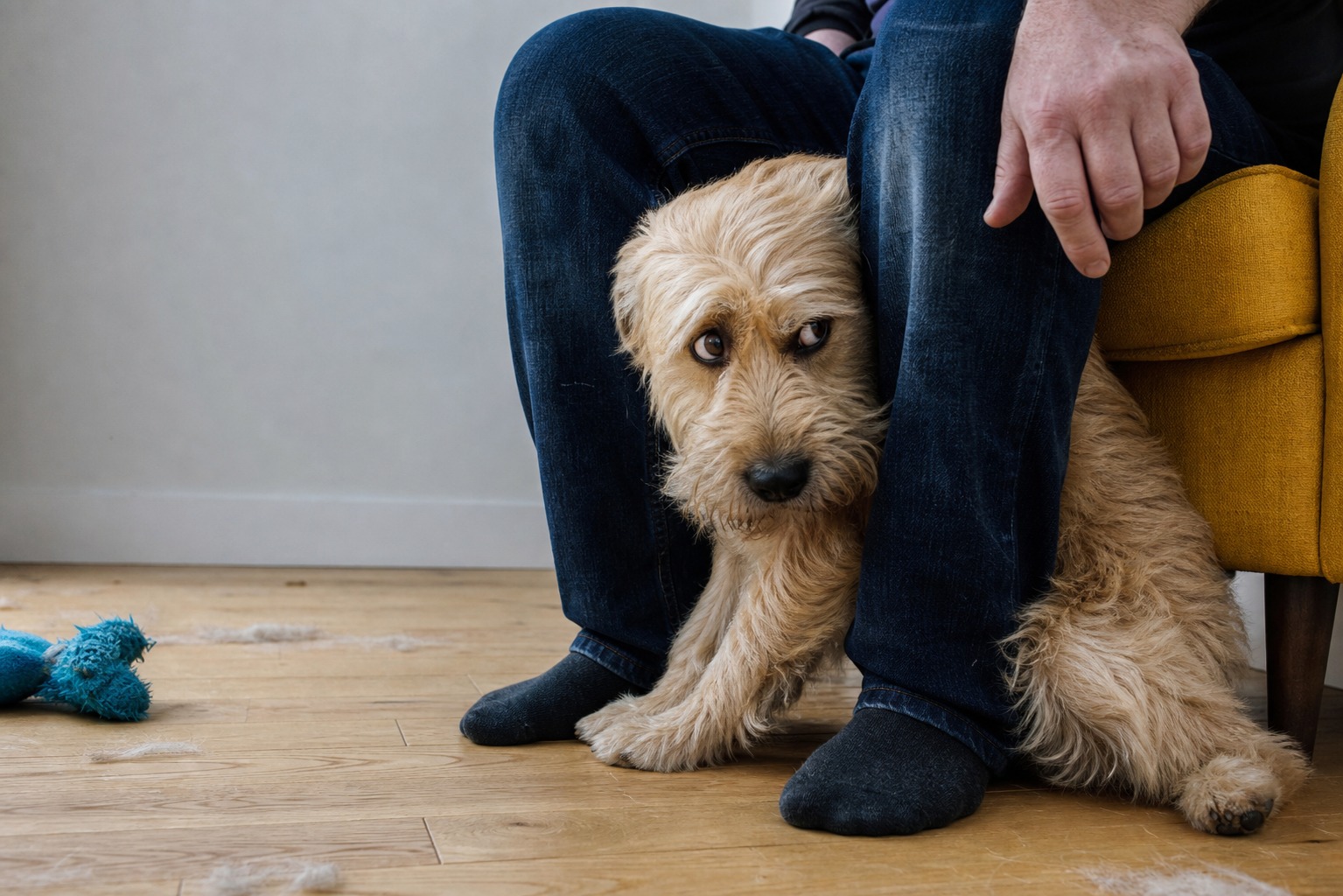
Here is the mistake almost everyone makes with this one: they treat “my dog stands between my legs” as a single behavior with a single cute explanation. It isn’t. The exact same pose, front end tucked into the tunnel your legs make, rump sticking out the back, can mean your dog is melting with affection or quietly begging you to make the scary thing stop. Same picture, opposite feelings. The whole job is telling them apart, because the right response to a happy dog and a frightened one are not the same, and getting it backwards can make a nervous dog worse.
So let’s skip the “isn’t it adorable” tour and go straight to what actually helps: read the dog, then decide whether to leave it alone, lean in, or get help.
Why your legs became a den in the first place
A dog wedged between your legs has picked the single most enclosed, most you-scented spot in the room. That’s not random. Dogs are den animals, and a tight three-sided space with a familiar body around it hits something old in their wiring. When a dog does this, they’re usually doing one of two things: coming toward you for something good, or backing into you for shelter. Sort every case into “approach” or “retreat” first, and the rest gets easy.
The happy version: approach
If your dog trots over, threads between your legs, and the tail is loose and swinging, ears in a neutral or relaxed position, mouth soft, maybe a full-body wiggle, this is the good kind. It shows up in a few flavors:
Some dogs do it as plain affection and attention-seeking. You walked in the door, they’re thrilled, and the between-the-legs move is a hug they can give with their whole body. Some do it for contact comfort, the canine equivalent of leaning on someone you trust. And smaller or short-coated dogs sometimes do it for literal warmth when it’s cold out, especially paired with shivering or a hunched posture.
None of that needs fixing. A dog who seeks you out as a safe, warm, good place is paying you a compliment.
The worried version: retreat
Now the one that matters more. If your dog backs into the space, tail tucked low or clamped, head down, ears pinned, maybe whining, pacing, panting, or trembling, this is not a cuddle. It’s a dog using you as a bunker. The trigger is usually obvious once you look for it: a garbage truck, thunder, fireworks, a stranger, a vacuum. Your dog has decided you are the safest object in the environment and is physically hiding behind you.
There’s also a quieter cousin of this: some dogs plant themselves between your legs and go still and stiff when a person or another dog approaches, sometimes with a low growl. That’s not fear seeking comfort, that’s a dog guarding you from that spot. It’s worth taking seriously, because a dog who feels cornered while also feeling protective is a dog who might snap. A hard rule that prevents a lot of bites: never let anyone reach in to pet a dog while the dog is tucked between your legs. Let the dog come out and choose the greeting.
Should you let it happen?
If it’s the happy version and it isn’t causing problems, do nothing. Genuinely. This can strengthen your bond, and trainers even teach the pose on purpose. The cue is often called “middle,” and a dog who will slot between your legs on command has a portable safe spot you can use in a crowded elevator, at a busy vet lobby, or anywhere you need them tucked close and steady.
You’d want to gently discourage it when it becomes a tripping hazard, when a large dog does it constantly and you can’t move, or when it’s the fear or guarding version, because in those cases the pose is a symptom and you want to treat the cause, not just the posture.
What newer research adds
It helps to know your dog isn’t just being clingy, they may be using you the way a toddler uses a parent. Behavior researchers describe dogs relating to their owners through a “secure base effect”: with their person present, dogs explore more boldly, recover from frightening things faster, and work harder at problems, and they show more stress signals when the person leaves. A dog diving between your legs during a thunderstorm is that effect made visible. Your presence is doing real physiological work to calm them.
That reframes the fix. You don’t want to punish a scared dog for running to their safe base, and you don’t want to flood them with the scary thing either. You want to make the base sturdier and slowly teach them the trigger isn’t worth panicking over.
How to shift the behavior, gently
For the attention or habit version, the classic approach is to stop rewarding the pose and start rewarding the alternative. When your dog picks a spot beside you instead of on top of you, that’s when the praise, the treat, and the affection show up. You can also simply make the tunnel unavailable by sitting or closing your stance, so the behavior quietly loses its payoff.
For the fear version, the work is different and slower. Build your dog’s confidence with consistent, reward-based training, plenty of physical exercise, and a predictable routine, and give them a real safe space of their own, a bed or crate they can retreat to. Then, if a specific trigger sets them off, that’s the thing to work on directly.
When a dog keeps burrowing between someone’s legs, the pose isn’t the problem I’m trying to fix, it’s the message. A loose, wiggly dog is telling you they adore you, and I’d leave that alone. A tucked, trembling dog is telling you the world got too big, and punishing that just teaches them their safest place isn’t safe either. I’d rather build the dog up until they don’t need the bunker.
When to bring in a professional
Call in help when the between-the-legs behavior comes with real, ongoing fear, when your dog guards you from that position, or when it’s tipping into aggression. A veterinarian can rule out pain or a medical driver and, if needed, talk through anxiety support, and a certified behavior consultant can build a desensitization plan for the specific triggers. And if it’s simply becoming a daily nuisance or a genuine safety risk for a big dog and a small hallway, that’s reason enough to get coaching. The goal isn’t to stop your dog from loving you. It’s to make sure the love, and not the fear, is what’s driving them into that spot.
References
- Horn, Lisa, et al. “The Importance of the Secure Base Effect for Domestic Dogs.” PLOS ONE, vol. 8, no. 5, 2013, e65296. https://doi.org/10.1371/journal.pone.0065296
- American Veterinary Society of Animal Behavior. “Position Statement on Punishment.” avsab.org. Accessed July 2026.
- ASPCA. “Fear of People.” aspca.org. Accessed July 2026.
Dr. Chen is a small-animal veterinarian who leads health and safety coverage at The Pet Times. She writes and reviews the bulk of our illness, condition, and safety content, translating clinical guidance into clear, practical advice owners can act on at home.
Meet our experts ↗Keep reading
 TrainingYour Dog Isn't Antisocial. They're an Introvert.Dr. Nina Kohl · 6 min
 TrainingThat Playful Puff of Air in Your Dog's Face? They Read It as a Threat.Dr. Nina Kohl · 6 min
 TrainingYour Dog Isn't Holding a Grudge. Their Fear Memory Just Works DifferentlyDr. Amara Solis · 8 min
 TrainingStop Telling Yourself Your Dog Was AbusedDr. Nina Kohl · 8 min
 TrainingYour Dog Isn't Misbehaving. They're Scared.Dr. Lena Park · 8 min
 TrainingYour 'Stubborn' Dog Is Actually Terrified. Here's What to Do.Dr. Nina Kohl · 10 min