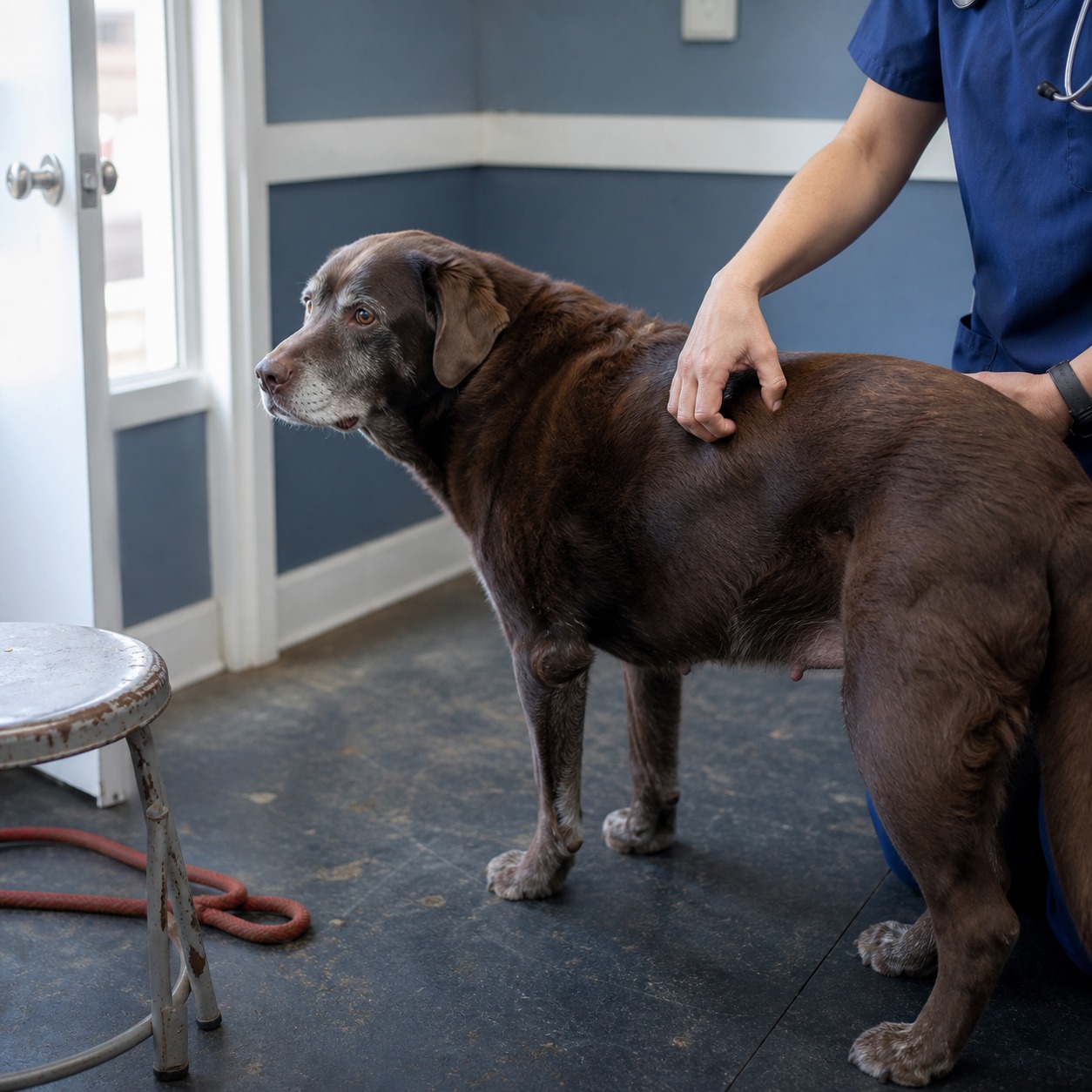
You are scratching your dog’s back, half watching something else, and your fingers stop. There is a lump there that was not there before. It is soft. It moves under the skin. Nothing about your dog seems wrong.
The internet will tell you within about four seconds that it is probably a fatty tumor, and statistically the internet is probably right. That is exactly the problem.
A lipoma is soft, squishy, and mobile. So are several things that are not lipomas, and some of them are cancer. No one can tell the difference by touch. Not you, and not your vet. That single fact is the whole point of this article, because it is the one that changes what you do next.
Why feel is not a diagnosis
Lipomas are benign tumors made of fat. They sit under the skin, feel soft and usually squishy, and are common in middle-aged and older dogs. Most need no treatment at all as long as they stay small and slow-growing.
But other tumors can look and feel almost identical, and some of them are malignant, which means an aggressive treatment plan and a very different conversation. A mast cell tumor is the classic impersonator: it can present as something that feels like an innocent fatty lump, and it can even change size from day to day.
That is why a visual and manual exam is not enough, and why any vet telling you “that’s just a fatty lump” without touching a needle is guessing, however experienced they are.
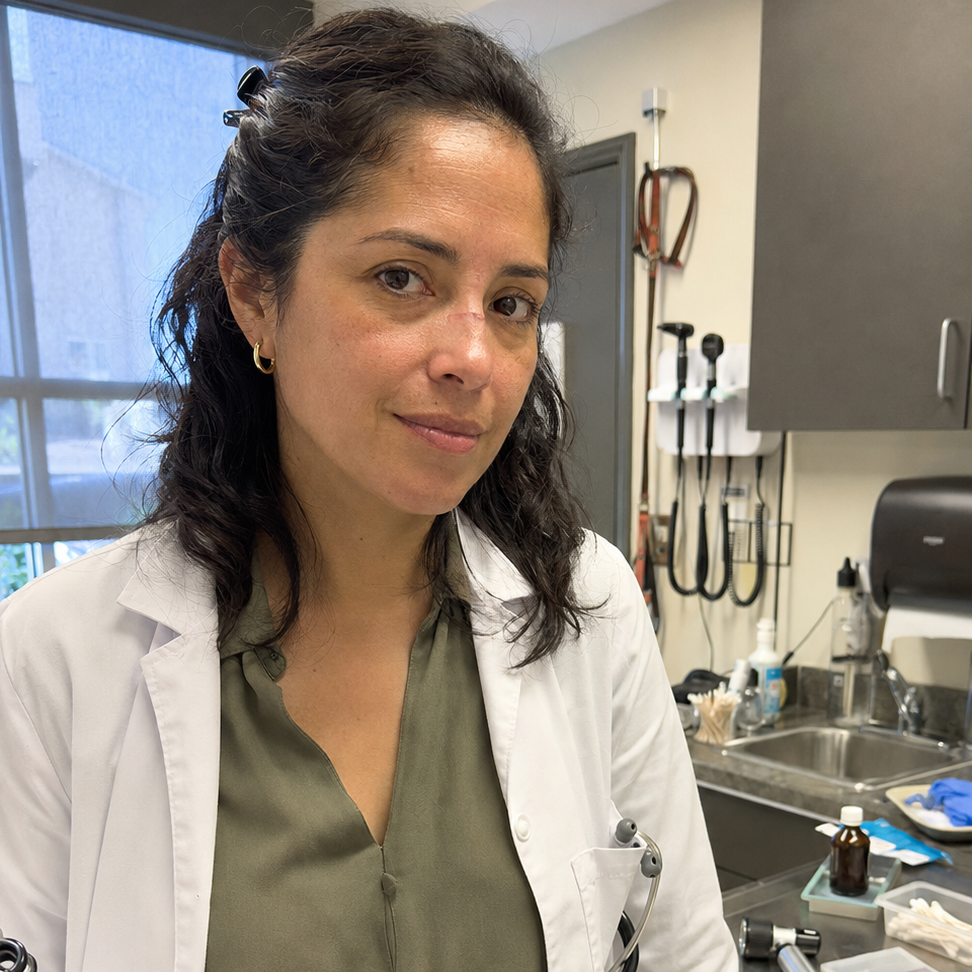
“The single most common thing I have to unlearn with owners is the idea that squishy means safe,” says Dr. Amara Solis. “Squishy means squishy. The needle is not me being cautious, it is me actually answering the question, and it takes about as long as taking your dog’s temperature.”
What the needle actually does
The tool is a fine needle aspirate, or FNA. Your vet puts a small needle into the lump, draws a sample of cells, puts them on a slide, and looks at them under a microscope, or sends them to a pathologist.
It is quick, it usually needs no sedation, and it is often done in the room while you wait. For many lumps it gives a clear answer the same day.
Where the answer is unclear, or where the cells look concerning, the next step is a biopsy, which takes an actual piece of tissue and gives a definitive diagnosis and, for a tumor, a grade.
That is the entire escalation ladder, and it is short: feel it, aspirate it, biopsy it if needed. There is no legitimate rung between “I felt it” and “we know what it is.”
Where lipomas sit in the picture
Some numbers, because they help calibrate the worry.
In a large study of UK dogs under primary veterinary care, drawn from 384,284 dogs across 215 clinics, the one-year prevalence of lipoma was 1.94%. So they are common enough that most owners will meet one, and not so common that a new lump is automatically one.
Breed changes the odds substantially:
| Breed | One-year lipoma prevalence |
|---|---|
| Weimaraner | 7.84% |
| Dobermann Pinscher | 6.96% |
| German Pointer | 5.23% |
| Springer Spaniel | 5.19% |
| Labrador Retriever | 5.15% |
| All dogs | 1.94% |
If you have a middle-aged Weimaraner, a new soft lump on the back is likely to be a lipoma. Likely is not the same as confirmed, and this is exactly the population where complacency does its damage, because owners of lump-prone breeds get used to lumps.
One more caution: lipomas are usually soft, but some are firmer than others. A growth that feels hard should be examined. And a lump previously confirmed as a lipoma that suddenly looks or feels different needs rechecking, because the diagnosis was true on the day it was made, not forever.
Everything else it could be
The category “lump on a dog’s back” covers a lot of ground, and where the lump sits relative to the skin is your first clue. Is it on the skin, in the skin, or under it? Is there hair loss, redness, or scabbing on the surface, which points at a skin problem, or is the coat perfectly normal over a bump you can only feel, which points underneath?
Skin tags. A loose term for growths that seem to hang off the skin surface. The medical names behind them include sebaceous gland adenomas, acrochordons, sebaceous cysts, apocrine cysts, and follicular cysts, each with different characteristics. And each can be impersonated by something malignant. Pigmented growths that appear black, blue-ish, or dark red should always be biopsied, because while many pigmented masses are benign, melanoma is not.
Hives. An allergic reaction producing round, flat or domed swellings across the skin, sometimes itchy and sometimes not. They can follow contact with a plant or chemical, or a reaction to a food or medication. Hives should be treated by a vet promptly, because they can be the visible edge of a more serious allergic reaction.
Ticks. An embedded tick genuinely feels like a small growth. Check before you panic.
Fleas. Too small to feel as bumps themselves, but the irritation they cause produces bumps and scabs across an infested dog.
Insect bites and stings. Usually resolve on their own. Sometimes they trigger a swelling reaction that needs treatment same-day.
Skin infections. Very common in dogs with allergies or an underlying skin condition. Look for itch, odor, redness, bumps, and scabs together. These need treatment, and often ongoing management of the underlying problem.
Tumors, benign and malignant. The whole reason the FNA exists.
Other conditions worth knowing. Older dogs with Cushing’s disease can develop mineralized bumps called calcinosis cutis, along with comedones, which are essentially blackheads. Autoimmune disease can cause vasculitis and the scabbing that comes with it. Repeated minor trauma can leave scars and tag-like growths. Viral papillomas are warts.
Yes, dogs can get pimples. “Pimple” covers pustules from infection, blocked follicles, and comedones, and treating the wrong one is how a minor skin problem becomes a chronic one.
What to actually do
- Write it down the day you find it. Date, location, size (use a coin or a ruler), texture, and whether it moves. This is the most useful thing you will do, because change over time is the signal.
- Photograph it with something for scale. Memory is a poor instrument, and “I think it’s a bit bigger” is not evidence.
- Book the appointment. Not urgently, unless the lump appeared suddenly, is growing quickly, is hot, painful, ulcerated, or bleeding, or your dog is otherwise unwell. Those go now.
- Ask for an aspirate. If you take one sentence from this article into the exam room, make it that one.
- Do not squeeze it, pop it, or drain it. You cannot diagnose a lump by rupturing it, and you can make a real mess of a tumor you were about to get answers on.
What newer research adds
The most useful recent work here is about management, and it should be reassuring.
Primary-care studies of how lipomas are actually handled in the real world support a conservative approach for most cases: many lipomas are monitored rather than removed, and dogs do fine. Surgery is reserved for lumps that grow quickly, sit in an awkward place, or interfere with movement and comfort. So a confirmed lipoma is not automatically a scalpel.
But that whole conservative approach only works because the lump was confirmed. Every “watch and wait” recommendation in the literature rests on a lump that has been aspirated and identified. Applied to an unidentified lump, “watch and wait” is not a clinical strategy, it is a delay.
Which loops back to the one thing worth remembering. The lump on your dog’s back is most likely fat. The needle is how you earn the right to relax about it.
References
- Lipoma in dogs under primary veterinary care in the UK: prevalence and breed associations — Canine Genetics and Epidemiology, 2018
- Clinical management of lipomas in dogs under primary care in the UK — Veterinary Record, 2020
- Mast Cell Tumors in Dogs — Merck Veterinary Manual
- Urticaria (Hives, Wheals) in Animals — Merck Veterinary Manual
- Cushing Disease (Hyperadrenocorticism) in Animals — Merck Veterinary Manual