


Your Cat Is Talking Nonstop. Most of It Isn't Aimed at You.
Cats run a constant broadcast across four channels, body, voice, scent, and touch. Learn to read them and your 'mysterious' cat suddenly makes a lot more sense.

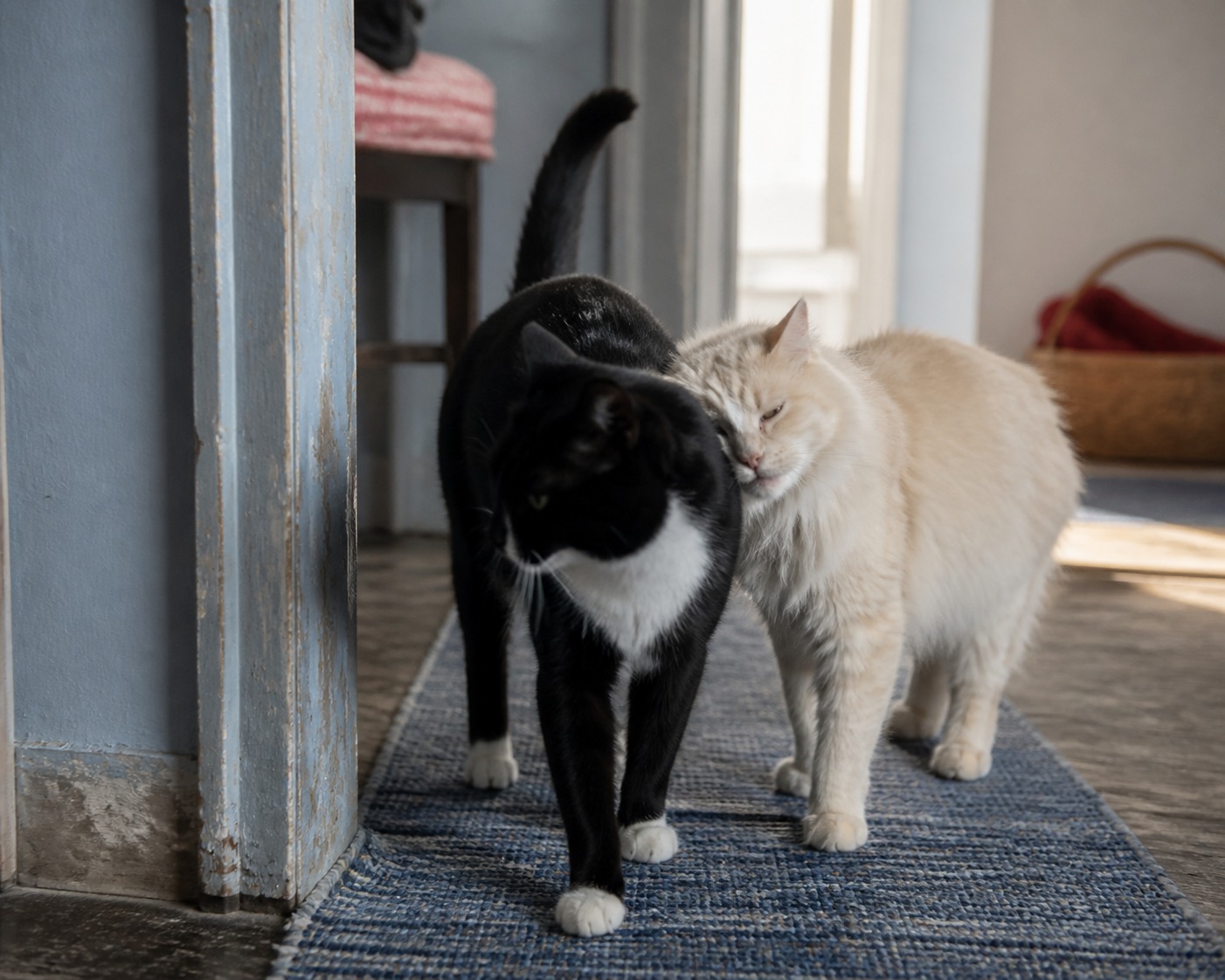
We like to call cats mysterious. It is a compliment and a bit of a cop-out, because the truth is that cats are not being secretive at all. They are communicating almost constantly, in a rich, layered language, and we simply were not taught to read it. Your cat is broadcasting their mood, their intentions, and their claim on the couch all day long. Learn the channels and the mystery mostly evaporates.
And here is the reframe worth holding onto: much of that language evolved for other cats, not for you. Cats developed these signals to manage encounters with rivals, threats, and companions long before they moved in with humans. The remarkable thing is that they have since learned to aim a chunk of it at us, too. So when you decode your cat, you are eavesdropping on a conversation that was originally meant for their own kind.
They run that conversation on four channels at once: body, voice, scent, and touch. Let’s take them in the order a cat actually leans on them, starting with the one you can watch from across the room.
Channel one: the body
A cat’s body is expressive from ear tip to tail tip, and the pieces work together. Read them as a set, not one at a time.
The tail is the loudest signal your cat has. Held up, sometimes with a little hook or quiver at the tip, it means a friendly, happy hello. Held out horizontal, your cat is curious and interested, and a big relaxed swish of that horizontal tail usually means a content, affectionate cat. A tail pointing down toward the ground leans worried. A low or horizontal tail twitching in a sharp, agitated way is an early warning that your cat is getting annoyed. And the classic bottle-brush, puffed-up tail signals fear or aggression, the cat trying to look bigger, though a wound-up cat mid-play will sometimes puff up in fun.
The ears swivel like little satellite dishes. Forward and perked means a happy, engaged cat. Turning to the sides can signal irritation, and during petting or play it is often a heads-up that your cat is getting overstimulated and needs a pause. Ears pinned flat and back, sometimes called airplane ears, mean real, intense fear, so remove whatever is triggering it if you can. As always, keep context in mind; a cat may flatten its ears slightly while zeroing in on a toy.
The eyes carry a surprising amount. Soft, relaxed eyes, maybe with a slow blink, are the look of a comfortable cat. Wide, saucer-like dilated pupils mean intensity, which could be fear or anxiety, or the fixed focus of a cat stalking prey. Narrowed, constricted pupils can accompany aggression. When you are unsure how a cat feels, the eyes are one of your best tells.
The whole posture rounds it out. A relaxed cat stretches long, rolls over, drapes around you, head-bunts, and kneads. A frightened or aggressive one goes to extremes: fur standing on end (piloerection, the Halloween-cat look), an arched back, a sideways hop to look bigger, or the opposite, tucked and crouched and small, avoiding eye contact. And a warning about the belly, because this one gets people bitten: an exposed belly is sometimes an invitation for rubs, but flopping onto the back with all four paws up is also a prime defensive posture, claws and teeth ready. With a cat you do not know well, admire the belly, do not grab it.
Channel two: the voice
Vocalizations are the channel cats aim most deliberately at us.
Meowing is, surprisingly, mostly a human-directed behavior in adults. Adult cats rarely meow to each other; the meow belongs to the kitten-and-mother relationship, and cats grow out of using it with other cats. But they learned early that we respond to their voices, so they kept, and customized, an assortment of meows just for people. When your cat “talks” to you, that is a tool they developed specifically for the human in the house.
Purring reads as pure contentment, and often it is, but not always. Cats also purr when they are frightened or stressed, apparently for self-soothing, and when they are in pain. There is evidence that the specific frequencies in a purr can have a genuine healing effect on the body, so a purr can be a cat comforting and even mending itself, not only signaling bliss.
Hissing, growling, and yowling all live in the warning category. These sounds are a cat asking for space, trying to put distance between themselves and whatever is worrying or scaring them. Listen to them; they are the polite version of a swat.
Channel three: scent
Here is the channel humans are nearly blind to, and cats depend on constantly. A cat’s body carries scent glands, and the pheromones they release are richer than plain smell, encoding who the cat is, where they have been, their reproductive status, and how they feel.
Scent marking happens when a cat rubs the glands on their face, head, feet, and the base of the tail against people, furniture, doorframes, and each other, leaving a friendly chemical calling card. That cheek rub on the table leg is a message, not an itch.
Spraying, or urine marking, is the same idea turned up to an unmistakable volume, and it is the one owners hate, because the scent is potent and hard to remove. A cat backs up to a surface, lifts and quivers the tail, and deposits a mix of urine and pheromones. Cats can also use regular feces to mark territory, a behavior called middening. Frustrating as it is, it is communication, not spite.
Channel four: touch
The last channel is physical contact, and it is where affection lives most plainly.
Grooming each other, and sometimes grooming you, is a bonding behavior that starts between mothers and kittens and continues into adulthood. Beyond affection, it mingles everyone’s scent into a shared “group smell” that says we belong together.
Head-bumping, officially called bunting, spreads facial pheromones while delivering a gentle nudge of affection. A cat who bonks their forehead into your hand is claiming you, kindly, and marking you as theirs.
Play-fighting is a bonding ritual too, provided both cats are genuinely into it, the same rough-and-tumble kittens do with littermates, sometimes roping in a patient family dog.
Once people stop trying to read a cat one gesture at a time and start reading all four channels together, the tail, the ears, the eyes, the scent-rubbing, the whole animal snaps into focus. A cat is not being cryptic. It is speaking a language most owners were simply never taught.
What’s new since this was written: cats have hundreds of expressions
We are only beginning to grasp how fine-grained feline communication really is. In a study published in 2023, researchers spent a year recording a colony of about 50 cats at a cat café and documented 276 distinct facial expressions, built from 26 individual muscle movements combined in different ways, with each expression typically drawing on about four of those movements at once. Nearly half of the expressions they coded were friendly and a bit over a third were aggressive.
The researchers suspect this range grew out of cats’ long coexistence with humans, another sign that domestication reshaped how cats signal. The practical lesson for you is humbling and hopeful at the same time: your cat’s face alone carries far more information than most of us ever notice. Watch the whole animal across all four channels, and you will find your “mysterious” cat has been telling you exactly how they feel all along.
References
- Scott, Lauren, and Brittany N. Florkiewicz. “Feline Faces: Unraveling the Social Function of Domestic Cat Facial Signals.” Behavioural Processes, vol. 213, 2023, 104959. https://doi.org/10.1016/j.beproc.2023.104959
- International Cat Care. “Understanding Feline Language.” https://icatcare.org/advice/understanding-your-cat/
Dr. Chen is a small-animal veterinarian who leads health and safety coverage at The Pet Times. She writes and reviews the bulk of our illness, condition, and safety content, translating clinical guidance into clear, practical advice owners can act on at home.
Meet our experts ↗Keep reading
 LivingMy Cat Has Never Once Felt Awkward. I'm Taking Notes.Sasha Ford · 5 min
 TrainingYour Cat Knows Its Roommate's Name. It Just Won't Perform for You.Dr. Nina Kohl · 4 min
 TrainingYour Cat Isn't Nocturnal. They're Running on Your ClockDr. Lena Park · 8 min
 LivingYou Bought the Bed. She Sleeps in the Drawer. She's Not Being Rude.Dr. Nina Kohl · 6 min
 TrainingYour Cat Holds a Picture of You in Their Head, Even When You Leave the RoomDr. Mara Chen · 4 min
 TrainingThe Cat-Stress Study's Real Twist: Knowing Isn't the ProblemDr. Nina Kohl · 5 min