


That Old Sweater Isn't Comforting Your Cat. It's Just Soft.
Cats can absolutely smell you on the laundry. Researchers keep finding that it does not calm them down. Here is what your scent actually does, and what genuinely settles a nervous cat instead.

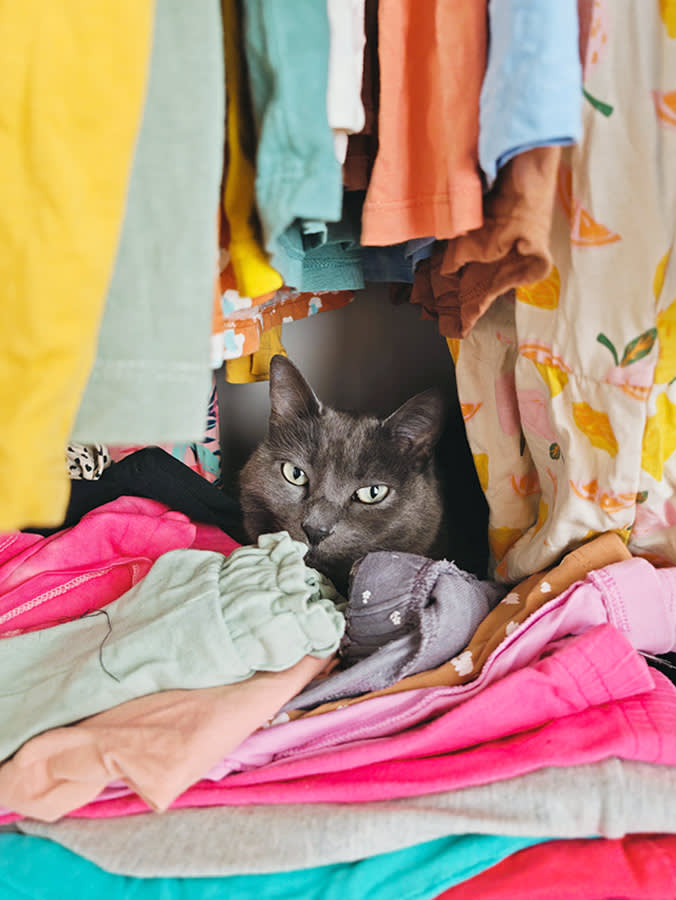
Somewhere in your house right now there may be a deliberately abandoned sweatshirt. You left it on the bed before a work trip, or on the couch before a long day, on the theory that your cat would curl into it and feel less alone. It is a kind gesture. It is also, according to the research, mostly for you.
The best evidence we have says the same thing from two directions: your cat can smell you perfectly well, and smelling you does not appear to calm them down. Your scent is not a hug. It is a name tag. It tells your cat who you are, it does not tell them that everything is fine.
That distinction sounds like a downgrade. It is not. Once you stop expecting your laundry to do emotional work, you can spend that effort on the things that actually settle a cat, and those things are surprisingly concrete.
The study that took the sweater away
Researchers publishing in Applied Animal Behaviour Science in October 2021 set out to test a comfortable assumption. They were looking for what attachment researchers call the Secure Base Effect: the ability of an animal to use a bonded caregiver, or some familiar stand-in, as a source of security when the world gets strange.
Forty-two adult cats went into an unfamiliar room under three conditions. Their person was there. Their person was gone. Or their person was gone and a scent object, something carrying the human’s smell, was there instead.
The first result was the sweet one. With their person in the room, cats showed fewer stress behaviors, even in a place they had never been. You, in the flesh, are a genuine calming presence.
The second result was the one that torpedoes the sweatshirt. Alone with the scent object, the cats were not measurably better off. There was no significant drop in stress vocalizations. In some cases the object seemed to make things slightly worse.
And there is a third finding people tend to skip past, because it stings a little: only about half the cats showed the Secure Base Effect even with their actual human present. Attachment in cats is real, but it is not universal, and it is not owed to you.
Why smell can identify you without soothing you
Cats are scent creatures. They read the world through their noses, they read each other through their noses, and they read you the same way. When your cat headbutts your shin and rubs the length of their body along you, they are doing something behaviorists call allorubbing: mixing scent, filing you under “mine,” and folding you into the territory.
That is exactly why the scent-object result surprises people. If smell is how a cat identifies safety, a shirt that smells like you should be a portable safe zone.
But look at where cats learn that lesson. Separation work with kittens found that distress vocalizations start as soon as a kitten is taken out of the nest, and increase the farther away they get. The nest, thick with the smell of mother and littermates, functions as an olfactory secure base. The key detail is that the nest is a place. It is a location the kitten can return to, with warmth and bodies and food in it. A cardigan on a couch is a smell with nothing behind it.
Your smell tells a cat you exist, not that you are coming back. The nose confirms an identity. It cannot make a promise. That is why the sweater underperforms and the routine overperforms.
Two fair objections to the study
Take the finding seriously, but do not take it as the last word. The design has two soft spots worth naming.
The scent object was carried into the room by a research assistant the cat had never met. A stranger walking into an unfamiliar space is its own stressor, and it landed at exactly the moment the comfort object arrived.
And the observation windows were short, a few minutes each. A cat dropped into a new room spends the opening minutes doing threat assessment, not seeking comfort. Given hours instead of minutes, some of those cats might well have wandered over to the object and settled on it. Short tests catch vigilance. They are not built to catch slow self-soothing.
So the honest summary is narrower than the headline: your scent, delivered by a stranger, in a strange room, over a few minutes, does not visibly calm a cat. That is worth knowing. It is not proof that your smell means nothing.
What newer research adds
Two things have landed since that study, and together they sharpen the picture.
In May 2025, a team at Tokyo University of Agriculture published work in PLOS One showing that cats really can tell you apart from a stranger by smell alone. Thirty pet cats were offered tubes holding a swab of their owner’s odor, a stranger’s odor, and nothing at all. The cats spent noticeably longer sniffing the stranger. That is the classic fingerprint of recognition: the familiar smell needs less investigation. The researchers also caught a curious detail, a nostril bias, with cats tending to lead with the right nostril on a new odor and drift to the left as it became familiar.
Put the two studies side by side and the story is no longer “your cat cannot smell you.” It is sharper and slightly funnier than that. Your cat knows exactly which shirt is yours. Your cat is simply not comforted by it.
The other addition, from a 2024 secure base test comparing owned and shelter cats, points the same way: the security a cat draws from a person is variable, individual, and shaped by history. Some cats have it, some do not, and no piece of clothing installs it.
What actually calms a cat
Here is the practical translation, and it is the reason the sweater question matters at all. If your cat is unsettled by a move, a renovation, a new baby, or your long days out, the useful levers are territorial and behavioral, not olfactory.
Shrink the world before you expand it. Give a nervous or newly arrived cat one room, not a house. It feels cruel. It is the opposite. A cat who can see the entire room from where they are sitting can stop scanning. Think about how you would rather hide in a one-room cabin than a three-story house, where the fear is in the unchecked rooms. Once they are relaxed there, open the next door.
Use the cat’s scent, not yours. Their bedding, their scratching post, their toys, a scoop of their used litter transferred into the new box. Cats build safety out of their own signature, which is why they spend so much of the day reapplying it to your furniture.
Make the day predictable. Same feeding times, same play window, same bedtime. Routine is the closest thing to a promise a cat can actually read.
Burn energy on purpose. Wand play to the point of real panting-adjacent effort, food puzzles, a window perch with a bird feeder outside it. Enrichment is not decoration. It is the thing that turns a hypervigilant cat into a tired one.
Keep the environment quiet while they adjust. Fewer visitors, less noise, no forced socializing.
When it is not anxiety at all
One threshold worth holding onto. If your cat’s departure-time distress includes any of the following, book a vet visit before you buy a single calming product:
- Straining in the litter box, blood in the urine, or crying while urinating. In male cats especially, urinary blockage is an emergency, not a mood.
- Peeing outside the box that appears suddenly in an otherwise settled cat.
- Weight loss, ravenous appetite, or new night-time yowling, particularly in a cat over ten.
- Any distress behavior that starts abruptly with no change in the household.
Separation-related behavior is a diagnosis of exclusion, not a first guess. Pain and urinary disease imitate it beautifully. Rule out the body before you start treating the feelings.
Genuine separation-related distress in cats does exist, and it responds to the same things everything else responds to: enrichment, predictability, gradual desensitization to your departure cues, and in some cases medication prescribed by your vet.
So should you leave the sweatshirt out?
Sure. It costs you nothing, it hurts nothing, and if you come home to find your cat asleep on it, enjoy that.
Just be honest with yourself about why they are lying there. It is warm, it is soft, it is on the good chair, and it holds a shape. The evidence says that is roughly the extent of it.
Your cat knows your smell. What they want is not the smell. It is you, back, at the usual time, doing the usual things. Nothing in the laundry basket substitutes for that, and there is something quietly flattering in the fact that nothing does.
References
- Behnke, A. C., Vitale, K. R., & Udell, M. A. R. (2021). The effect of owner presence and scent on stress resilience in cats. Applied Animal Behaviour Science, 243, 105444.
- Miyairi, Y., et al. (2025). Behavioral responses of domestic cats to human odor. PLOS One, 20(5), e0324016.
- Bonzom, C., et al. (2024). Cat behaviour in the secure base test: Comparison between owned and shelter animals. Behavioural Processes.
- Vitale Shreve, K. R., Mehrkam, L. R., & Udell, M. A. R. (2017). Social interaction, food, scent or toys? A formal assessment of domestic pet and shelter cat (Felis silvestris catus) preferences. Behavioural Processes, 141, 322-328.
Common questions
Is it bad to leave a worn shirt out for my cat?
No. It will not hurt anything, and some cats clearly enjoy sleeping on soft, familiar-smelling fabric. It just should not be your whole plan for a cat who is anxious when you are gone, because the evidence that your scent lowers stress on its own is thin.
Can cats actually recognize my smell?
Yes. A 2025 study in PLOS One found that cats sniffed the odor of a stranger noticeably longer than they sniffed their own person's odor, which is the classic signature of recognition: the familiar smell needs less investigating. Recognition and reassurance are simply two different things.
What does calm a cat down when I am away?
Structure and territory, mostly. A small, fully surveyable safe room with litter, food, water, and hiding spots, a predictable daily routine, food puzzles and play that burn real energy, and time. In a new home, expand the cat's territory only as fast as their confidence grows.
My cat cries, paces, or has accidents whenever I leave. Is that separation anxiety?
It might be, and it might also be a medical problem wearing a behavioral costume. Urinary trouble, pain, hyperthyroidism, and cognitive decline in older cats can all look like distress at departure. Get a vet to rule those out before you treat it as an emotional problem.
Dr. Chen is a small-animal veterinarian who leads health and safety coverage at The Pet Times. She writes and reviews the bulk of our illness, condition, and safety content, translating clinical guidance into clear, practical advice owners can act on at home.
Meet our experts ↗Keep reading
 LivingOne Cat Tree Isn't Enough. The Rule Is One Per Room.Dr. Amara Solis · 6 min
 First DaysBringing a Cat Into a Dog's House? The Dog Is Your Real Project.Dr. Nina Kohl · 7 min
 Health & WellnessBringing an Outdoor Cat Inside Isn't Cruel. Doing It All at Once Is.Dr. Nina Kohl · 8 min
 LivingYour Cat Isn't Jealous of Your Sex Life. It's Mad About the Door.Dr. Priya Nair · 5 min
 LivingYour Cat Isn't Trying to Cuddle. They're Doing Math.Dr. Nina Kohl · 6 min
 LivingYou Bought the Bed. She Sleeps in the Drawer. She's Not Being Rude.Dr. Nina Kohl · 6 min