


Bringing an Outdoor Cat Inside Isn't Cruel. Doing It All at Once Is.
The mistake is not the decision. It is the doorway. A cat who has run the neighborhood for years cannot be handed a whole house on day one, and the fix is smaller and stranger than you think: one room.

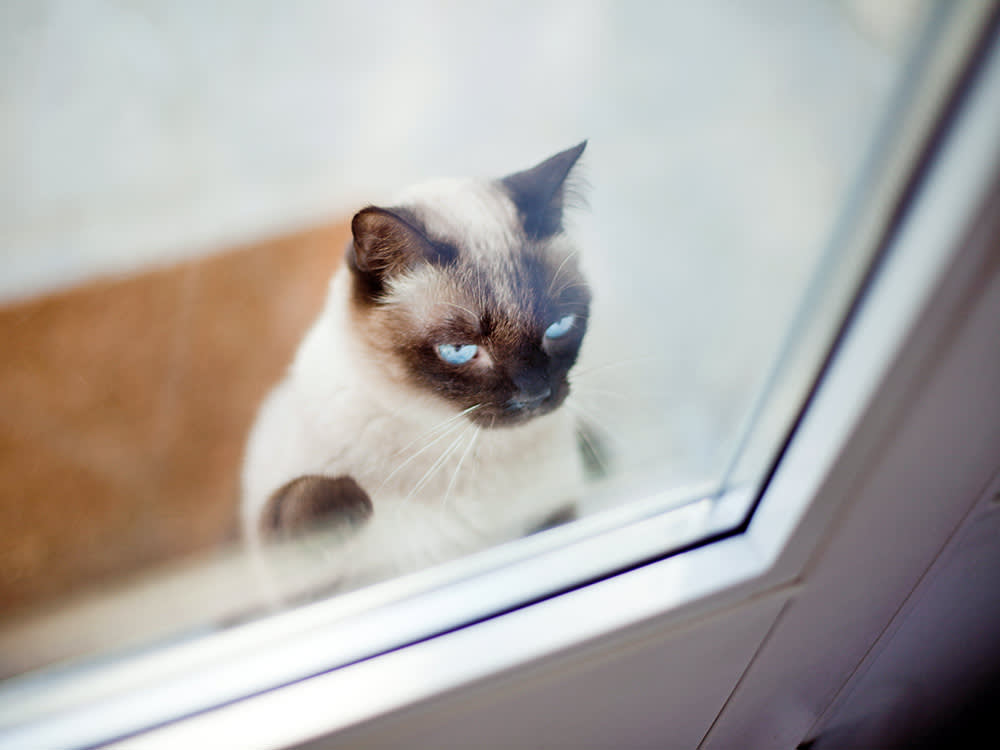
The decision is usually made in a hurry, and usually because of something frightening. A neighbor’s cat gets hit by a car. A coyote turns up on a doorbell camera. Or, lately, a bird lands on the back step and you find yourself calculating things you never used to calculate.
So you bring your cat in. And then, forty minutes later, they are screaming at the back door, and you are standing in the kitchen wondering if you have just done something cruel.
You have not. But there is a good chance you have done it wrong, and the error is almost always the same one: you gave a cat who has spent years managing a territory of several thousand square feet an entire unfamiliar house, all at once, and expected them to feel safer.
The house is the problem. Not the indoors.
Why one room works better than a whole house
A cat who has lived outside is not a cat who lacks space. They are a cat who has an intimate map: where the sun hits at nine, which fence is safe, which yard has the dog. Bringing them inside does not just remove the risks. It deletes the map.
The fix is to give them a map they can actually finish drawing in a day. One room, door closed, with everything they need inside it.
That room needs bedding, food, water, two litter boxes rather than one, and, critically, somewhere to hide where they cannot be seen at all. Cats decompress by disappearing. A cat who cannot disappear stays switched on.
People assume a scared cat wants to be reassured, so they follow them around the house offering treats. What the cat actually wants is a small room with a door and one very good box to sit inside. Let them be invisible for a few days. That is not them rejecting you. That is them doing the work.
Expect several days of very little. That is normal and it is not a bad sign.
Three signals are all you are watching for: food going down, water going down, and a used litter box. Once all three are happening reliably, the cat has accepted the room as territory. That, and not the calendar, is when you open the door and let the rest of the house happen on their schedule.
Leave that starter room available afterward. It becomes the place they retreat to for the next year, and having it available is part of why the rest of the house eventually feels safe.
Do the medical part first, not later
This step gets skipped, and it is the one with the highest cost.
A cat coming in off the street needs a veterinary visit: vaccines brought current, testing for FIV and FeLV, and parasite prevention started. An outdoor cat has been eating unknown things and meeting unknown cats, and both of those facts have consequences that can travel into your home and into any other animals in it.
There is a second reason to do it up front. During a stressful transition, a cat who stops eating or stops grooming can look like a cat who is unhappy. Sometimes they are unhappy. Sometimes they are sick, and the transition is a coincidence. If you have a recent baseline from a vet, that question gets much easier to answer.
Build the house upward, not outward
Here is the thing most people get backwards: the indoor cat’s problem is not floor space. It is altitude.
Outside, your cat had a fence, a shed roof, a tree, a car hood. Their entire safety strategy was built on the ability to get above the situation and survey it. A living room, no matter how big, is a flat plain if the highest available surface is a couch.
So the retrofit is vertical. Perches. Cat trees. A window seat, because watching is the closest thing to hunting that a windowsill can offer. And scratching posts placed in the rooms your cat actually spends time in, not tucked in a corner of the guest room where nobody goes.
This is the part where you are genuinely giving something back, rather than just taking something away.
The doorway is now the most dangerous object you own
If you have never had an indoor cat, this will not be a reflex, and it needs to become one.
Your cat may still very much want to get out, and a cat who has been outside knows exactly what the door is. Keep windows and doors closed, and get everyone in the house on the same protocol: check for the cat before opening the front door, and do not stand chatting in an open doorway with a bag of groceries.
It is worth also, quietly, taking the safety step you would want if this goes wrong once. A microchip with a current address on it is the single thing most likely to bring back a cat who slips out, and it is cheap.
Replace the hunt, or it will find you at 4 a.m.
An outdoor cat’s day had a structure: patrol, stalk, chase, catch, eat, sleep. Take away the first four and leave only “eat” and “sleep” and you have not created a peaceful cat. You have created a cat with an unspent budget of predatory energy and eleven hours of night in which to spend it.
Three things replace it, and all three matter:
Interactive play, daily, on a schedule. Not a toy left on the floor. A wand, a human, and a sequence that ends the way a hunt ends: with a catch, and then with food. Ending play on a “catch” and following it with a meal is what lets a cat actually stand down.
A rotation. Cats habituate fast. Six toys in a box, two out at a time, swapped weekly, will out-perform twenty toys permanently strewn across the floor.
Food that has to be worked for. Puzzle feeders and food-dispensing toys put a small amount of effort back between your cat and their dinner. This is also, conveniently, how you keep a former hunter from ballooning: an outdoor cat burned calories all day, and an indoor one, fed the same amount, will not.
How long, honestly
Some cats settle in two days. Some take weeks. A few take months, and a very small number never fully make peace with it.
The honest answer is that you cannot know in advance, and pretending otherwise is how people give up on day four. Use positive reinforcement, a calm voice, and a lot of treats, and let the cat set the pace.
There is one hard rule inside all that patience. If your cat stops eating, or stops grooming themselves, call your veterinarian. Do not file it under “adjusting.” Both of those are illness signs at least as often as they are stress signs, and a cat who has recently come indoors from a life of eating whatever they caught has more than one plausible reason to be unwell.
And if, after real and sustained effort, your cat is genuinely miserable, you are allowed to weigh that. Every cat is an individual. Quality of life is a real thing, and the honest version of this advice includes middle paths: a secure catio, a leash and harness, a supervised balcony. Those give back the sky without giving back the road.
What’s new since this was written
The bird flu question that pushed a lot of people into this decision has not gone away, and what we know now is more specific than what we knew then.
Cats turn out to be unusually vulnerable to H5N1. Since the U.S. outbreak in dairy cattle began in March 2024, dozens of domestic cats have been infected, and the illness in cats is frequently severe and often fatal, with neurologic signs like tremors and seizures alongside respiratory ones. The American Veterinary Medical Association’s guidance is direct: keep cats indoors, keep them away from wild birds, poultry, and cattle and those animals’ environments, and do not let them eat dead birds or other animals.
The part that surprised everyone, though, is that going indoors is only half of it. A meaningful share of infected house cats never went outside at all. They were infected through food, specifically raw pet food and raw milk. The FDA has since issued guidance to pet food makers on preventing H5N1 in cat food, and multiple raw products have been recalled after cats died.
So if you are bringing your cat in over bird flu, finish the job. The door is one exposure route. The bowl is the other.
References
- American Veterinary Medical Association. “Avian influenza A (H5N1) in cats.” https://www.avma.org/resources-tools/animal-health-and-welfare/animal-health/avian-influenza/avian-influenza-h5n1-cats
- Centers for Disease Control and Prevention. “Managing Cats and Captive Wild Animals Exposed to Bird Flu (H5N1).” https://www.cdc.gov/bird-flu/hcp/animals/index.html
- U.S. Food and Drug Administration. “FDA guidance to help prevent H5N1 bird flu risk in cat food.” https://www.fda.gov/animal-veterinary
- American Association of Feline Practitioners. “Feline Retrovirus Testing and Management Guidelines (FIV/FeLV).” https://catvets.com/guidelines/practice-guidelines
- AAFP and ISFM. “Feline Environmental Needs Guidelines.” Journal of Feline Medicine and Surgery. https://journals.sagepub.com/doi/10.1177/1098612X13477537
Common questions
How long does the transition take?
Anywhere from a couple of days to a couple of weeks for the initial decompression, and sometimes longer. Cats vary enormously. The milestone that matters is not the calendar, it is behavior: once your cat is eating, drinking, and using the litter box reliably in their starter room, they are ready for more house.
What if my cat is truly miserable indoors?
Some cats do not adjust despite months of good-faith work. If yours has stopped eating or has stopped grooming, call your veterinarian first to rule out an underlying medical problem, because both are illness signs as often as they are distress signs. If your cat is medically fine and still genuinely distressed, it is fair to weigh their quality of life against the risks, and to look at middle paths like a catio or leash walks.
Not a substitute for your vet. Our guidance is educational. For urgent symptoms, contact a vet or emergency clinic right away. Editorial standards
Dr. Kohl is a board-certified veterinary dentist with a particular interest in preventive oral care. She reviews all dental health content at The Pet Times and contributes practical guides on home dental routines, professional cleaning, and oral disease prevention.
Meet our experts ↗Keep reading
 LivingYour Cat's Stress Isn't Emotional. It's Sensory.Dr. Mara Chen · 8 min
 TrainingYour Cat Isn't Guarding You in the Bathroom. They Hate the Door.Dr. Nina Kohl · 6 min
 First DaysBringing a Cat Into a Dog's House? The Dog Is Your Real Project.Dr. Nina Kohl · 7 min
 LivingOne Cat Tree Isn't Enough. The Rule Is One Per Room.Dr. Amara Solis · 6 min
 FoodYour Cat Won't Eat Without You. That's Sweet Until It Isn't.Dr. Nina Kohl · 7 min
 TrainingThat Old Sweater Isn't Comforting Your Cat. It's Just Soft.Dr. Mara Chen · 8 min