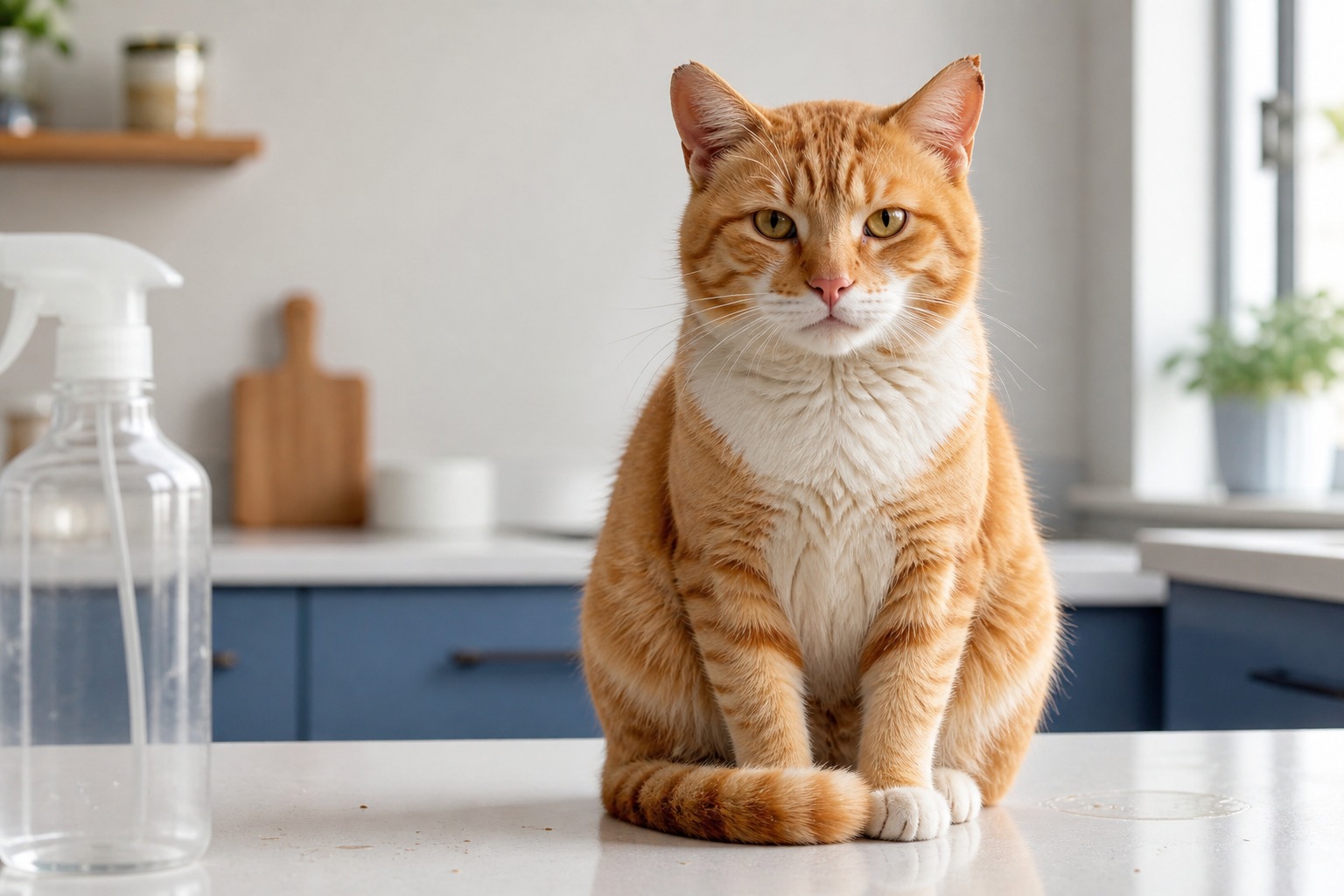
The spray bottle looks like it works, and that is the problem. You spritz, the cat leaps off the counter, the counter is empty, and you feel like a person who has solved something.
Then you leave the room, and the cat gets back on the counter.
That is not defiance and it is not stupidity. It is the exact lesson you taught. Your cat did not learn “counters are off limits.” Your cat learned “counters are off limits when the human with the bottle is watching,” which is a completely different rule, and a much easier one to work around.
What the cat actually associates the spray with
Punishment only teaches something if the animal can connect it to their own behavior. That connection requires the animal to understand which of the many things they were doing caused the bad thing to happen. Cats are not built for that inference, because jumping onto an elevated surface is not, to a cat, a transgression. It is Tuesday.
So the cat does what any animal does when something unpleasant arrives without an obvious cause: they blame the most salient thing in the environment. That is you.
“The cat is not thinking ‘I broke a rule,’” says Dr. Ravi Mehta. “The cat is thinking ‘that person becomes dangerous without warning.’ You have not taught a boundary. You have taught unpredictability, and unpredictability is the fastest way to make an anxious cat.”
There is also a physical cost people wave off. Wet fur is genuinely uncomfortable for a cat, and it takes real effort to fix. You are not administering a gentle reminder. You are imposing a small, wet, unearned punishment on an animal who cannot work out why.
The slide from correction to something worse
The other thing that happens is escalation, and it is almost invisible while it is happening.
You start with the counter. Then the bottle comes out for scratching the couch. Then for yowling at 5 a.m. Then for biting your ankles. Each use is individually defensible in the moment, and the cumulative effect is a household where an unpredictable aversive can arrive at any time, for reasons the cat cannot decode. That is not training. That is a cat living under a low-grade threat, and it damages the relationship in ways that are slow to repair.
The clearest sign that it never worked: people who spray are usually still spraying, months later, at the same cat, for the same behavior. If it were teaching anything, it would have stopped being necessary.
Where it makes things actively worse
Aggression. Spraying a cat who is already aroused, hissing, swatting, or hunting your feet, raises the arousal. From the cat’s perspective, you have joined the fight. Cats who attack ankles are usually running a predatory sequence, and a squirt of water is just an escalation from a worthy opponent. Expect more biting, not less.
Fear-based hiding. A cat who cannot predict when the water comes stops doing things in general. Owners report this as the cat becoming “calmer.” It is not calmer. It is shut down.
What to do instead: ask what the cat is getting out of it
Every unwanted behavior is paying the cat something. Find the payment, and you can either replace it or stop making it.
Counter surfing. There are only two reasons a cat is up there. Either they want height, or they want food. If it is height, they need a legal high place with a good view: a cat tree near the action, or wall shelves, ideally taller than the counter. If it is food, the counter is a slot machine that occasionally pays out crumbs, and you have to close the casino. Wipe it down, put food away, and stop leaving anything interesting up there. A counter that never pays stops getting checked.
Ankle attacks and biting. This is unspent predatory energy, not malice. Cats with drive need to hunt something. A wand toy session once or twice a day, run properly, with a chase, a catch, and a kill at the end, drains the tank that otherwise gets emptied into your feet. Add a meal after the “kill” and you have completed the sequence a cat is wired to run.
Scratching furniture. Cats scratch to maintain claws and to mark. They will not stop. Give them a scratcher they actually like, which usually means tall enough to fully stretch on, sturdy enough not to wobble, and placed where they already scratch, not where it matches your rug.
Waking you at dawn. Cats hunt at dawn. If breakfast reliably follows the yowling, you have trained the yowling. A timed feeder that goes off before the cat’s alarm goes off breaks the link between “harass human” and “get fed.”
Train the cat you want, with a clicker
Cats are trainable. They are just not trainable with fear.
Clicker training works well with cats, and it flips the whole dynamic: instead of teaching your cat what makes you dangerous, you are teaching them what makes you profitable. Mark the moment the cat does something you like, pay it, repeat. You can build a reliable “get off,” a “go to your mat,” a carrier that the cat walks into voluntarily, and a cat who finds you interesting rather than threatening.
The bar to start is low: a clicker, some very good treats, and two minutes.
What newer research adds
The strongest support for putting the bottle down is not a cat study. It is the wholesale shift in what the veterinary behavior field now recommends.
In 2021, the American Veterinary Society of Animal Behavior issued a position statement on humane training after reviewing the available literature, and its conclusions were blunt. Reward-based methods are recommended for training and for treating behavior problems. Aversive methods, including physical and psychological punishment, damage animal welfare and the human-animal bond. And critically, there is no evidence that aversive methods are more effective than reward-based ones in any context. The AVSAB’s guidance on reward-based methods is written for dogs and cats alike.
That last finding is the one that ends the argument. The usual defense of a spray bottle is that it is unpleasant but efficient, a trade of some discomfort for a fast result. The evidence does not support the trade. You are paying the cost and not getting the result.
Which leaves the bottle doing exactly one job: making you feel like you did something, while your cat waits for you to go to bed.
References
- American Veterinary Society of Animal Behavior. “Position Statement on Humane Dog Training,” 2021. avsab.org/resources/position-statements/
- American Veterinary Society of Animal Behavior. “Position Statement: The Use of Punishment for Behavior Modification in Animals.” avsab.org/resources/position-statements/
- American Veterinary Society of Animal Behavior. “What Are Reward-Based Training Methods for Dogs (and Cats)?” avsab.org/what-are-reward-based-training-methods-for-dogs-and-cats/
- American Veterinary Medical Association. “Veterinary Behaviorists: No Role for Aversive Dog Training Practices.” JAVMA News, November 2021. avma.org/javma-news/2021-11-01/veterinary-behaviorists-no-role-aversive-dog-training-practices