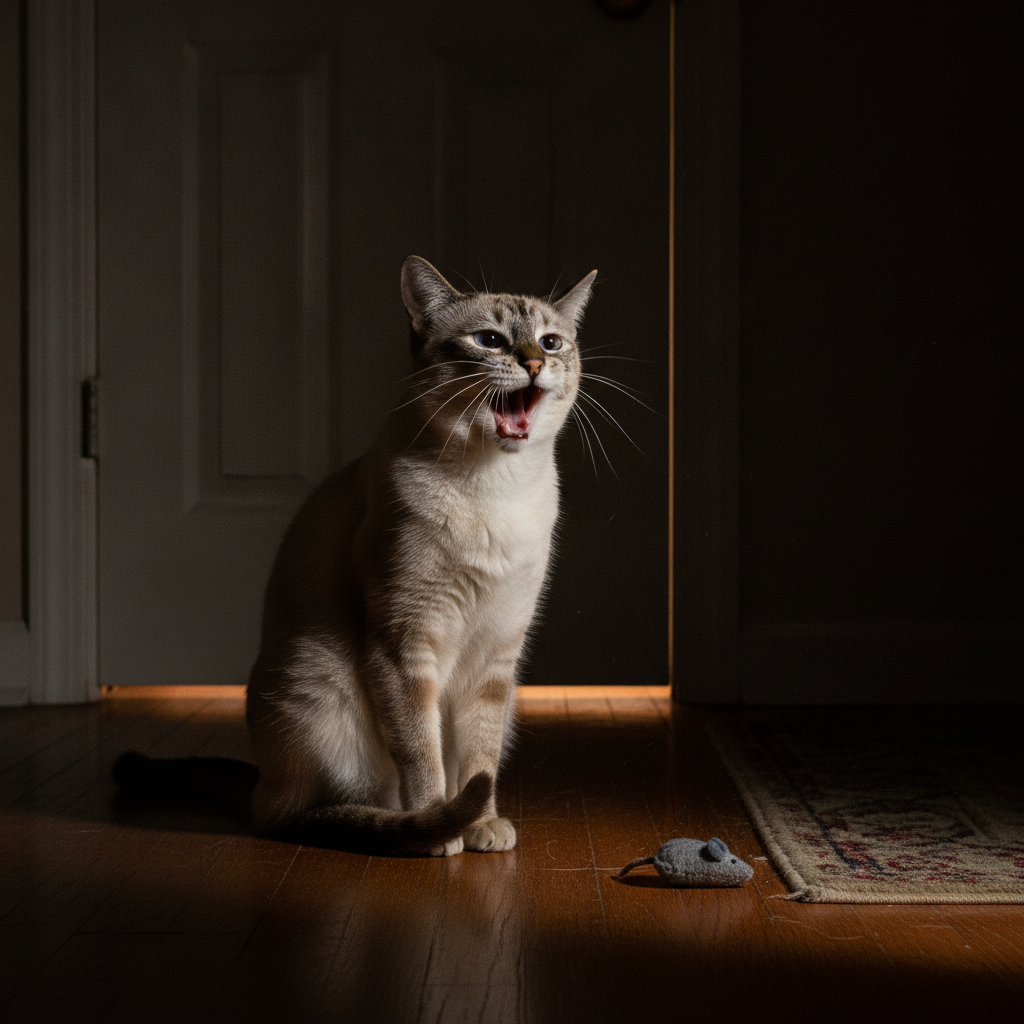
At 3am, a sound that has no business coming out of a housecat travels down your hallway, and you lie there wondering what exactly you have invited into your home.
Before you do anything else, throw out the assumption underneath most advice on this: cats are not nocturnal.
They are crepuscular. Their activity peaks at dawn and dusk, because that is when the things they evolved to eat are moving. Cats sleep in fragments across the whole 24 hours, and yes, they are light sleepers. But a cat that is genuinely awake and shouting all night is not simply expressing its nature.
Something is unmet, or something is wrong.
First: rule out the medical, because this is the part people skip for months
If the meowing is new, or has changed in character or intensity, treat it as a medical question before you treat it as a behavior one. This is especially true in an older cat.
The conditions that produce night vocalization are specific and common:
- Hyperthyroidism. Extremely common in older cats. Restlessness, increased appetite, weight loss, and vocalizing at night are a classic picture.
- Hypertension, which often travels with thyroid or kidney disease.
- Feline cognitive dysfunction. Feline dementia. Disorientation, disrupted sleep cycles, and yowling in the dark, often in a distinctive lost, plaintive tone, in a cat who seems confused about where they are.
- Pain. And here is a fact that surprises most owners: cats as young as six years old can develop arthritis. A cat who cannot get comfortable at night may simply hurt.
None of these get better with a wand toy. All of them are treatable, and several are far more manageable when caught early.
“A cat that has suddenly started shouting at 3am is telling me something, and my first job is to work out whether it is a behavioral message or a medical one,” says Dr. Mara Chen. “In an older cat especially, new night vocalization is a thyroid, a blood pressure, or a brain, until I have proved otherwise. I would rather run the bloodwork and find nothing than spend two months adjusting a play schedule for a cat with a treatable disease.”
Once the vet has cleared them, everything below applies.
The real reason, most of the time
Your cat is a predator whose hunt never finished.
In the wild, a cat’s day runs on a loop: hunt, eat, groom, sleep. Each stage triggers the next. The kill leads to the meal, the meal leads to the wash, the wash leads to sleep. It is a physiological sequence, not a preference.
An indoor cat gets the eating and the grooming and the sleeping. What it usually does not get is the hunt, and without it the loop never closes. So the cat lies in the dark at 2am with an engine that was never switched off, and starts making phone calls.
The predatory sequence has four stages, and a cat needs to complete all of them:
- Stare
- Stalk and chase
- Pounce and grab
- Kill bite
A cat that never gets past stage one, batting listlessly at a toy on the floor, has not hunted. It has been teased.
The fix, precisely
Use a long wand toy. Length matters, and this is where most people go wrong. Short wand toys are close to useless for this, because they keep the “prey” within arm’s reach and inside the cat’s suspicion zone. You want something long, around six feet. Da Bird is the standard reference here for exactly this reason.
Put something on the end that resembles real prey. Feathers for a bird. A mouse lure, an insect, a snake-like ribbon. Then, and this is the part people feel silly doing, act like that animal. A bird does not fly straight at a cat. It flutters, lands, freezes, panics, and escapes upward. A mouse skitters along the baseboard and hides. Make the toy behave like the thing it is pretending to be.
Run it for 10 to 15 minutes, in the evening, before bed. Take the cat all the way through: let it stare, let it stalk, let it chase, and crucially, let it catch the thing and bite it. A hunt with no kill is a frustration, not a release.
Then feed them. Immediately after. A meal on the heels of a successful hunt closes the loop: hunt, eat, groom, sleep. Your cat will wash its face and put itself to bed, because that is what the sequence does.
This single routine resolves an astonishing proportion of night-meowing cases, and it costs you fifteen minutes.
The cold-house problem
The second underrated cause, and one almost nobody addresses.
Cats have a much higher thermoneutral zone than we do, the temperature range at which the body spends no extra energy heating or cooling itself. For humans it is roughly 68 to 72°F. For cats it is roughly 83 to 100°F.
Which means the house you keep at a comfortable temperature is, for your cat, chilly. At night, with the heating down, it is chillier. A cat that cannot get properly warm does not settle, and a cat that does not settle goes looking for you.
Get a heated cat mat and put it under their favorite bed. It is a small purchase that solves an actual physiological problem, and for a lot of cats it is the difference between wandering the house at 3am and being unconscious in a warm spot until morning.
The other reasons on the list
Hunger. Cats do best on multiple small meals across the day, including one just before bed. Hunger causes wakefulness, and a hungry cat on the prowl is loud. If your cat is fed at 6pm and expected to last until 8am, that is a fourteen-hour fast, and the yowling is a reasonable response to it.
Boredom and under-stimulation. The same problem as the unfinished hunt, but broader. An indoor-only cat with nothing to do is bored a good deal of the time, and boredom slides into stress, anxiety, and depression.
Attention. Cats have genuine social needs, contrary to the folklore. A cat that has not had meaningful interaction with you all day will ask for it at an inconvenient hour.
Stress or anxiety. New pet, rearranged furniture, changed schedule, unpredictable loud noises, separation anxiety. Anything that would keep you awake will keep a cat awake.
Territorial stress. This one is easy to miss because you are asleep for it. Outdoor cats moving through your yard at night can trigger long, tense stand-offs through a window or a glass door, complete with a great deal of yowling. If your cat’s meowing has a location, a particular window, a particular door, go and look at what is on the other side of it at 2am.
Mating behavior. If your cat is not spayed or neutered, this is very likely your answer. Females in heat vocalize to get out. Males caterwaul to locate a female they can sense. Neutering solves it.
Stop accidentally paying for the meowing
Positive reinforcement is a double-edged tool, and at 3am most people are on the wrong edge of it.
If your cat meows and you talk back, pet them, get up, or feed them, you have just paid for the meowing. You have taught your cat, with excellent clarity, that vocalizing at night produces food, love, or attention. Cats learn this in one or two repetitions and unlearn it very slowly.
The correct move is the mirror image: wait for quiet, and reward the quiet. Praise or pet the cat once they have stopped. That is the behavior you actually want, and it is the one that almost never gets marked.
And if you have been feeding a 4am meowing cat for six months, be warned: it will get worse before it gets better. A behavior that has been reliably rewarded and is suddenly not gets louder first, as the cat escalates to see whether the old rules still apply. Hold the line, keep meeting the real needs, and it fades.
When to call for help
Talk to your vet about any sudden behavior change, and night vocalization in a previously quiet cat is exactly that.
Beyond the vet, certified cat behavior consultants and veterinary behaviorists exist and are worth the money for a case that is not budging. You do not have to suffer through it, and neither does the cat.
What newer research adds
The clearest shift in thinking here is the reframing of night vocalization as a welfare signal rather than a nuisance behavior.
The old advice was largely about suppression: ignore it, shut the door, wait it out. The current understanding is that a cat yowling in the dark is almost always reporting an unmet need or an untreated condition, and that the suppression approach fails precisely because it addresses neither.
The other development worth knowing is the increasing recognition of feline cognitive dysfunction as a real, common, and partially manageable condition in senior cats, rather than “he’s just old.” Night-time disorientation and vocalizing are among its earliest and most recognizable signs, and there are environmental and medical interventions that help. A senior cat crying in an empty hallway at 3am is not being difficult. It may be lost.
Which is, in the end, the whole argument. The cat is not staging a protest. It is unfinished, or cold, or hungry, or hurting, or frightened, or confused. Every one of those has an answer.
References
- Cornell Feline Health Center. “Cognitive Dysfunction.” Cornell University College of Veterinary Medicine. https://www.vet.cornell.edu/departments-centers-and-institutes/cornell-feline-health-center/health-information/feline-health-topics/cognitive-dysfunction
- Cornell Feline Health Center. “Hyperthyroidism in Cats.” https://www.vet.cornell.edu/departments-centers-and-institutes/cornell-feline-health-center/health-information/feline-health-topics/hyperthyroidism-cats
- Bennett, D., Zainal Ariffin, S. M., and Johnston, P. “Osteoarthritis in the cat: how common is it and how easy to recognise?” Journal of Feline Medicine and Surgery, vol. 14, no. 1, 2012. https://journals.sagepub.com/doi/10.1177/1098612X11432828
- Nicastro, N., and Owren, M. J. “Classification of domestic cat (Felis catus) vocalizations by naive and experienced human listeners.” Journal of Comparative Psychology, vol. 117, no. 1, 2003. https://psycnet.apa.org/
- National Research Council. Nutrient Requirements of Dogs and Cats. National Academies Press, 2006. (Feline thermoneutral zone.) https://nap.nationalacademies.org/catalog/10668/nutrient-requirements-of-dogs-and-cats