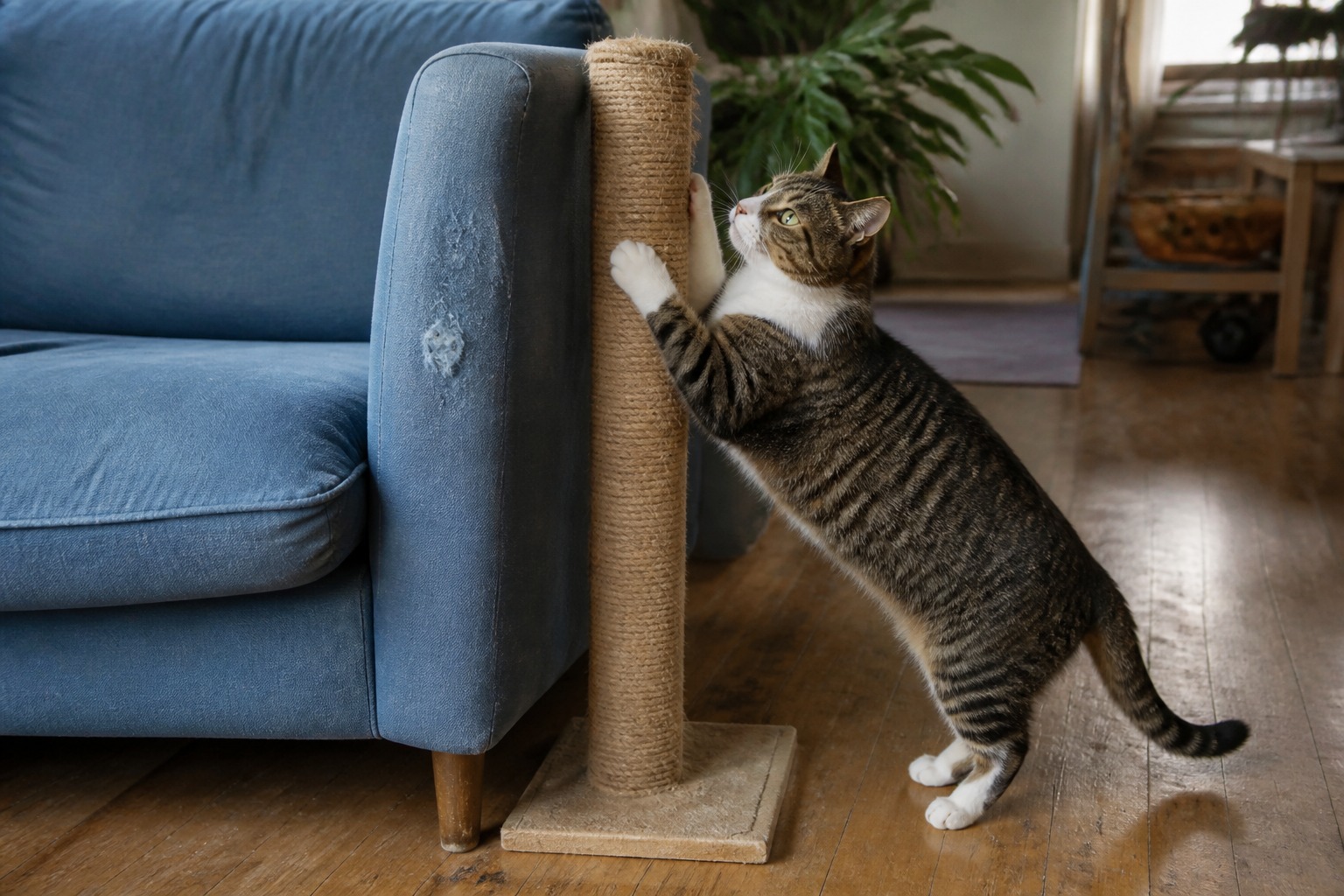
Most people buy a scratching post, put it in the corner of the living room where it looks least offensive, and then decide their cat is stubborn when the sofa keeps losing stuffing. The cat is not stubborn. The post is in the wrong place.
Scratching is not a bad habit your cat picked up. It is a fixed piece of feline hardware, and it happens in locations the cat chooses on purpose. Which means the damaged spots in your home are not random destruction. They are a map, and the map tells you exactly where a scratcher needs to go.
Read the spots you already have
Before you buy anything else, walk the house and look at what has been shredded.
Scratched furniture next to a favorite nap spot. This is a stretch. Cats wake up and haul their spine long, usually by hooking their claws into something and leaning back into it. If the arm of the sofa nearest the sunny cushion is the one that is destroyed, your cat is not attacking the sofa. They are doing a full-body stretch on the nearest available anchor.
Scratched corners along hallways, doorways, and walkways. These are signposts. Cats have scent glands in their paws, and a scratch leaves both a smell and a visible mark. The freshness of the smell tells the next cat how recently someone passed through. If the marks are on the corners of a route through your home, your cat is posting notices along a road.
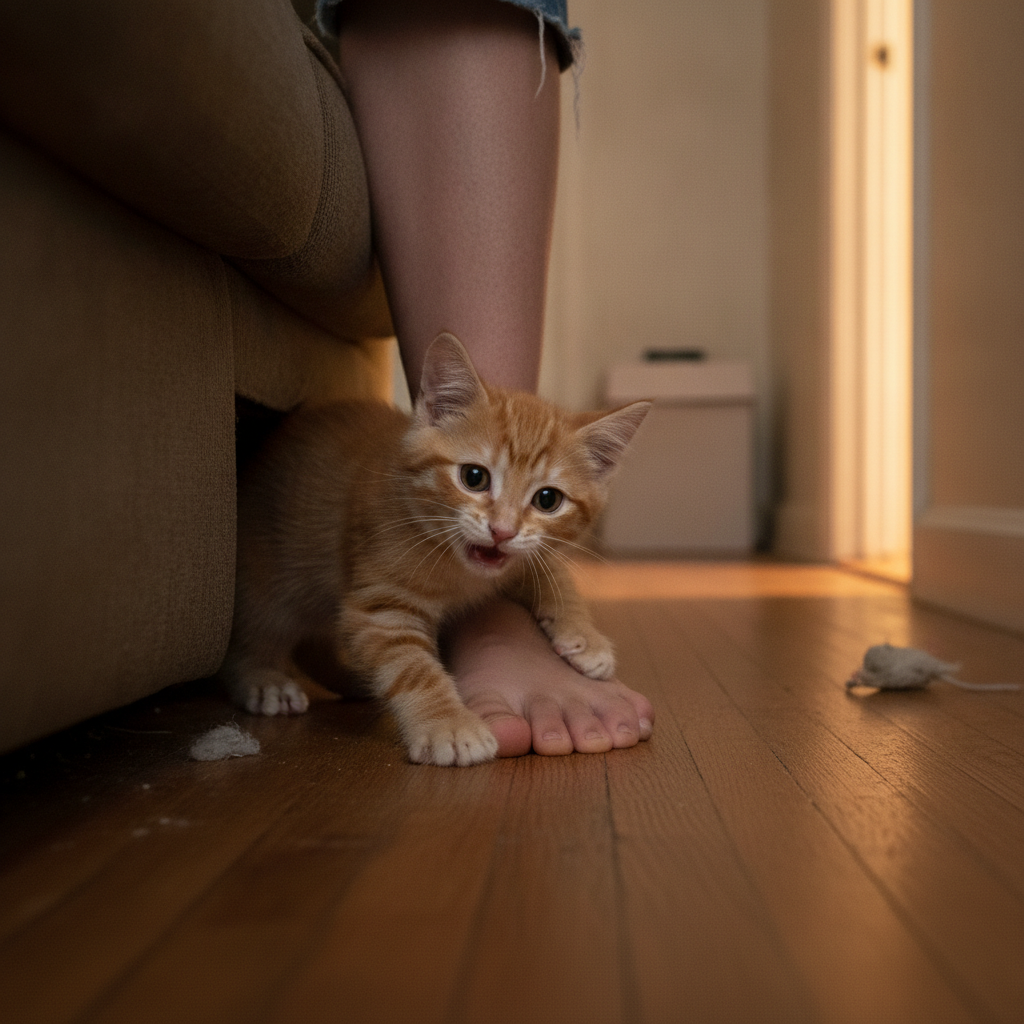
Scratching that happens right when you walk in the door, or right before the zoomies. This one is arousal, not territory. Happy, excited, wound-up cats scratch. It is a way of discharging energy, the same way a person bounces a knee.
Scratching that shows up everywhere, on everything, all at once. That is a different signal. A cat blanketing the house in marks is usually a cat who feels territorially unsure, often after a new pet, a new person, a move, or a neighborhood cat lurking outside the window.
Once you have the map, the rule is simple: the alternative goes where the damage is, not where you would prefer it.
What scratching actually does for your cat
It is worth knowing what you are replacing, because a scratcher that fails to deliver these things will be ignored.
- Claw maintenance. Scratching dulls the sharp tips, sheds the outer claw sheath, and keeps nails from growing long enough to interfere with walking. Regular nail trims cover part of this need, which does lower the pressure on your furniture, but they do not remove the urge.
- Scent and pheromone marking. Those paw glands are a communication system. Cats mark territory this way, and they read how recently another cat passed through by how strong the mark still smells. Their own scent also calms them down: a cat surrounded by a smell they recognize as theirs is a cat who feels less on edge.
- The stretch. A tall, stable vertical surface lets a cat extend fully through the shoulders and back.
- Energy and arousal. Play, zoomies, greeting you at the door, all of it can end in a scratch.
- Something to do. A bored cat will find an activity, and scratching is a readily available one.
Nothing on that list is optional, and none of it is a behavior problem. The goal is never to stop the scratching. It is to move it.
Match the scratcher to the crime
This is where most posts fail. Look at how your cat scratches the furniture and buy the thing that copies it.
Orientation. Does your cat rake downward on a vertical surface, or crouch and pull along the carpet? Vertical scratchers and horizontal scratchers are not interchangeable, and plenty of cats want both.
Material. Sisal, cardboard, carpet, rattan, and raw wood all feel different under a claw. If your cat has committed to the woven fabric of the couch, a slick carpeted post is not the same experience.
Height. If the appeal is the post-nap stretch, the scratcher has to be taller than your cat is long when fully extended. Most cheap posts are not.
Stability. A cat who launches into a scratch mid-zoomie will knock over a wobbly post once and never touch it again. Heavy bases, wall-mounted pads, and flat floor scratchers all solve this.
People tell me their cat refuses to use the post, and nine times out of ten the post is fine, it is just standing in a room the cat does not care about. Put it six inches from the spot they are already wrecking. You can move it across the room later, slowly, once the habit has transferred.
Then make the new surface pay. Praise, a treat, or a play session the moment they use it. Reward what you want, and you will see more of it.
The stress dial nobody adjusts
Here is the part that gets left out of most advice: how much a cat scratches is not fixed. It rises and falls with what else is going on in their life.
A large 2024 study in Frontiers in Veterinary Science surveyed the owners of 1,211 cats and found that undesirable scratching was linked to specific, changeable things. Cats who were described as more playful, more active at night, more easily aroused, and more disruptive scratched more. So did cats living with a child. And, most usefully, longer stretches of play were associated with more scratching, not less, which is why the researchers landed on short, frequent play sessions spread through the day rather than one long wrestling match.
The same study confirmed the placement point directly: scratching posts put in the areas a cat actually spends time in were the ones that worked.
So if you have done everything right and the scratching is still climbing, treat it as a stress and arousal readout rather than a furniture problem. Several short play sessions. Somewhere high to sit. A safe retreat away from the kids, the dog, or the window where the neighborhood tom parades past.
Three things that make it worse
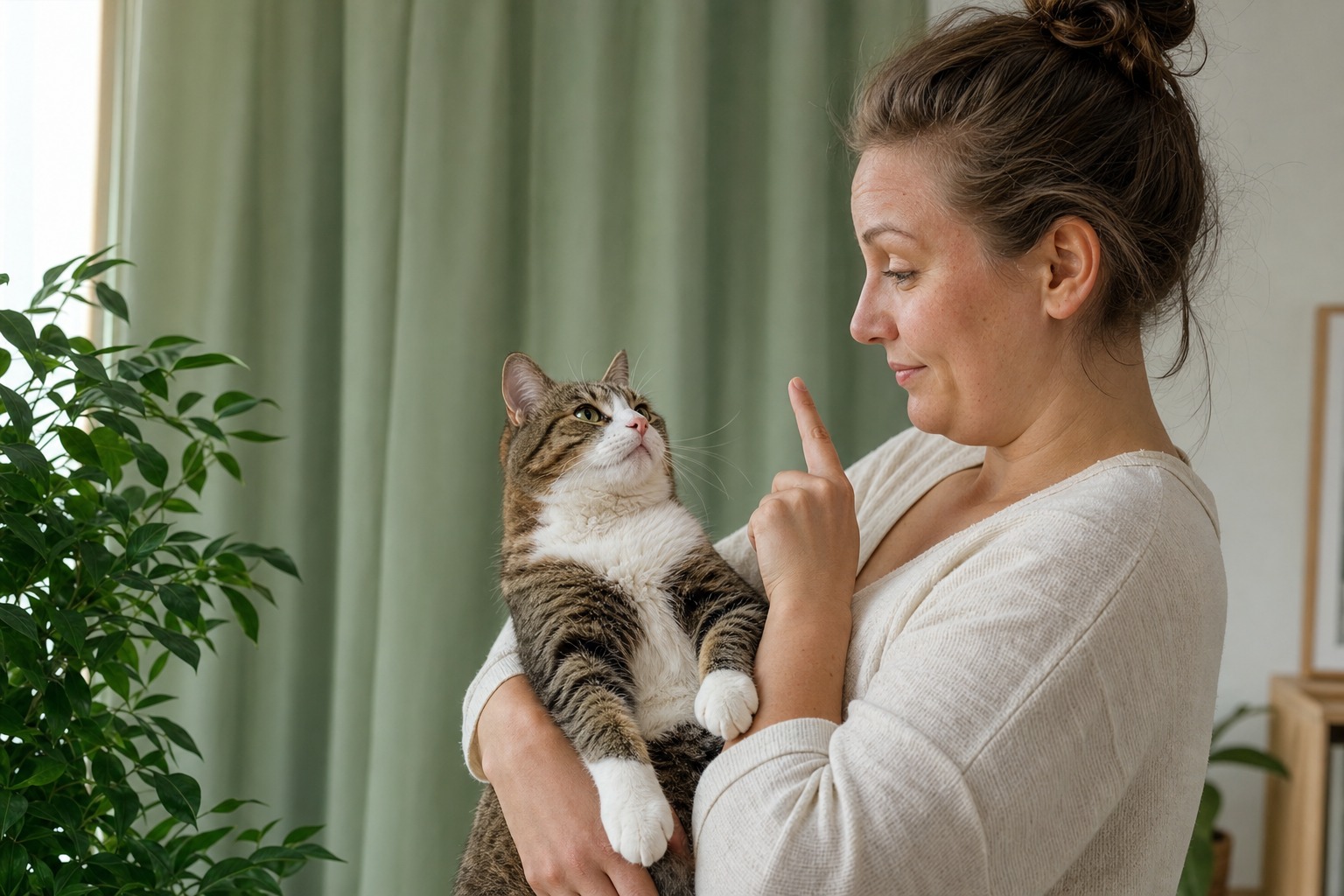
Punishment. Yelling, spraying water, or scruffing adds stress, and stress increases scratching. It also damages your relationship with an animal who cannot connect your anger to a behavior they consider entirely reasonable.
Anti-scratch sprays. These are usually scented with something the cat finds offensive. A cat who encounters an offensive smell in their own territory often responds by trying to cover it with their own scent, which can mean more scratching, not less.
Declawing. This is the one to rule out completely. Declawing is not a nail trim. It is an amputation of the last bone of each toe, the equivalent of taking your finger off at the first knuckle. It changes how a cat distributes weight and can cause lasting musculoskeletal pain. It also removes their primary defense, which tends to produce a more anxious, more reactive cat. The problems that follow, urine spraying, fear, and house-soiling, are far worse to live with than a scratched sofa.
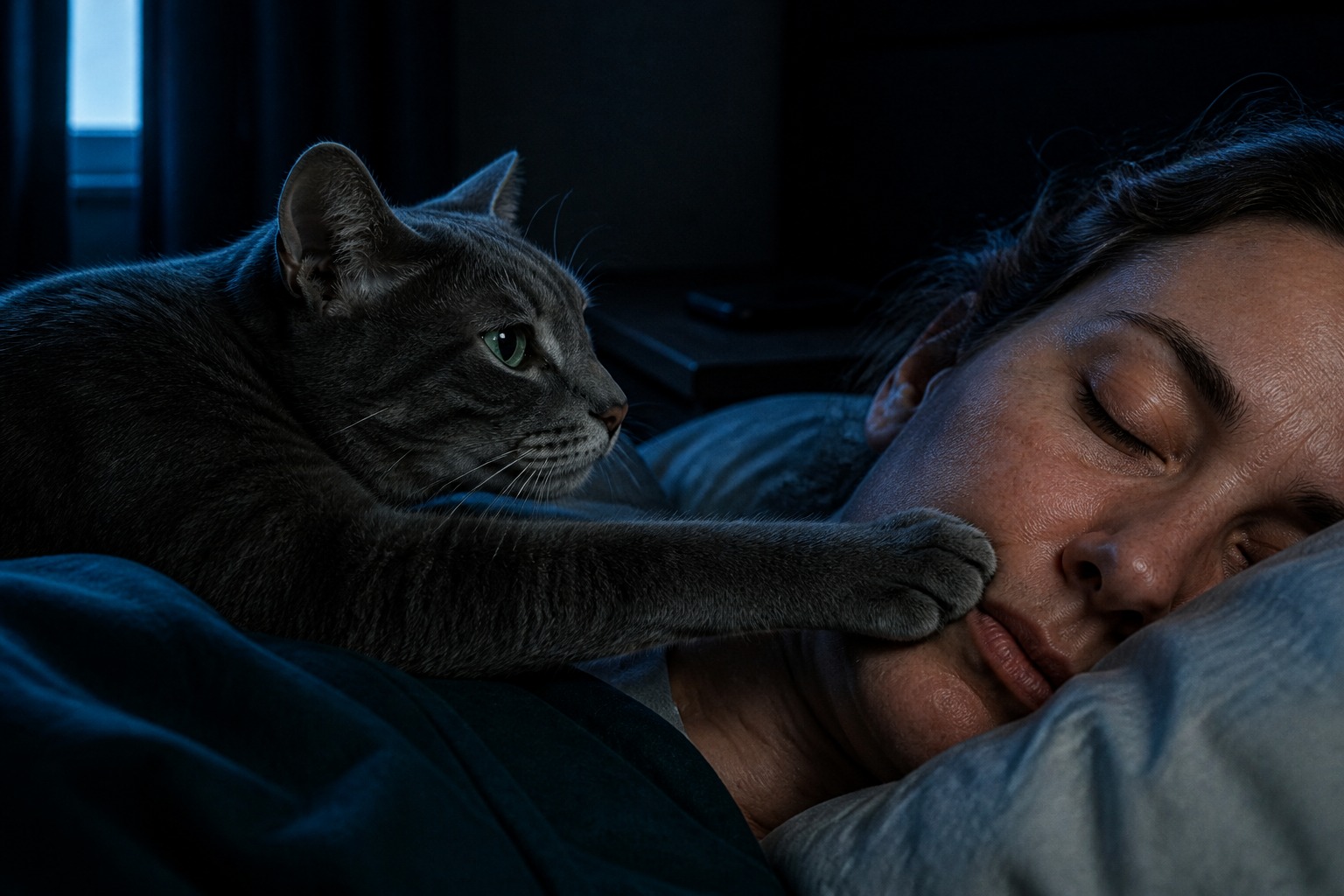
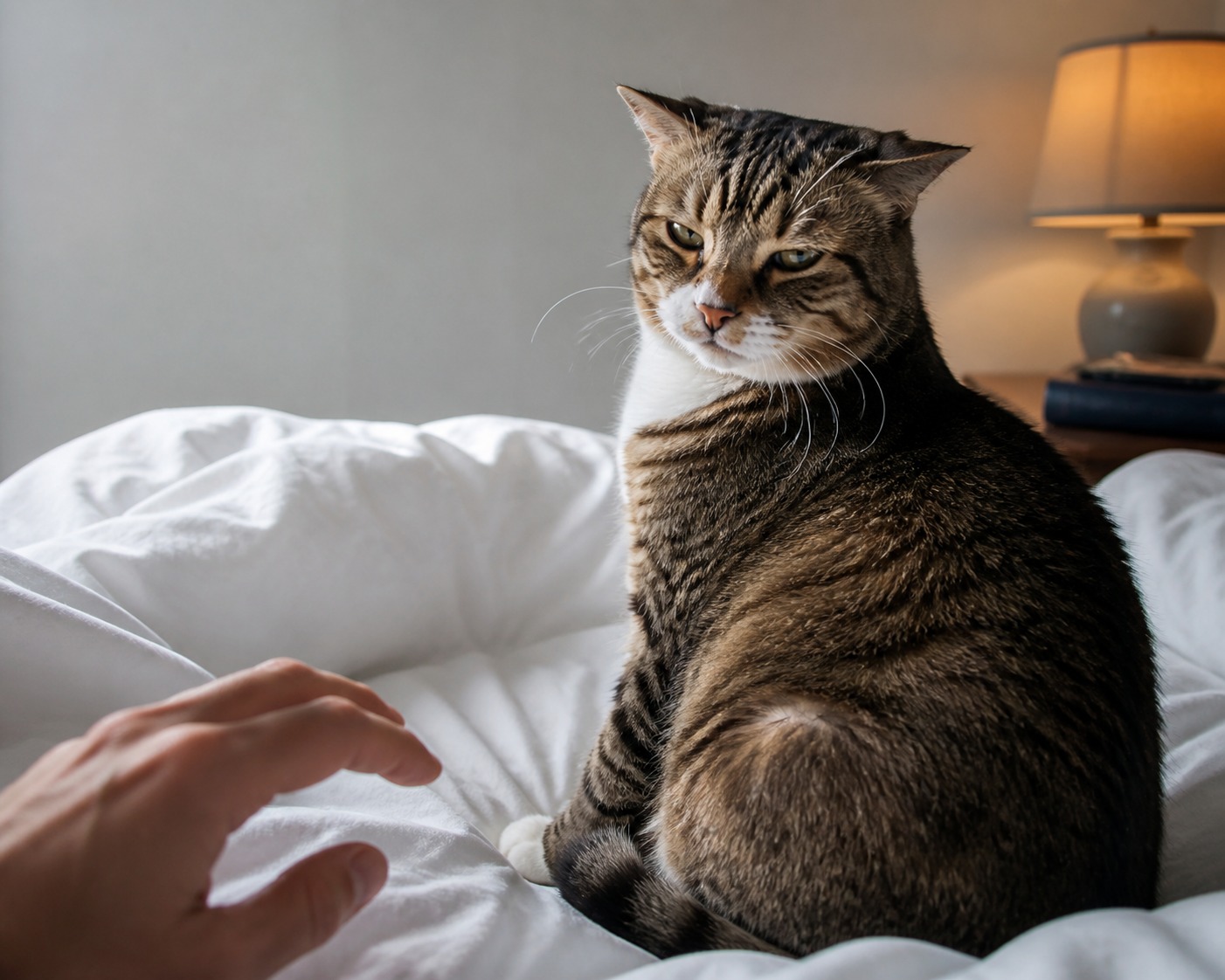
If you catch your cat in the act and need to stop it right now, be boring about it. Walk over, lift them, set them down a few feet away, and point them at the scratcher. No lecture. A lecture is attention, and attention is a reward. Plenty of cats have figured out that clawing the couch is the fastest way to make their person get up and engage.
What newer research adds
The 2024 survey work is the most useful update here, because it moves the conversation away from “is my cat being bad” and toward things you can actually change: where the post sits, how often you play, and how wound up your cat is by the rest of their day.
It is also worth being skeptical about plug-in pheromone products. A 2025 systematic review in the New Zealand Veterinary Journal, looking at cats with a stress-linked bladder condition, found encouraging evidence for changing the cat’s environment and very little evidence supporting feline facial pheromone. That is not proof they do nothing for scratching, which nobody has tested properly, but it is a good reason to spend the money on a taller, sturdier post in the right room first.
None of this makes scratching go away. It is not supposed to. A cat with nothing to scratch is a cat with a problem. A cat with the right thing to scratch, in the right place, is just a cat.
References
- Cisneros, A., et al. “Unwanted Scratching Behavior in Cats: Influence of Management Strategies and Cat and Owner Characteristics.” Animals, vol. 12, no. 19, 2022, p. 2551. https://doi.org/10.3390/ani12192551
- Yamada, R., et al. “Evaluating Undesired Scratching in Domestic Cats: A Multifactorial Approach to Understand Risk Factors.” Frontiers in Veterinary Science, vol. 11, 2024. https://doi.org/10.3389/fvets.2024.1403068
- American Association of Feline Practitioners. “Declawing Position Statement.” https://catvets.com/guidelines/position-statements/declawing
- Forster, L., et al. “Understanding the Current Evidence Base for the Commonly Recommended Management Strategies for Recurrent Feline Idiopathic Cystitis: A Systematic Review.” New Zealand Veterinary Journal, 2025. https://doi.org/10.1080/00480169.2025.2477542