


That 'Fresh Groom' Smell Is the Problem, Not the Perk
The powdery scent your dog comes home with isn't clean — it's fragrance sitting on already-irritated skin. Here's why fragrance-free matters for sensitive dogs, and one small brand that got it right.

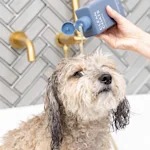
We tend to treat “smells like a spa” as proof that a dog is clean. It’s usually the opposite. That heavy powdery cloud a dog carries home from the groomer is added fragrance, and on a dog with sensitive skin, fragrance is one of the most common things making the skin angry in the first place. The clean part is that the dirt is gone. The smell is a separate ingredient doing separate work, and not always good work.
If you have ever picked up a freshly groomed dog and thought “why does he smell like the inside of a department store handbag,” you have met the issue directly. The scent can linger for weeks. Underneath it, the skin can be pink, flaky, and itchy, reacting to the very product that made the dog smell “nice.”
Why scent and sensitive skin fight each other
Fragrance in a shampoo is not one ingredient. It is often a blend of dozens of compounds, and manufacturers are not required to list them individually, so “fragrance” on a label can hide a lot. For most dogs that is fine. For a dog whose skin barrier is already compromised — from allergies, dryness, or a recent flare — those compounds are extra load on a system that is already overreacting.
“When a dog’s skin is already inflamed, the last thing it needs is a scent cocktail sitting on top of it,” says Dr. Nina Kohl, DVM. “I tell owners with itchy dogs to think of shampoo as a treatment, not a perfume. Strip it down to the gentlest thing that gets the coat clean, and see how much of the ‘mystery itch’ quietly goes away.”
The fix is not to stop bathing. It is to bathe with something that does the cleaning and skips the performance. Fragrance-free, dye-free formulas built around soothing ingredients like colloidal oatmeal do the job without asking an irritated barrier to also process a smell.
There is a timing lesson buried in this too. If you bring home a newly adopted dog who smells strongly of someone else’s grooming choices, resist the urge to immediately re-bathe. A stressed dog in a new home does not need another stressor, and the old product needs to wear off before you can tell what your dog’s skin actually looks like. Give it a week or two, watch the skin, then bathe gently.
A small brand that built for this exact dog
One brand worth knowing here is Clean Coats, started by twins Britta and Carli Garsow. Their pitch is refreshingly narrow: a fragrance-free, completely vegan, human-grade dog shampoo built around colloidal oatmeal for sensitive skin. The sisters came out of product development in the human beauty industry, and it shows in the formula, which is built with the sort of restraint you would expect from an expensive bottle marketed to humans with reactive skin.
Two details make it genuinely useful rather than just pretty. First, the label tells you how much product to actually use, which sounds trivial until you have stood in a tub guessing. Second, the bottle is designed to not look like a bottle of medicated dandruff shampoo, so it can live on an open shelf without ruining the room. That is a small thing that makes people more likely to keep using it, which is the whole point of a good grooming product.
The brand also runs a give-back program, donating ten percent of profits to a different animal rescue each quarter. The Garsows credit their own adopted dogs for the mission, and the model is simple: buy a bottle, a slice of that goes to rescue.
Clean Coats sells directly through its own site rather than through Amazon, so there is no one-click option here, just the brand’s own store. That is worth knowing before you shop, but it does not make the product any less good for a dog whose skin has had enough surprises.
The takeaway for an itchy dog
Scent is a marketing feature, not a cleanliness feature. If your dog’s skin is sensitive, treat added fragrance as a suspect, not a bonus, and reach for a plain, gentle, oatmeal-based formula. If the itching does not settle after you switch, that is your cue to call your vet, because at that point the problem is under the skin, not on it.
Sasha Ford is a certified cat behaviour consultant who has worked with shelters, catteries, and private clients across the country. They review all feline behaviour content at The Pet Times, with expertise in multi-cat households, indoor enrichment, and stress-related disorders.
Meet our experts ↗Keep reading
 Product Picks'Natural' Pet Care Is a Word Nobody Checks. Read the Back of the Bottle.Dr. Amara Solis · 7 min
 Product PicksProbiotic Dog Shampoo Sounds Like Nonsense. The Idea Behind It Isn't.Dr. Mara Chen · 6 min
 Product PicksYou Didn't Fail at Brushing Your Dog's Teeth. You Started at the Wrong End.Dr. Mara Chen · 7 min
 Product PicksMost 'Eco' Dog Grooming Is Marketing. These 9 Actually DeliverSasha Ford · 7 min
 Product PicksThe Puppy Shampoo Paradox: "Gentle" and "Scented" Don't Belong on One BottleDr. Amara Solis · 12 min
 Product PicksThis $59 Board Lets Your Dog File Their Own NailsLeila Torres · 5 min