


Probiotic Dog Shampoo Sounds Like Nonsense. The Idea Behind It Isn't.
Skout's Honor puts live kefir cultures in a bottle and points them at your itchy dog's skin. The science is genuinely plausible and genuinely thin. Here's what the evidence supports, what it doesn't, and when to skip the bottle and call a vet.

Affiliate disclosure. This article contains affiliate links. We may earn a small commission if you buy through a link, at no extra cost to you. How we handle recommendations.
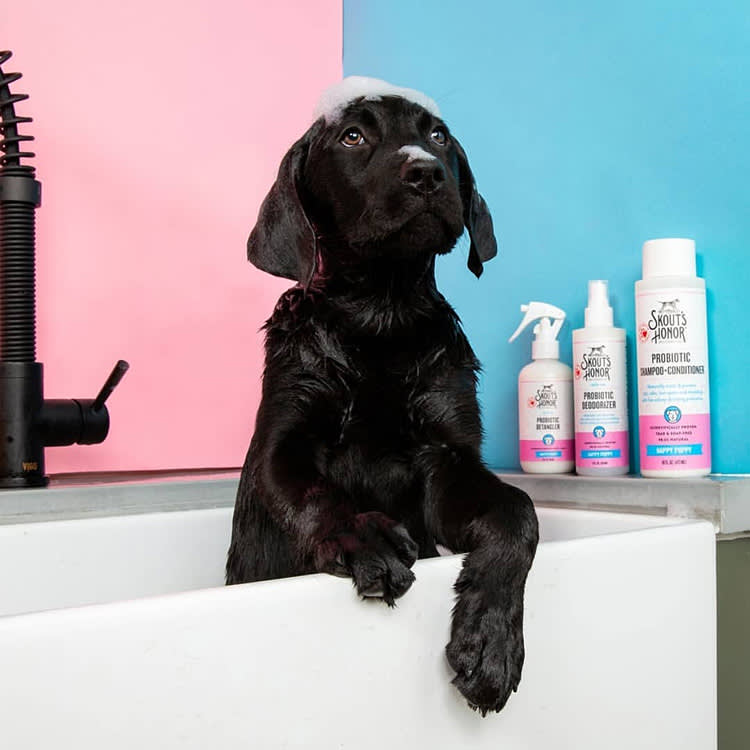
Put “probiotic” on a bottle in 2026 and roughly half your audience reaches for their wallet and the other half rolls their eyes. Both reactions are reasonable, and neither is a substitute for understanding what is actually in the bottle.
So let us be precise about Skout’s Honor’s central claim, because it is more interesting than the marketing makes it sound, and less proven than the marketing implies.
The idea, stated fairly
Your dog’s skin is not a sterile surface. It is an ecosystem, host to billions of bacteria colonizing its outer surface, exactly as your own skin is. That community, the skin microbiome, is a real, well-documented thing, and its balance appears to matter: dermatology research consistently finds that dogs with allergic skin disease have a different, less diverse bacterial community on their skin than healthy dogs do, often overgrown with Staphylococcus.
The Skout’s Honor proposition follows logically from that. Their probiotic line carries a live, colony-forming probiotic kefir culture, delivered inside microscopic beads that release when the fur dries, leaving what the company describes as a protective barrier of good bacteria against irritants and infection. The pitch is that instead of killing everything on the skin, you crowd the bad organisms out with good ones.
If you have ever taken a probiotic for your gut or put a yogurt mask on your face, you already understand the concept. The company’s VP of Marketing, Jenny Gilcrest, frames it as an old technique, one humans have leaned on for centuries, aimed at a new surface.
It is a good idea. Good ideas are not the same as proven ones.
Where the evidence actually stands
Here is the part the brand does say, and it is to their credit that they say it: when they launched, they did not know what would happen. The line shipped on the strength of what topical probiotics appeared to do for human complaints, acne and rosacea among them.
What came back was testimonials, and they were striking ones. Pet parents whose dogs had been on steroids for skin problems, or who were fighting recurring ear infections, reported these products worked better than anything else they had tried.
Testimonials are not data, and the company knew it. Because nobody else was doing topical probiotics in pet care, there was no independent literature to lean on, so Skout’s Honor commissioned researchers to test whether the anecdotes held up. Independent third-party scientists found the probiotics outperformed a common antimicrobial surface treatment by up to 30 percent.
Read that sentence twice, because the important word is commissioned. This is industry-funded research on the funder’s own product. That does not make it fraudulent, and the 30 percent figure may well be real. It makes it preliminary. It has not been replicated by anyone with nothing to gain, and a surface-treatment comparison is not the same as a clinical trial in dogs with atopic dermatitis.
The honest summary of topical probiotics in veterinary dermatology right now: biologically plausible, early, promising, unsettled. Veterinarians are watching it, and the veterinarian Dr. Liz Hanson has written that researchers are now examining whether good bacteria, applied to the skin, can help with allergic skin disease and the bacterial infections that ride along with it, a pairing vets see constantly.
“May benefit” is an accurate phrase. Treat anyone who gives you a stronger one with suspicion.
The microbiome logic is sound, and I have clients who swear by these products. What I will not do is let a shampoo delay a diagnosis. If your dog has been itching for six weeks, the problem is not that you bought the wrong bottle.
Who this is actually for
The real appeal here is the thing pet parents keep saying out loud: they want to avoid the heavy stuff where they can. Long-term repeated use of steroids and antibiotics carries genuine costs to a dog’s overall health, and a gentle product that reduces how often you need them is a legitimate win.
A probiotic shampoo is a reasonable bet if: your dog is mildly itchy or smelly, has sensitive skin, gets the seasonal-allergy grumbles, or you simply want a gentle, low-irritation wash that will not strip the skin. Yeast and fungal overgrowth are common in dogs who roll around outdoors, and they are often exactly why a dog is chewing their paws or scratching at their ears.
It is not the answer if: your dog is chewing themselves raw, has open sores or hot spots, has a hot, painful, or smelly ear, is losing hair in patches, or has been itching persistently for weeks. That is a veterinary appointment, not a shopping trip. Skin infections, ear infections, mites, and flea allergy all need diagnosis, and none of them are cured by a nice bath.
The lineup, and the prices
The brand started life in California in 2015, selling a single plant-based odor eliminator, then widened into shampoo, conditioner, and flea and tick products. The probiotic line is the part that made it distinctive, and it now runs across shampoos, conditioners, detanglers, and deodorizers.
The core products, currently available on Amazon:
- Probiotic Shampoo + Conditioner (fragrance-free), 16 oz — the workhorse of the range, a 2-in-1 with avocado oil and omega-3s. Start here if you are curious.
- Probiotic Itch Relief Shampoo, 16 oz — non-medicated and fragrance-free, aimed at the itchy-but-not-infected dog. Non-medicated is the operative word.
- Probiotic Pet Shampoo (honeysuckle), 16 oz — same idea, if you want your dog to smell like something.
- Probiotic Shampoo and Conditioner with avocado oil, 16 oz — 97% natural, paraben- and sulfate-free, cruelty-free.
The Probiotic Paw Care Kit runs $53 and is sold direct rather than on Amazon.
The other half of the brand
Skout’s Honor makes a real point of the parts of a pet-care company that usually go unexamined.
Ingredients are sourced to be, in the company’s framing, the cleanest and greenest available, always free of alcohol and essential oils. That last exclusion matters more than it sounds: essential oils are a genuine toxicity concern for cats in particular, and a grooming brand that leaves them out entirely is making a safety decision, not just a marketing one. Packaging is recyclable and biodegradable. Product development, per the company, is anchored in the sustainability of the ingredients, then the benefit and safety of the animal, then the people around that animal.
There is a giveback attached, too: through a Greater Good Charities partnership, each purchase pays for one day of meals for an animal in rescue.
The verdict
Buy it for what it is: a gentle, thoughtfully made, environmentally serious shampoo built on a plausible and genuinely interesting idea about skin ecology, with early evidence that is mostly the company’s own.
Do not buy it as a treatment. The difference between a mildly itchy dog who could use a better shampoo and a dog with a skin disease is a difference only a vet can draw, and the cost of getting it wrong is measured in months of your dog being uncomfortable.
References
- Bradley, C. W., et al. “Longitudinal Evaluation of the Skin Microbiome and Association with Microenvironment and Treatment in Canine Atopic Dermatitis.” Journal of Investigative Dermatology, 2016. https://pubmed.ncbi.nlm.nih.gov/27015456/
- Skout’s Honor. “Probiotic Shampoo & Conditioner for Dogs & Cats.” https://www.skoutshonor.com/products/probiotic-shampoo-conditioner-2-in-1-for-dogs-cats
- Skout’s Honor. “Breakthrough study on the efficacy of its probiotic skin care line for pets.” https://www.skoutshonor.com/pages/skout-s-honor-releases-breakthrough-study-that-scientifically-proves-the-efficacy-of-its-probiotic-skin-care-line-for-pets
- American College of Veterinary Dermatology. “Atopic Dermatitis.” https://www.acvd.org/
- ASPCA Animal Poison Control. “Essential oil and liquid potpourri poisoning in pets.” https://www.aspca.org/news/what-you-need-know-about-essential-oils-and-pets
Dr. Chen is a small-animal veterinarian who leads health and safety coverage at The Pet Times. She writes and reviews the bulk of our illness, condition, and safety content, translating clinical guidance into clear, practical advice owners can act on at home.
Meet our experts ↗Keep reading
 Health & WellnessYou're Probably Washing Your Dog Too MuchSasha Ford · 6 min
 Health & WellnessYou'll Never Stop the Shedding. You Can Stop Finding the Hair.Sasha Ford · 7 min
 Product PicksThe At-Home Grooming Kit a Celebrity Dog Groomer Actually UsesSasha Ford · 5 min
 Product PicksThe $350 Grooming Kit's Best Tool Isn't a ToolNina Vasquez · 5 min
 Product PicksThe Puppy Shampoo Paradox: "Gentle" and "Scented" Don't Belong on One BottleDr. Amara Solis · 12 min
 Product PicksThis $59 Board Lets Your Dog File Their Own NailsLeila Torres · 5 min