


Pothos Isn't a Strong Poison. It's a Mild One You've Hung at Snout Height
Pothos is mildly toxic to dogs, but it's also the trailing, unkillable plant in half the homes in America, often dangling exactly where a curious dog can reach. The risk is design, not potency.

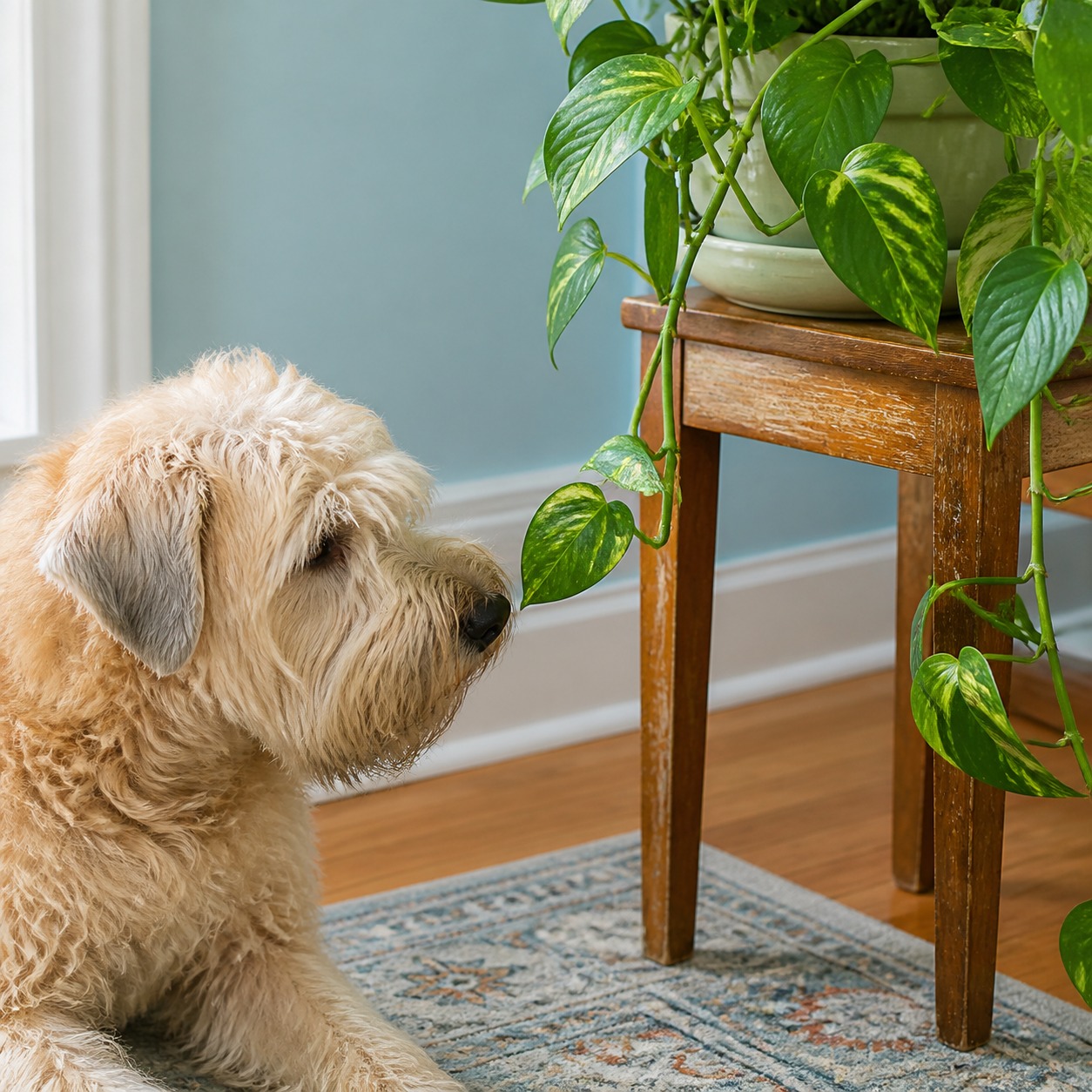
If you wanted to design a houseplant that maximized the odds a dog would eat it, you would build something close to a pothos. Make it nearly impossible to kill, so it ends up in beginner homes everywhere. Give it long, dangling vines, so it trails off bookshelves and out of hanging baskets. Make the leaves glossy and fluttery, so they catch a dog’s eye and bat around at nose height. Pothos checks every box. And it happens to be mildly toxic.
That combination, not the strength of the toxin, is the real story. Plenty of plants are more poisonous than pothos. Few are more available to a dog. So the smart way to think about pothos is less “how dangerous is this chemical?” and more “why is the one toxic plant I own hanging exactly where my dog can reach it?”
A mild toxin, by the numbers that matter
Pothos goes by several names, devil’s ivy, taro vine, golden pothos, and it is often mistaken for a philodendron because they look alike and share equally forgiving care. Botanically it is Epipremnum aureum (or E. pinnatum), a tropical climber that thrives indoors in temperate homes and asks for almost nothing.
Its toxic principle is insoluble calcium oxalate, the same irritant in peace lilies and dieffenbachia. Insoluble means it does not dissolve in saliva, so it cannot melt away harmlessly. Instead the crystals take the form of raphides, microscopic needles bundled inside plant cells called idioblasts. When a dog bites a pothos leaf, those cells rupture and shoot the needles into the moist tissue of the mouth and throat. The result is mechanical injury, tiny punctures, not a poison absorbed into the blood.
That mechanism is good news and bad news. The good news is that it is rarely fatal and tends to be self-limiting, because the instant pain usually makes a dog stop. The bad news is that the irritation is genuinely painful, can affect any tissue the crystals touch, and, because the needles embed, can linger or flare for up to two weeks after a single bite. All parts of the plant carry the crystals, with the leaves more concentrated than the stems, so there is no “safe” part.
What pothos poisoning looks like
Because the crystals strike on contact, symptoms show up almost immediately, often while the dog is still chewing:
- Drooling
- Foaming or pawing at the mouth
- Redness and swelling of the tongue, lips, or mouth (severe swelling can make breathing difficult)
- Difficulty swallowing
- Refusing to eat
- Vomiting
The reassuring pattern is that most dogs, hit with that burst of oral pain, want to spit the plant out rather than keep going. With a little luck, an encounter ends as a small taste and a few days of mild irritation that clears on its own.
What to do, and the line that means “go now”
If your dog takes a nibble, watch for the signs above. You can gently flush the mouth with water to wash out loose crystals before they embed, carefully and ideally with a second person, so you neither get bitten nor cause your dog to inhale water.
The pothos cases that worry me aren’t the dog who took one bite and backed off, those usually do fine. It’s the dog who came home to an empty house, got bored, and worked through a whole trailing vine. Volume and a swollen, painful mouth are what move this from ‘monitor at home’ to ‘see me today.’
Call your vet, or the ASPCA Animal Poison Control Center at (888) 426-4435, if your dog ate a large amount, is showing significant discomfort, has a red and swollen mouth, is struggling to swallow, or shows any difficulty breathing. And if you did not see it happen but come home to a drooling, miserable dog and a shredded plant, get to the vet to rule out a more dangerous ingestion.
At the clinic, treatment fits the injury: an oral exam (sometimes under sedation) to flush remaining crystals, anti-inflammatories or antihistamines for swelling, fluids to help clear the crystals from a dog who ate a lot, and, in the rare breathing emergency, oxygen or airway support until the swelling subsides. The large majority recover with monitoring and a little pampering.
The fix pothos actually needs: rethink placement
Since pothos is a mild toxin with a placement problem, the highest-leverage prevention is also about placement. A high shelf is not enough; a trailing plant defeats “high up” by definition, dangling its vines right back down into reach. The reliable options are a genuinely enclosed space (a room with a door that closes), a wall-mounted spot with the vines trained up a trellis instead of cascading down, or simply swapping it for a dog-safe trailer. A “leave it” cue gives you a verbal brake for the moments your staging fails.
It also helps to know that pothos is not a lone offender but part of a family. It shares the arum family (Araceae) and the exact calcium-oxalate mechanism with several other extremely common houseplants, dieffenbachia (dumb cane), philodendron, peace lily, and Chinese evergreen. Learn to manage pothos and you have learned to manage all of them. Better yet, replace the riskiest trailers with safe lookalikes: spider plants trail beautifully and are dog-safe, as are several true ferns.
The bottom line
Pothos is mildly toxic to dogs, an oral irritant that injures through tiny embedded crystals rather than poisoning the bloodstream, and most encounters are painful but self-limiting. What makes pothos worth real attention is not its potency but its ubiquity and its habit of dangling at exactly the wrong height. Treat it as a placement problem: enclose it, train it upward, or swap it for a safe trailer, learn the one warning line that means a vet visit, and remember the same playbook covers an entire shelf of arum-family lookalikes.
References
- ASPCA. “Toxic and Non-Toxic Plants: Golden Pothos.” https://www.aspca.org/pet-care/animal-poison-control/toxic-and-non-toxic-plants/golden-pothos
- Pet Poison Helpline. “Insoluble Calcium Oxalates.” https://www.petpoisonhelpline.com/poison/insoluble-oxalates/
- Merck Veterinary Manual. “Houseplants and Ornamentals Toxic to Animals.” https://www.merckvetmanual.com/toxicology/poisonous-plants/houseplants-and-ornamentals-toxic-to-animals
- University of Wisconsin-Madison Horticulture Extension. “Pothos, Epipremnum aureum.” https://hort.extension.wisc.edu/articles/pothos-epipremmum-aureum/
- ASPCA Animal Poison Control Center. https://www.aspca.org/pet-care/animal-poison-control
Common questions
How much pothos is dangerous to a dog?
The injury is on contact, so even one good bite causes irritation. But because it hurts immediately, most dogs spit it out before eating a large amount, which keeps severity low. A dog who powers through and swallows a lot can develop more significant mouth and throat swelling.
What are the symptoms of pothos poisoning in dogs?
Drooling, foaming or pawing at the mouth, redness and swelling of the tongue or lips, difficulty swallowing, refusing food, and vomiting. Signs typically appear right away and, because the crystals embed in tissue, can linger or recur for up to two weeks.
When should I call the vet about pothos?
Call right away if your dog ate a large amount, is in obvious distress, has a red and swollen mouth, is struggling to swallow, or shows any difficulty breathing. If you only find an uncomfortable, drooling dog and a chewed plant, see your vet to rule out a worse exposure. The ASPCA Animal Poison Control line is (888) 426-4435.
Not a substitute for your vet. Our guidance is educational. For urgent symptoms, contact a vet or emergency clinic right away. Editorial standards
Dr. Park is a board-certified emergency and critical care specialist. She reviews our health and safety content for clinical accuracy and contributes guides on recognising urgent conditions. Her focus is helping owners act quickly and correctly when it matters most.
Meet our experts ↗Keep reading
 Product PicksJuly 5 Is the Busiest Day at the Shelter. Here's the Fireworks Kit That Keeps Your Dog Home.Dr. Lena Park · 8 min
 Health & WellnessCold Water for Dogs: Safe Treat or Bloat Risk? Sorting Myth From FactDr. Lena Park · 7 min
 Health & WellnessThe Prettiest Plant at the Water's Edge Can Kill a Dog in HoursDr. Mara Chen · 6 min
 TrainingYour Dog Hates Citrus. That's a Free Training Tool.Sasha Ford · 5 min
 TrainingThe Viral 'Run Away From Your Dog' Trick Works. You Get to Use It Once.Dr. Mara Chen · 7 min
 Health & WellnessLeptospirosis Used to Be a Country-Dog Problem. Now It's Hunting City Dogs.Dr. Ravi Mehta · 8 min