


Neutering Won't Change Your Cat's Personality. It Will Change His Appetite.
The behavior people brace for after neutering mostly doesn't come. The complication that actually shows up is a cat who gains a quarter of his body weight in six months.

Most people walk into a neuter appointment braced for a personality transplant. They come home watching the cat for signs that something essential has been removed, and half of them are quietly worried they have traded a character for a calmer, blander animal.
That is not what happens. What happens is far more boring and far more consequential: he gets hungry, and if you keep feeding him the way you did before, he gets fat. Ask a vet what goes wrong most often after this surgery and the honest answer is not a suture or an infection. It is a food bowl.
What neutering actually is
Neutering removes a male cat’s testicles. It is done under anesthesia, through two small incisions in the scrotum, and it is quick. Those incisions usually do not even need sutures, which is a mercy, because cats loathe them.
In some cats, one or both testicles never descended into the scrotum. That is called cryptorchidism, and it turns a simple surgery into a more involved one: the surgeon usually has to open the abdomen and go looking. If your vet mentions the word, expect a longer procedure and a more careful recovery.
Beyond the obvious (no litters), the health case is real: a decreased risk of testicular cancer, which is not much of a surprise, and a longer average lifespan in neutered cats.
The behavior changes that do arrive
Testosterone drives most of the male-cat behaviors that make people miserable. Take away the biggest source of it and those behaviors fade.
Fighting and yowling drop off. Studies of cats living outdoors found less fighting and less vocalizing once the cats were neutered, and the effect carries indoors. Nobody enjoys being woken at 3 a.m. by a blood-curdling howl because something walked across the yard your cat believes he owns through a window.
Roaming pressure drops. Without testosterone pushing him, a cat is far less determined to force his way out the door and go find trouble. Overall activity settles down after the surgery, and a lot of cats become perfectly happy to spend the afternoon doing nothing at all.
Spraying mostly stops. An intact male’s project in life is to back up to your furniture, hoist his tail, and put his name on everything within reach. Intact male urine has a smell that gets into your nose and stays in your clothes. Neutering shuts that down fast, and it is often the single change owners notice first.
Litter box use improves, for the direct reason that urine not going on your walls has to go somewhere.
Affection tends to increase. Neutered cats are generally warmer with their people and more tolerant of the other cats in the house. Intact cats can be perfectly friendly. There is just no reason to pick the version with less of it.
Notice what is not on that list. He does not stop hunting toys, stop being bold, stop being a menace at 6 a.m., or stop being himself. Testosterone was running the marking and the fighting. It was not writing his personality.
The timeline nobody explains
It takes one to two months for testosterone to drain out of the system entirely. Hormone-driven behaviors and smells hang around through that window, and owners routinely panic in week two thinking the surgery did not take.
Meanwhile, some effects show up almost immediately. A bigger appetite can appear within three days of the procedure. Younger cats settle into their new baseline faster; older cats with years of established habits take longer, because by then the behavior is partly a habit and not only a hormone.
The complication that actually gets your cat
Surgical complications after neutering are genuinely rare. Bleeding at the site or scrotal swelling can happen. Infection is possible after any incision, but it is uncommon unless the cat licks the area, which is exactly what the cone exists to prevent.
The complication that gets cats is metabolic. Because of the hormone shift, neutered males often start eating more, and in studies, adult cats have gained roughly 20 to 28 percent of their body weight within six months of surgery.
Sit with that. A 10-pound cat becoming a 12-and-a-half-pound cat in half a year, and nobody in the house noticing because it happened at the pace of a plant growing. That weight is hard on joints, and it drives up the risk of diabetes and heart disease. It is the single most likely way this routine, beneficial surgery ends up costing your cat years.
Every owner asks me whether their cat will act different after neutering, and almost nobody asks how much he should be eating. The hormones settle on their own. The calories will not. Start measuring meals before the surgery, not after you notice he has gotten heavy.
How to prevent it, starting before surgery
The fix is unglamorous and it works.
Switch him to set meals before the procedure, not after. A cat who is already used to measured meals will not experience the appetite bump as a free-for-all. A free-fed cat will simply visit the bowl more often, and you will never see it happen.
Weigh him every two weeks for the first six months. Not “keep an eye on him.” An actual number, written down. A quarter-pound gain is invisible by eye and obvious on a scale.
Watch body condition, not just the number. You should be able to feel his ribs under a thin layer of cover, and see a waist when you look down at him.
Staying on top of this in the six months after surgery is far easier than fighting an obesity problem in a seven-year-old cat, and it is the whole ballgame.
Recovering him at home
Follow the instructions from the vet who actually did the surgery, because they know what they found in there, what they gave him, and whether anything was unusual. That said, the general shape of the week looks like this.
Cats need to take it easy afterward, which is easier to say than to do, particularly with kittens. Your vet will likely want him confined: a roomy crate, or a small room stripped of anything he can launch himself onto. The confinement is not for comfort. It exists so he cannot tear the surgery site open and start it bleeding.
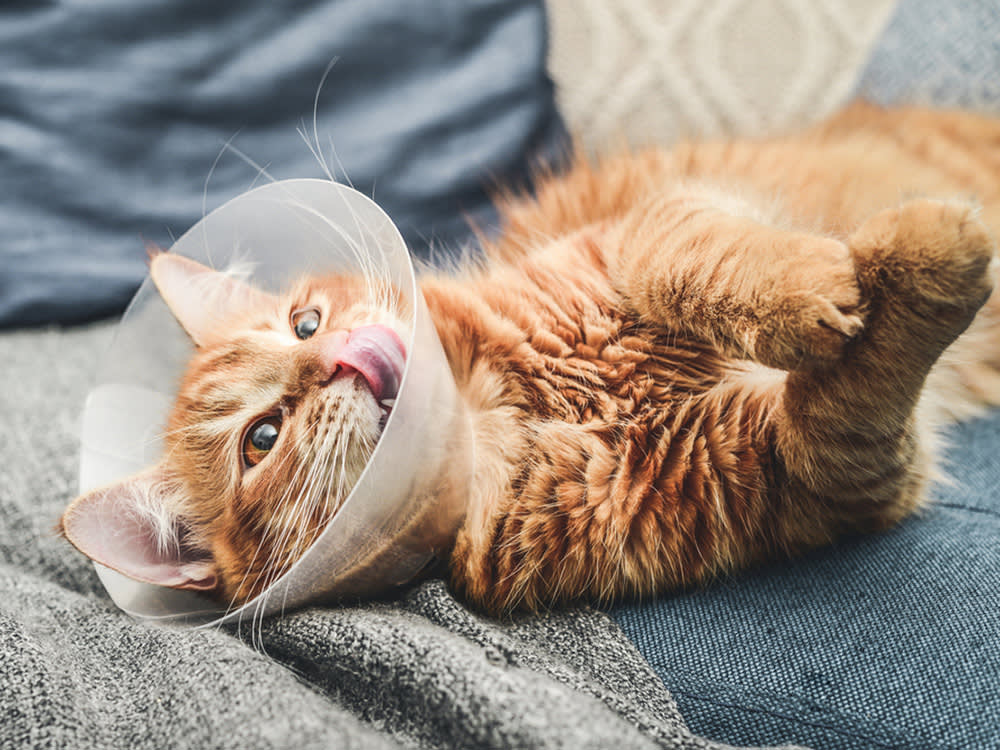
He will likely come home in an e-collar, and it stays on until the incisions have healed. Cats hate cones and are unnervingly talented at twisting out of them, so check that it is still on and that he is not working on the incision. Look at the scrotum and the incisions daily for discomfort, redness, swelling, or discharge, and call your vet if you see any of it.
What’s new since this was written
The advice on when to neuter has moved, and a lot of owners are still working from the old version.
The major veterinary bodies, including the AVMA, AAHA, the American Association of Feline Practitioners, and the Association of Shelter Veterinarians, now endorse spaying or neutering cats by five months of age, an effort usually called “Fix Felines by Five.” Neutering a male cat before he reaches sexual maturity heads off the roaming, fighting, and territorial spraying that get cats surrendered to shelters in the first place, rather than waiting for those habits to form and then trying to reverse them.
The old worry that early neutering causes urinary blockages in male cats, which is why many people were told to wait, has been examined and does not hold up.
The surgery itself is safe from about seven weeks old, provided the kitten is big enough (roughly two pounds). Plenty of practices still schedule around the end of the vaccine series at about four months, which lands comfortably inside the five-month window. If your vet suggested waiting until six months or later, it is a fair thing to ask about.
References
- The “Fix by Five” Initiative: Feline Spay/Neuter by 5 Months of Age Becomes the Accepted Norm — American Animal Hospital Association
- Early Spay and Castration — American Association of Feline Practitioners
- When Should I Spay or Neuter My Pet? — American Animal Hospital Association
- Feline Sterilization at 5 Months Accepted as New Normal — dvm360
Common questions
What should I expect in the first week after neutering?
A quieter cat for a few days, and a hungrier one. Increased appetite is common and shows up fast. Confinement and an e-collar are normal. Weight gain is the thing you are actively preventing from day one.
Do male cats become less affectionate after being neutered?
The opposite, usually. Neutered males tend to be more affectionate with people and more tolerant of other cats in the house.
How long until he calms down?
Testosterone takes about one to two months to clear, so hormone-driven behaviors and odors can persist through that window. Kittens settle faster than adult cats with established habits.
How do I keep him calm while he heals?
Confine him to a crate or a small room without furniture to launch off of. If he genuinely cannot settle, ask your vet about a short course of sedative medication rather than letting him tear the incision open.
What is the best age to neuter a male kitten?
Neutering is safe from about seven weeks old, and the major veterinary bodies now recommend doing it by five months. The old advice to wait until six months or later has been left behind.
Not a substitute for your vet. Our guidance is educational. For urgent symptoms, contact a vet or emergency clinic right away. Editorial standards
Dr. Solis is a board-certified veterinary dermatologist with over twelve years of clinical experience. She advises on skin conditions, allergies, and grooming practices that affect coat and skin health. All dermatology and allergy content at The Pet Times is reviewed by her team before publication.
Meet our experts ↗Keep reading
 Health & WellnessYour Kitten Stops Growing Months Before You Stop Feeding Them Like OneDr. Priya Nair · 7 min
 Health & WellnessYour Cat's Diabetes Can Go Into Remission. The Window Is Smaller Than You ThinkDr. Mara Chen · 11 min
 FoodForget the Clock: Build Your Cat's Feeding Schedule From Calories, Not Meal TimesDr. Mara Chen · 7 min
 FoodHigh-Calorie Cat Food Isn't an Upgrade. It's a Prescription.Dr. Lena Park · 6 min
 FoodYour Cat Isn't Hungry. Unless These Three Things Are Also True.Dr. Priya Nair · 10 min
 FoodYour Cat's 'I'm Starving' Act Is Fake. A Skipped Meal Isn't.Dr. Lena Park · 6 min