


High-Calorie Cat Food Isn't an Upgrade. It's a Prescription.
The bag looks like a treat for a beloved cat. For a healthy adult, it's closer to a mistake. When calorie-dense food is genuinely the right call, when it isn't, and how to read the label either way.

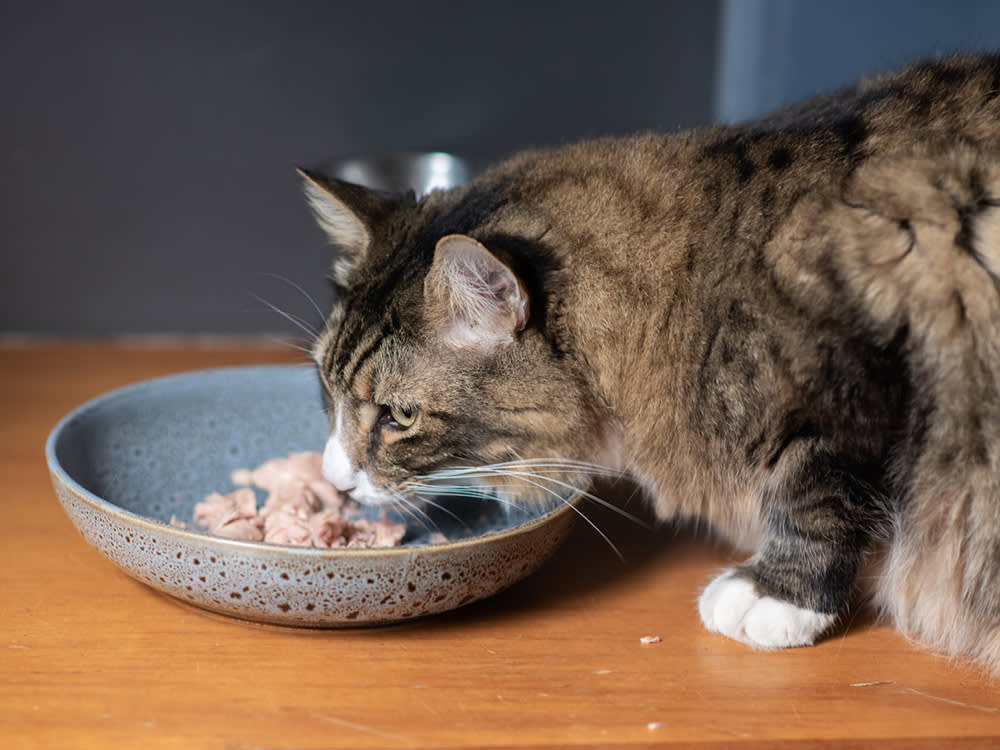
There is a certain kind of cat food that looks like generosity in a bag. It promises more calories, richer meals, a little indulgence for a cat you adore. And for the vast majority of cats, buying it is a quiet mistake. High-calorie cat food is not a premium tier. It is a medical tool, and using it on a healthy adult cat mostly means signing that cat up for weight it did not need.
That reframe matters because the cat food aisle is engineered to confuse. There are diets for every preference, sensitivity, and life stage, and “high-calorie” gets shelved next to all of them as if it were just another flavor of care. It isn’t. Understanding when calorie density is genuinely useful, and when it is the wrong answer, is one of the more practical things a cat owner can learn.
First, how to even spot one
Most high-calorie diets announce themselves, and a good number are available only with a veterinarian’s prescription, which tells you something about how the industry itself views them. But some over-the-counter foods pack in calories quietly, so the label is your friend.
Two things to check. First, confirm the food carries an Association of American Feed Control Officials (AAFCO) statement that it is complete and balanced, so it can actually serve as a daily diet rather than a supplement. Second, find the life stage it is formulated for. Some are labeled for all life stages; others specify adult maintenance only. Once you can read those two lines, the question of whether a calorie-dense food belongs in your cat’s bowl gets a lot clearer.
When calorie density is the right call
There are real situations where packing in calories is exactly what a cat needs, and they tend to be short-term and specific.
Kittens, pregnancy, and nursing. Growing kittens and pregnant or nursing cats have outsized energy demands. A nursing queen needs at least twice the daily calories of an ordinary adult. The challenge is fitting that energy into a small stomach: a kitten or a nursing mother physically fills up before she can eat enough of a low-calorie food to meet her needs. Calorie density solves that, but only within a food that is also complete and balanced for that life stage, which is why the life-stage label matters so much here.
Feeding-tube recovery. The other common scenario is a cat with a feeding tube, often an esophagostomy tube placed in the neck for syringe feeding while the cat recovers from injury or illness. A frequent reason is hepatic lipidosis, or fatty-liver disease, where a cat who has stopped eating may need tube support for weeks to months. Since anything going through a narrow tube has to be liquefied first, the diet has to pack a lot of energy into a small volume so the cat gets enough calories without over-distending the stomach. In these cases the vet gives precise instructions and quantities calculated from the cat’s weight.
The supplement trap
Owners often get pointed toward high-calorie pastes and gels sold over the counter, frequently marketed for kittens as insurance against low blood sugar. Be skeptical. These products are usually loaded with sugar and short on useful nutrients. A healthy kitten simply does not need one. And a kitten that genuinely has low blood sugar almost always has an underlying problem that requires actual treatment; the gel will not fix it, and worse, if a kitten fills up on paste it eats less of the balanced food it truly needs to grow. Use these only under a vet’s direction.
Why a healthy cat should skip it
Here is the part the cheerful packaging skips. Healthy adult cats do not benefit from high-calorie food, even the athletic ones tearing around the house at 2 a.m. Cats are built to eat small, frequent meals, the rhythm of an animal that hunts, and that steady grazing pattern is the healthiest schedule for them.
When an owner tells me their cat seems too thin or is always hungry, my answer is never ‘add a richer food,’ it’s ‘let’s find out why.’ Unexplained weight loss or a bottomless appetite is a symptom, not a preference. There’s a reason behind it, and a calorie-dense diet just paints over the warning light instead of fixing the wiring.
The downsides are concrete. High-calorie diets are often high in fat, which can trigger diarrhea in some cats, and they drive rapid weight gain, which is the entire point when a cat is recovering and a real problem when a cat is not. Indoor cats are especially prone to obesity because they move less and eat more than a hunting cat would. And weight is far easier to add than to lose: excess pounds push a cat toward diabetes, joint pain, and reduced mobility. That is why these diets belong under veterinary guidance, not in an impulse buy.
What’s new since this was written
Feline obesity has only sharpened as a concern. Surveys from the Association for Pet Obesity Prevention continue to find that well over half of US cats are overweight or obese, which makes the casual use of calorie-dense food a bigger deal than it sounds. The current veterinary emphasis is on measuring rather than guessing: using a body condition score to judge whether a cat is actually lean, and weighing or measuring portions instead of free-feeding.
The other shift is toward hydration and protein quality over raw calories. Newer guidance leans on moisture-rich diets and appropriate protein to help cats hold a healthy weight and muscle mass as they age, rather than simply concentrating energy. The upshot for owners is the same as it has always been: match the food to the cat’s real medical situation, and when in doubt, the answer is a vet visit, not a heavier bag.
References
- Association of American Feed Control Officials. “Understanding Pet Food Labels.” aafco.org
- Cornell Feline Health Center. “Feeding Your Cat.” vet.cornell.edu
- Association for Pet Obesity Prevention. “Pet Obesity Prevalence Surveys.” petobesityprevention.org
Common questions
How can I tell if a cat food is high-calorie?
Check the label. Look for the AAFCO statement confirming it's complete and balanced, and note the life stage it's formulated for. Many true high-calorie diets are prescription-only. Some over-the-counter foods are also calorie-dense, so compare the calories per cup or can rather than trusting the front of the bag.
Are high-calorie paste supplements safe for kittens?
They're usually unnecessary and often mostly sugar. A healthy kitten does not need a calorie gel. Genuine low blood sugar in a kitten almost always signals an underlying medical problem that the paste won't fix, so see a vet rather than reaching for the tube.
Not a substitute for your vet. Our guidance is educational. For urgent symptoms, contact a vet or emergency clinic right away. Editorial standards
Dr. Park is a board-certified emergency and critical care specialist. She reviews our health and safety content for clinical accuracy and contributes guides on recognising urgent conditions. Her focus is helping owners act quickly and correctly when it matters most.
Meet our experts ↗Keep reading
 FoodYour Cat Isn't Hungry. Unless These Three Things Are Also True.Dr. Priya Nair · 10 min
 Health & WellnessA Six-Month 'Ozempic' Implant for Fat Cats Is Already in TrialsDr. Lena Park · 5 min
 FoodForget the Clock: Build Your Cat's Feeding Schedule From Calories, Not Meal TimesDr. Mara Chen · 7 min
 Health & WellnessThis Cat Is 26. Her Secret Is 15 Boring Habits, Not One Magic Trick.Dr. Priya Nair · 9 min
 Health & WellnessYour Kitten Stops Growing Months Before You Stop Feeding Them Like OneDr. Priya Nair · 7 min
 FoodWet vs. Dry Cat Food: The Moisture Question Settles Most of ItDr. Mara Chen · 6 min