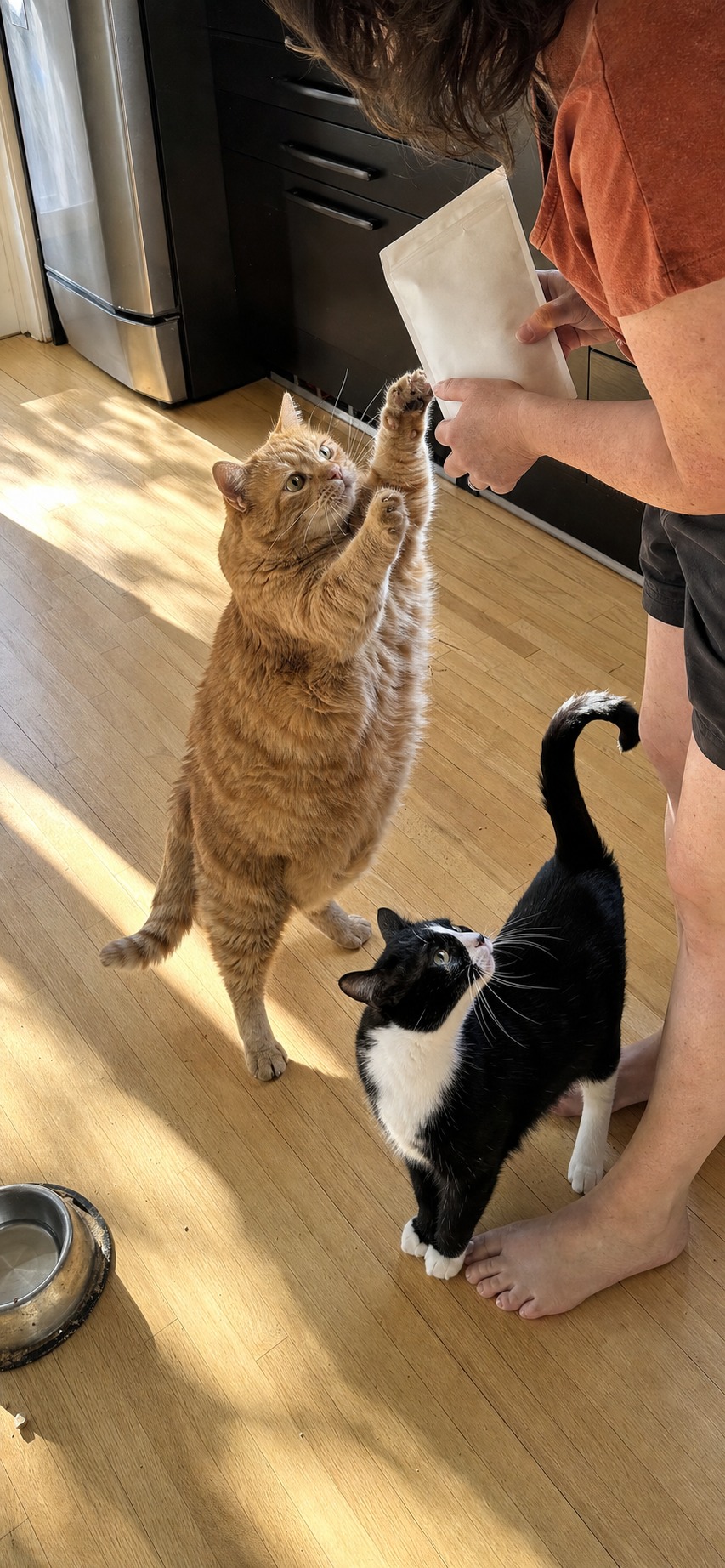
Every cat on earth acts hungry. It is arguably their central skill. The 5am face-pat, the sit-and-stare at an empty bowl, the theatrical collapse in front of the cupboard. If “seems hungry” were a diagnostic criterion, we would have to admit the entire species.
Which is exactly why “my cat is always hungry” is such an unhelpful place to start. The question is not whether your cat is asking. The question is whether the asking is coming from an appetite that a meal can actually turn off.
There is a simple way to find out, and it does not require a vet visit. It requires paying attention to three places most people never look.
The three-place test
Do this for a week. Feed the same measured ration you always feed. Then check:
1. The half-hour after a full meal. This is the single most informative window in the whole picture. A cat that is genuinely, physiologically hungry eats, is satisfied for a while, and then gets hungry again on a normal schedule. A cat that finishes a full portion and immediately resumes campaigning, within minutes, is telling you the drive is not coming from an empty stomach. Something else is running that loop.
2. The scale. Not your hands. An actual number, weekly, at the same time of day, using a baby scale or by weighing yourself holding the cat and subtracting. A cat can lose a fifth of its body mass before the average person notices under the fur. Weight moving in either direction while the food stays the same is the loudest signal you will get.
3. The litter box. Volume of urine and character of stool. More urine and more drinking, alongside more eating, is a specific and worrying combination. Enormous, greasy, poorly formed stools with visible undigested food is a different and equally specific one.
Now put it together.
- Begging is up, but the post-meal satisfaction is normal, weight is stable, and the box looks the same? That’s behavior. Skip to the second half of this piece.
- Begging is up, and the weight is moving, or the drinking and urinating have changed, or the stool has changed? That’s medicine. Book the appointment. Don’t buy a different food and wait.
That is the whole framework. Everything below is the detail.
When it’s medical: what’s actually causing it
Cats do not fake illness well, but they hide it beautifully. These are the conditions that drive a real, biological increase in appetite, roughly in the order a vet would think about them.
Hyperthyroidism. The classic. An overgrown thyroid gland floods the body with thyroid hormone, and the cat’s metabolism runs like an engine with the throttle jammed open. The picture is unmistakable once you know it: ravenous, thinner, often vomiting, often noisier and more active, especially at night. It is overwhelmingly a disease of older cats, and it is common enough in that group to be the first thing on the list. It is also very treatable.
Diabetes mellitus. Without enough insulin, or with cells that won’t respond to it, glucose can’t get into the cells that need it. The body is starving in the middle of plenty. So the cat eats, and eats, and still loses weight, and drinks and urinates far more than usual.
Intestinal parasites. Worms take their cut of every meal before your cat gets any. The cat compensates the only way it can, by eating more. You may or may not see anything in the stool.
Exocrine pancreatic insufficiency. The pancreas stops making enough of the enzymes that break food down. Meals pass through largely undigested. The result is a hungry, thin cat producing large, foul, greasy stools full of food that never got processed.
Inflammatory bowel disease. Chronic inflammation of the gut wall interferes with nutrient absorption. Some cats respond by eating more to make up the shortfall; others eat less because they feel nauseated and sore. Vomiting and diarrhea usually come along.
Cancer. Several cancers produce a syndrome in which a cat loses weight steadily despite eating, through changes in metabolism, impaired absorption, or simply taking in fewer calories per meal than they appear to.
Pregnancy. Obvious in hindsight, easy to miss in the moment. An unspayed female with access to males and a rising appetite deserves a look at her belly and a call to the vet.
Pica. Eating things that are not food, wool, plastic, cords, litter. Sometimes it’s behavioral. Sometimes it points at anemia or a nutritional deficiency. Either way it’s worth investigating, and it’s dangerous in its own right.
Medication side effects. Steroids in particular can crank appetite up substantially. If the hunger started when a prescription did, that is your answer, and the fix is a conversation with your vet rather than a bigger bowl.
“The mistake I see most often is a well-meaning owner treating a medical appetite with a nutritional solution,” says Dr. Priya Nair. “They buy a richer food, feed more of it, and buy the cat six months of steadily worsening disease. If the weight is moving, the food is not the problem.”
How your vet will work it out
Expect bloodwork first: a general panel plus a thyroid level, which catches the two most likely culprits in an older cat straight away. Urine testing follows, and abdominal imaging if the answer isn’t obvious. Treatment then depends entirely on what turns up, which is exactly why guessing at home wastes time.
When it’s behavior: what’s actually causing it
You’ve ruled out disease. The cat is a healthy weight, stable, and still lobbying you around the clock. Now the causes look completely different.
They’re bored. This is the biggest one and the least flattering. A cat indoors is a predator with nothing to hunt. In a life with no prey, no territory to patrol, and nothing that needs deciding, food becomes the only event on the calendar. Cats learn very quickly that food-seeking behavior produces a reaction from you, which means it produces attention, which is itself the reward. The begging outlives the hunger.
The food isn’t doing its job. A diet low in protein or fat, or padded out with filler, can leave a cat eating a reasonable volume and still feeling unfinished. This matters most for growing kittens, pregnant or nursing cats, and any cat with specific needs. Cats are obligate carnivores, and a complete, balanced diet that respects that is what makes a meal feel like a meal.
Somebody else is eating it. In a multi-pet house, the cat who “won’t stop begging” is sometimes the cat who isn’t getting fed. Bullying at the bowl is quiet and easy to miss. Feed separately, in different rooms if necessary, and watch each animal actually eat its own portion.
The gaps are too long. Cats are built to eat many small meals, not two large ones. A cat fed once or twice a day has long, empty stretches to complain about. Timed feeders and puzzle feeders let you split the same daily ration into four, five, or six smaller events without adding a single calorie.
Stress. Moving house, building work, a new baby, a new cat, a change in your schedule. Some cats respond by going off food entirely. Others overeat, sometimes gorging fast enough to bring it straight back up.
Age and body composition. Older cats lose muscle mass, and metabolism shifts. A senior cat can genuinely need a different balance of nutrients than they did at four. That’s a diet plan built with your vet, not a bigger scoop.
How to actually fix a begging cat
If the cause is behavioral, more food is the one intervention guaranteed to make things worse. Obesity is not cosmetic in cats: it drives arthritis, it drives diabetes, and it shortens lives.
Do this instead.
- Split, don’t increase. Take the daily ration your vet signs off on and divide it into more, smaller meals. Same calories, more events.
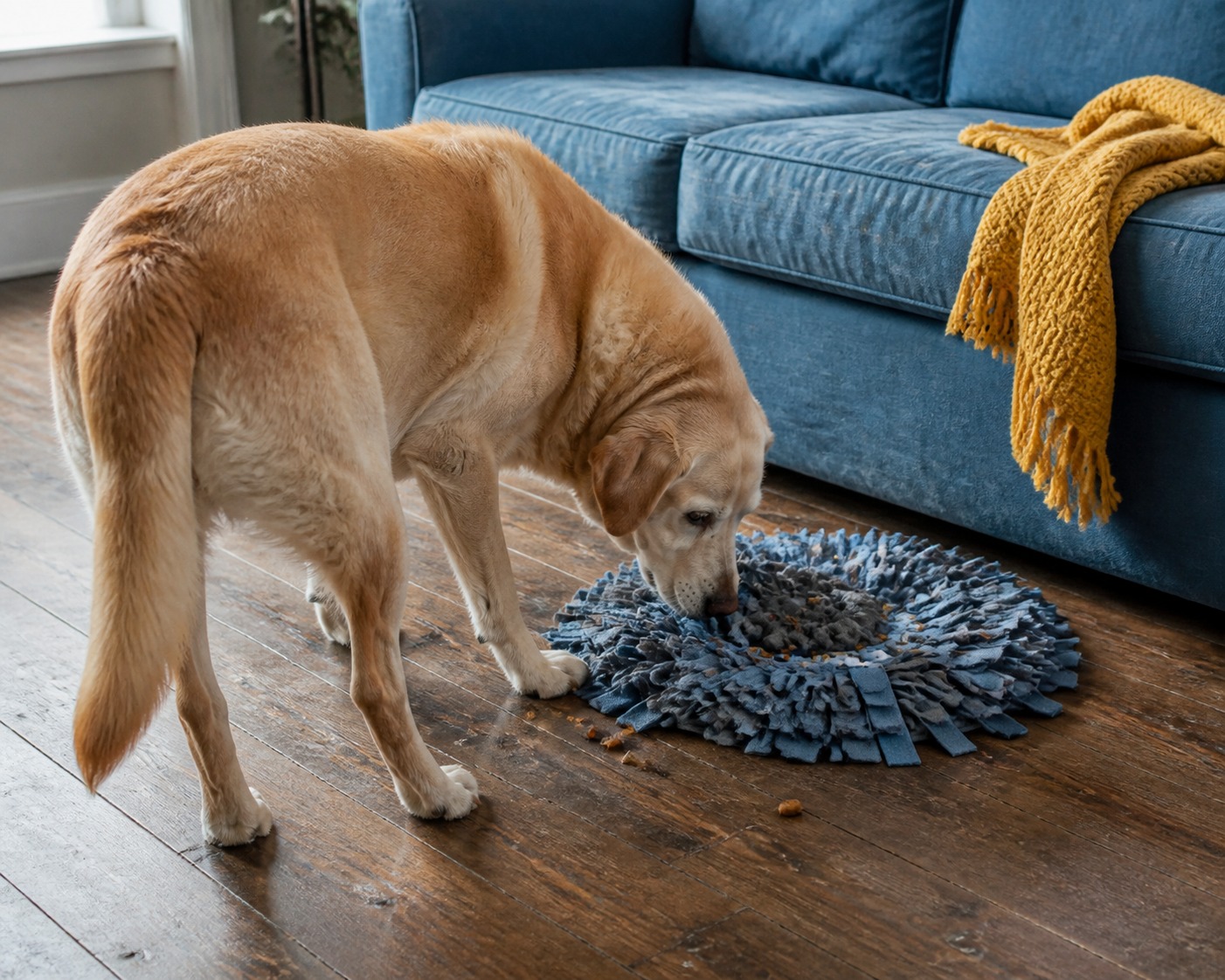
- Make them work for it. Puzzle feeders, treat balls, and food scattered across the house convert eating from a two-minute transaction into a twenty-minute activity that uses the predatory brain.
- Feed the play, not the fridge. When the begging starts outside mealtimes, pick up a wand toy instead of the bag. Play, then a small portion, mirrors the hunt-eat cycle a cat is wired for.
- Stop paying the behavior. Any response, even irritation, is attention. Cats are excellent statisticians and terrible at ignoring an intermittent reward.
- Weigh monthly. It is the only way you’ll notice a problem before it becomes one.
What’s new since this was written
Two things are worth knowing that were not true a few years ago.
The first is about how common thyroid disease actually is. Hyperthyroidism is now the most frequently diagnosed hormonal disorder in older cats worldwide, and in the United States it turns up in something on the order of one in ten cats over the age of ten. If your cat is in that age bracket and eating like a teenager while getting lighter, this is very likely what you’re looking at, and a single blood test finds it.
The second is genuinely good news for diabetic cats, and for the owners who dread the word “insulin.” Until recently, managing feline diabetes meant twice-daily injections, full stop. That is no longer the only option. The FDA has now approved two once-daily oral medications for cats with diabetes, a tablet and a liquid, both in a drug class called SGLT2 inhibitors, which work by letting the body dump excess sugar into the urine instead of replacing the missing insulin.
They are not right for every cat, they don’t suit cats who have already been on insulin, and they carry real risks that your vet will walk you through. But for a newly diagnosed, otherwise healthy cat, a needle is no longer automatically part of the deal. If the last time you thought about feline diabetes was a decade ago, that alone is a reason to have the conversation rather than dread it.
The bottom line
A cat asking for food is a cat being a cat. A cat that eats a full meal and is not satisfied by it, whose weight is drifting, whose water bowl is emptying faster, is telling you something else, and telling you early.
Check the half hour after the meal. Check the scale. Check the box. That’s it. If those three are steady, you have a behavior problem, and it is solvable with a puzzle feeder and twenty minutes of play. If any of them are moving, you have a medical problem, and the fastest, kindest, cheapest version of it is the one you catch this month instead of next spring.
References
- Peterson, M. E. “Hyperthyroidism in Cats: What’s Causing This Epidemic of Thyroid Disease and Can We Prevent It?” Journal of Feline Medicine and Surgery, vol. 14, no. 11, 2012, pp. 804–818. https://pmc.ncbi.nlm.nih.gov/articles/PMC11112171/
- Carney, H. C., et al. “2016 AAFP Guidelines for the Management of Feline Hyperthyroidism.” Journal of Feline Medicine and Surgery, vol. 18, no. 5, 2016, pp. 400–416. https://journals.sagepub.com/doi/full/10.1177/1098612X16643252
- U.S. Food and Drug Administration. “Two New Drugs to Treat Diabetes in Cats — Is One Right for Your Cat?” https://www.fda.gov/animal-veterinary/animal-health-literacy/two-new-drugs-treat-diabetes-cats-one-right-your-cat
- Behrend, E., et al. “SGLT2 Inhibitor Use in the Management of Feline Diabetes Mellitus.” Journal of Feline Medicine and Surgery, 2025. https://pmc.ncbi.nlm.nih.gov/articles/PMC11736986/
- Delgado, M., and L. Dantas. “Feeding Cats for Optimal Mental and Behavioral Well-Being.” Veterinary Clinics of North America: Small Animal Practice, vol. 50, no. 5, 2020, pp. 939–953. https://pubmed.ncbi.nlm.nih.gov/32653265/
- Steiner, J. M. “Exocrine Pancreatic Insufficiency in Dogs and Cats.” MSD Veterinary Manual, 2024. https://www.msdvetmanual.com/digestive-system/the-exocrine-pancreas/exocrine-pancreatic-insufficiency-in-dogs-and-cats
- Cornell Feline Health Center. “How Often Should You Feed Your Cat?” Cornell University College of Veterinary Medicine. https://www.vet.cornell.edu/departments/cornell-feline-health-center/health-information/feline-health-topics/how-often-should-you-feed-your-cat