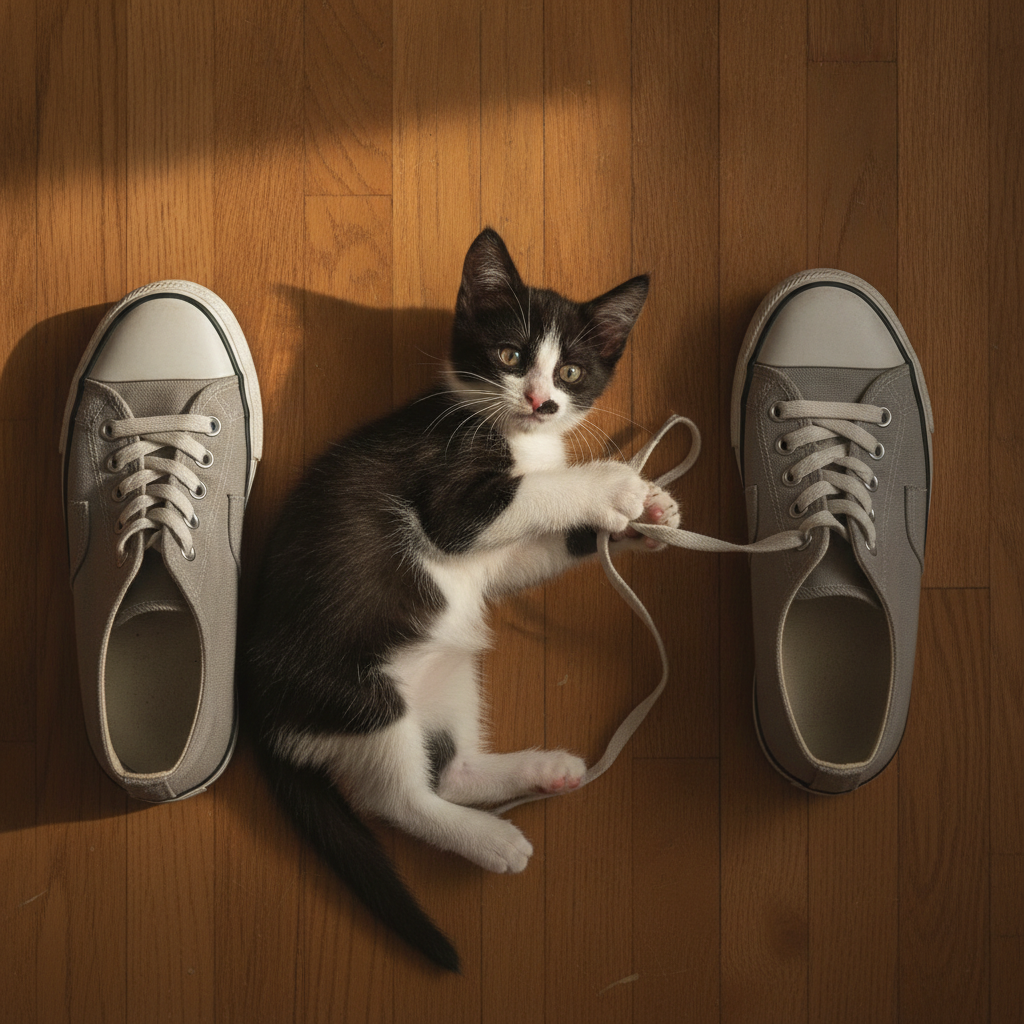
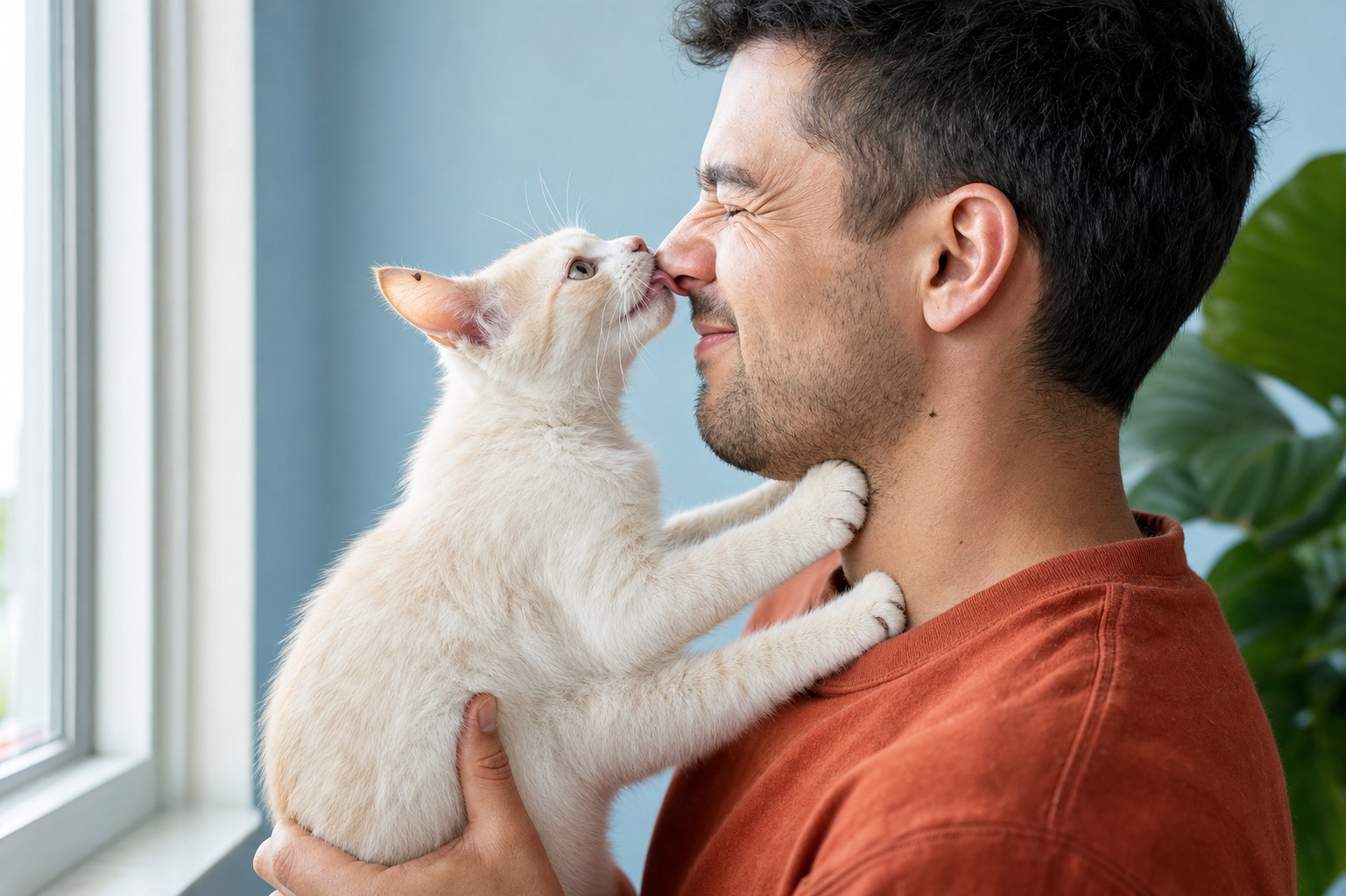
A kitten climbs your chest, plants two front feet, looks directly at you, and starts sandpapering your nose. It is one of the strangest, sweetest things a small animal can do to a large one. And the standard explanation, that they are giving you a kiss, quietly gets the whole thing backwards.
Here is what is actually happening. Cats who live together build a group scent, a shared smell made by grooming each other, rubbing against each other, and generally swapping chemical signatures until the whole household smells like one unit. That group scent is how cats recognize their own and relax around them. When a cat grooms another cat, they are not just cleaning them. They are adding them to the file.
Your face is the part of you that is closest, warmest, and most obviously you. So your kitten climbs up and does maintenance on it. You are not being kissed. You are being enrolled.
Once you see it that way, most of the other explanations stop competing and start stacking.
Everything nose-licking is doing at once
It is affection, in the way cats do affection. Your face is where all the sweet noises come from. You nuzzle their head, you talk to them, you smooch the top of their skull. It makes complete sense that they head for the place where all the action is. Also, and this is not a small point, noses stick out. They are simply the easiest part of a human face to reach.
It is grooming, and you taste interesting. Cats groom constantly, themselves and their companions. Human skin is faintly salty, and it is often carrying a lotion, a sunscreen, or a moisturizer with a scent or taste worth investigating. To a kitten, your face is a slightly savory surface that needs a wash.
It is social bonding. A queen washes her litter. Littermates wash each other. Adult cats who get along keep doing it for life, and some of them extend the service to us. Allogrooming, the technical name, is one of the load-bearing behaviors of cat relationships. It is closeness. It can also, in cat society, carry a mild note of authority: the cat pinning another cat down to lick their head is making a point as well as offering a service.
It might be nursing, sort of. Kittens who were bottle-fed, or weaned early, often keep a suckling fixation, and it can attach to your pinky, your shirt collar, or your nose. If the licking has a rhythmic, trance-like, kneading quality to it, you may be watching a comfort behavior with roots in nursing rather than a grooming one.
And it is attention-seeking, because it works. Kittens are excellent empiricists. Very few humans can be licked on the nose and not react. They log that. Then they use it at 4 a.m., when everything else has failed.
“People are always slightly disappointed when I explain the group-scent part, as though it makes the behavior less loving,” says Dr. Amara Solis. “I would argue it is the opposite. A cat who is mixing their scent with yours is not being polite to a stranger. They are treating you as part of the group. That is a bigger compliment than a kiss.”
When licking is not a compliment
Most nose-licking is exactly as nice as it looks. Two things should make you pause.
Stress licking. Cats self-soothe by licking, and in an anxious cat that can escalate toward compulsion. The tell is not the licking itself, it is whether you can interrupt it. A kitten who is hard to distract, hard to redirect into play, and who returns to the behavior immediately is not comforting you. They are managing themselves.
Look for the rest of the picture: a jumpy kitten who hides, slinks low to the floor, shrinks themselves down, goes off their food or their toys, and flinches when handled. That combination is worth a call to your vet.
Medical causes. Cats are famously bad at telling us when something hurts, and a change in licking behavior is one of the ways it slips out. Oral pain, nausea, and physical discomfort anywhere can all drive more licking than usual.
The rule with kittens is to err early. Not because a licking kitten is likely to be sick, they usually are not, but because kittens have very little margin, and they can go downhill quickly when something is wrong. A sudden increase in licking, especially with anything else off, is a phone call, not a wait-and-see.
The safety rule about your own face
This is the part of the article that actually matters, and it is the part the cute framing tends to bury.
Your kitten is licking whatever you put on your skin. Most of the time, that is a moisturizer, and most of the time, nothing happens. But a few things people routinely wear on their faces are genuinely dangerous to a cat, and the mechanism is exactly this one: the cat licks the treated skin.
The clearest case is topical fluorouracil, the prescription skin-cancer and actinic-keratosis cream sold as Efudex, Carac, Tolak, and Fluoroplex. The FDA has issued repeated warnings about it, and the numbers are stark: of the exposures reported to the agency, every single reported dog died, in some cases after ingesting only a small amount, sometimes within six to twelve hours. Signs can start within thirty minutes. The FDA has not yet received a feline report, but the Pet Poison Helpline calls the prognosis for a cat that ingests it grave, and the agency’s guidance is unambiguous: keep it away from all pets.
That means if you use a prescription cream anywhere your cat can reach, on your face, your arms, your scalp, the answer is not “be careful.” It is that the cat does not get access to that skin until it is washed and covered. Same for the tube. Cats and dogs chew tubes.
Ordinary cosmetics deserve a smaller version of the same thought. Essential oils, salicylic acid treatments, and anything medicated is not something you want a kitten grooming off your nose. If you are wearing it, they do not get the face that night.
The rest of the vocabulary
If you have been enrolled by a kitten, you will start noticing the rest of the affection repertoire.
Purring is the crowd favorite. Cats do purr to self-soothe when stressed, so it is not a perfect happiness meter, but in a relaxed cat in your lap, it means what you think it means.
Kneading, making biscuits, happy paws, whatever you call it in your house, starts as a nursing behavior to stimulate milk flow and never really goes away. It is comfort and security, expressed with claws.
Head-bunting is the full-body version of this whole article. A cat drives their skull into you, then drags the side of the face, the shoulder, and the length of the body along you, laying scent down the whole way. Again: not a kiss. A signature.
Following you around, sitting on your lap, riding on your shoulder, and getting into whatever you are doing are attachment behaviors, plain and simple.
The slow blink is the one you can answer. A cat who narrows their eyes at you slowly and holds it is telling you they are not worried. Return it, then look away rather than staring back, because a hard stare is what a cat does to prey.
What’s new since this was written
The most useful development for kitten parents in the last few years has not come from behavior research at all. It has come from drug safety.
The FDA’s warnings about topical fluorouracil have been strengthened, and manufacturers were asked to add explicit label language: may be fatal if your pet licks or ingests, avoid allowing pets to contact this tube or your skin where it has been applied, store and dispose out of reach of pets. That warning exists because of exactly the behavior this article is about. A pet licked a person’s treated skin.
So enjoy the nose licks. Just make a habit of asking what is on your face before you let a kitten wash it.
References
- U.S. Food & Drug Administration. Don’t Expose Pets to Prescription Topical Fluorouracil Medicine for People.
- U.S. Food & Drug Administration. Fluorouracil and Pet Safety.
- Crowell-Davis, S. L., Curtis, T. M., & Knowles, R. J. (2004). Social organization in the cat: a modern understanding. Journal of Feline Medicine and Surgery, 6(1), 19–28.
- Humphrey, T., Proops, L., Forman, J., et al. (2020). The role of cat eye narrowing movements in cat–human communication. Scientific Reports, 10, 16503.
- Cornell Feline Health Center. Feline Behavior Problems: Aggression.
- ASPCA Animal Poison Control Center. People Foods and Products to Avoid Feeding Your Pets.