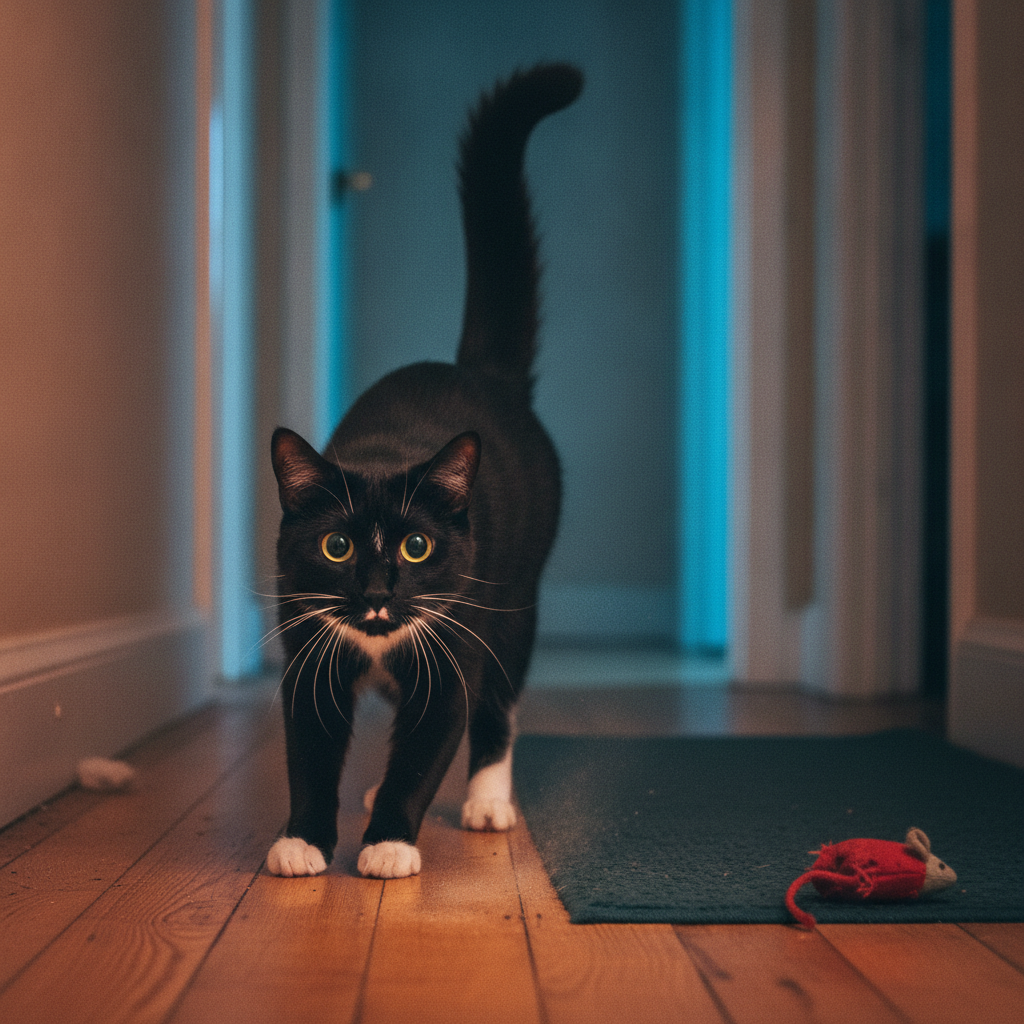
Here is the thing nobody tells you about introducing cats: by the time you see hissing, growling, or swatting, the introduction has already failed.
Not permanently. But that session is over, and the moment you should have acted on passed several minutes earlier, while you were watching two cats sit quietly in a room and thinking it was going well.
Cats are extraordinarily economical with warnings. The loud signals are the last ones. Everything before them is subtle to the point of near-invisibility, and learning to read those quiet signals is the entire skill.
Start with the reason it is so difficult in the first place.
Cats are not built for this
Cats are not designed to meet strange cats and become friends. Instinctually, most cats will fear for their safety and their resources when another cat appears. This is not a personality defect. It is a survival strategy that worked for a very long time.
So when you bring a new cat home and expect the two of them to simply cohabit, you are asking an animal to override a deep instinct on your schedule. When it goes wrong you get stress, aggression, house-soiling, fear, and a genuine collapse in quality of life for everyone.
Which is why the process is slow, and why the slowness is the medicine rather than an inconvenience.
The single rule that governs everything
Neither cat is ever allowed to end up outside its comfort zone.
That is the whole method. Everything below is a technique for implementing it.
Failed introductions almost always fail the same way: too fast, in strides the cats were never going to manage. So you begin somewhere both animals are genuinely relaxed, and you advance in increments so small they feel absurd, alert for the faintest indication of stress.
There is no timeline. None. Not two weeks, not a month. Your cats set the pace, in both directions, and your only job is to notice which direction they are asking for.
The ladder of warning signs
This is the most important list in the article. Learn the bottom of it, because the top of it is the part that gets everybody’s attention and it is far too late.
The loud signals (you have gone way too far)
Hissing. Growling. Swatting. Obvious fear or aggression.
This is a cat shouting NO. End the session immediately. Do not try to push through, soothe them into it, or “let them work it out.” You will make no progress with a cat this frightened, and you have just taught them that the other cat’s presence means something bad happens.
Think seriously about how to turn the intensity way down next time. Not a little. A lot.
The quiet signals (act here)
These come first, and this is where you should be operating:
- Refusing to engage with treats, petting, or whatever positive thing you brought. This is the earliest and most reliable one. A cat that will not eat is a cat that is too stressed to eat.
- Staring intensely at the other cat.
- Trying to look bigger or smaller. Puffing up, or flattening down.
- Ears turning even slightly to the side or back. Even slightly.
- Fidgeting, an inability to settle.
- The tail shifting from a calm, casual swish to an agitated swish or flick.
- Skin twitching or rippling along the back.
- Lip licking.
- Any posture that reads as tense rather than relaxed.
“The signal I train people to watch for above all others is the refused treat,” says Dr. Mara Chen. “It is unambiguous and it comes early. A cat that has stopped eating in the presence of the other cat has told you, quite clearly, that its nervous system has moved out of ‘this is fine’ and into ‘I am monitoring a threat.’ Everything you do after that point is being learned by a frightened animal, which is the opposite of what you want.”
The process, in four stages
1. Scent before sight
The cats are separated, with no visual access at all, and you begin with smell.
Bedding swaps. Leave a scrap of fabric in each cat’s preferred sleeping spot for a day, long enough to soak up their smell. Now cross them over: each cat’s fabric goes into the territory of the other.
Not into the other cat’s bed, which is a trespass. Anywhere else in a room they use is fine. Lay a treat on top of it. You are engineering an association: that animal’s smell arrives with something delicious. Retrieve the fabric a couple of hours later to be re-scented, and repeat tomorrow.
Group scent work. Get a clean cotton sock. Wipe it over one cat’s cheeks and shoulders, which is where the friendly scent glands live. Carry it to the second cat for a sniff. Comfortable? Treat, and wipe the sock over their cheeks and shoulders too. Then return to cat one: sniff, treat, wipe again.
What you are doing is fabricating a shared group scent by hand, which is the actual mechanism cats use to sort family from stranger. It is the single most underrated tool in this whole process.
A cat that objects to the sock is telling you no, so listen. Leave the sock on the floor near them, put a treat on it, and try again the next day.
Both exercises run daily through the early stages, and can drop to every second or third day as things improve.
2. Swapping spaces
Once the scent work is landing well, give the newcomer the run of the house while your existing cat waits somewhere separate and secure.
No spare room? Then you rotate: the newcomer comes out, and your existing cat goes into the room the newcomer just left.
Be honest that this version costs both animals something. Your existing cat is now marinating in a stranger’s smell with nowhere to retreat to, and the newcomer has been locked out of the only safe place it has. Make those rotations brief, and make them pleasant, until both cats have more confidence to spend.
3. Barrier work
This is the heart of it, and it is slower than you want.
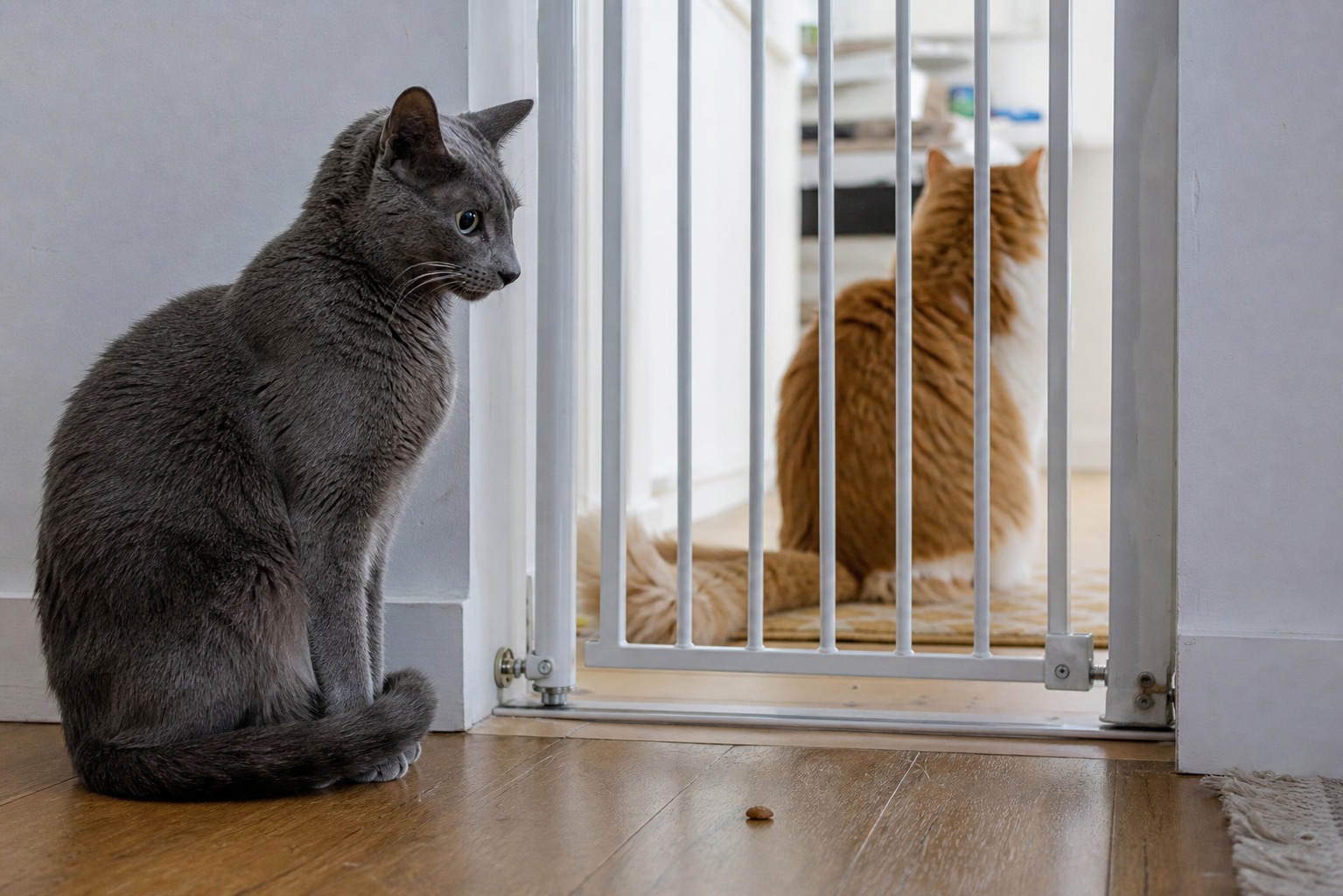
Build a see-through barrier you can cover. Two or three stacked baby gates works. A screen door works.
Keep sessions short. Once a day or more. Both cats focus on something positive throughout.
Do not use their meals for this. Use treats, petting, catnip, gentle play, brushing, something mellow they enjoy. Meals are too high-stakes; you do not want a cat’s dinner to be contingent on tolerating a stranger.
Begin with the barrier fully covered, so neither cat can see the other. Set them so far apart that neither reacts at all and both can give their whole attention to the nice thing in front of them. Shut the door when the session ends so nobody can get to anybody.
Then narrow the distance, glacially. Nudge them a little closer every second or third session, as long as nothing is going wrong. Halt at roughly five feet.
Then uncover, a few inches at a time. Over many sessions. Not one session. Many.
Once the barrier is fully uncovered and they are relaxed, extend the sessions. Let them move around, do their own thing, with the barrier, the distance, and the good thing all still available as safety nets. If they are tense or fearful, they are not ready.
Then start opening the barrier, gradually, over multiple sessions, going back to short durations with both cats fully engaged in their positive thing.
4. Sharing space
Short, supervised sessions in a neutral room where both cats feel comfortable. Set their positive activities on opposite sides. Over many sessions, move them closer and extend the time.
Eventually, ease off the distractions and let them simply exist together, watching for tension and redirecting attention to something positive when you see it. When that is going well, try unsupervised time, and then full-time.
When it goes wrong: turn the dial down
Any warning sign means the intensity is too high. You have five dials, and you can turn any or all of them:
- Back up to the previous step.
- Increase the distance between them.
- Cover more of the barrier, or all of it.
- Shorten the session.
- Raise the value of the reward. Swap the everyday treat for something spectacular.
And hold on to this, because it is the thing people get wrong: the goal is never to hold a frightened cat in place until the fear wears off. The goal is to move so gradually that the fear never arrives. A stressed cat is not an obstacle to be waited out. A stressed cat is evidence that you asked for too much.
The resource question, which is really the jealousy question
People describe their cats as jealous. Usually it is not jealousy, it is competition for resources, and it is fixable with arithmetic.
Food, water, litter boxes, high perches, hiding places, scratchers, beds. Multiples of everything, spread out through the home, not clustered in one room where a confident cat can control access.
And here is the part people miss: you are a resource too. Your attention and your time are competed over exactly like a food bowl. Tension over your lap is not sentimentality; it is the same instinct.
What newer research adds
Two findings are worth carrying into this.
Work out of Ohio State found that healthy cats begin showing sickness behaviours when their routine is disrupted: vomiting, appetite loss, house-soiling, hiding. That reframes the introduction period entirely. The upheaval itself is a physiological stressor, and a cat that starts vomiting during an introduction may not be ill and may not be “reacting” to the other cat. It may simply be a cat whose world stopped being predictable.
The second is the consistent finding that humans are poor at recognizing negative emotional states in cats. We are good at spotting a happy cat and unreliable at spotting a frightened one, which is precisely why the hiss always seems to come from nowhere.
It never comes from nowhere. It comes at the end of a long, quiet, entirely legible sequence that we were not watching.
Watch the ears. Watch the tail. And above all, watch whether they will still eat.
References
- Ohio State University Indoor Pet Initiative. “Conflict between Cats.” https://indoorpet.osu.edu/cats/problemsolving/conflict
- Stella, J. L., Lord, L. K., and Buffington, C. A. T. “Sickness behaviors in response to unusual external events in healthy cats and cats with feline interstitial cystitis.” Journal of the American Veterinary Medical Association, vol. 238, no. 1, 2011. https://avmajournals.avma.org/
- Cornell Feline Health Center. “Feline Behavior Problems: Aggression.” https://www.vet.cornell.edu/departments-centers-and-institutes/cornell-feline-health-center/health-information/feline-health-topics/feline-behavior-problems-aggression
- Rodan, I., et al. “2022 AAFP/ISFM Cat Friendly Veterinary Interaction Guidelines: Approach and Handling Techniques.” Journal of Feline Medicine and Surgery, vol. 24, no. 11, 2022. https://journals.sagepub.com/doi/10.1177/1098612X221128760
- International Cat Care. “Introducing a new cat to your household.” https://icatcare.org/advice/introducing-a-new-cat-to-your-household/