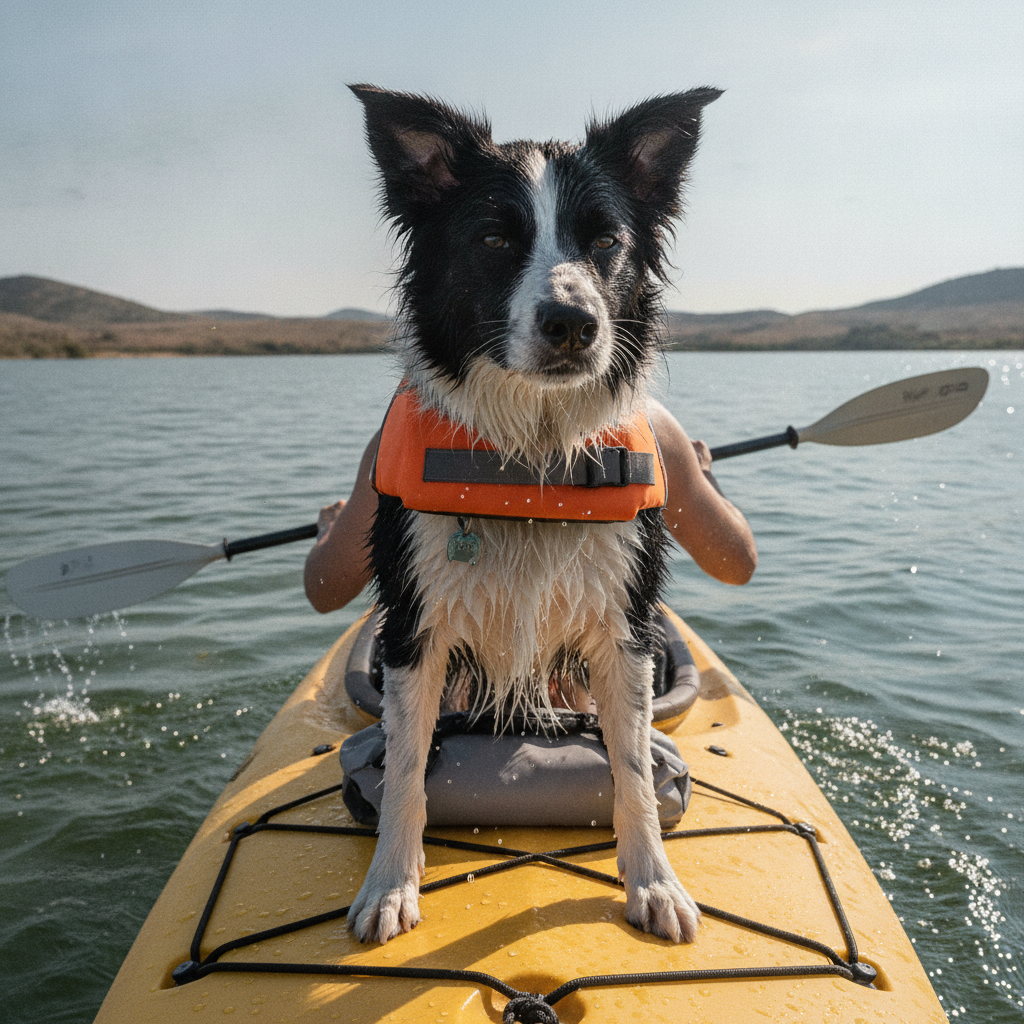
Everybody planning their first paddle with a dog worries about the same thing: will the dog stay in the boat? It is the wrong worry. Dogs fall out of kayaks all the time and it is almost always a non-event, because they are wearing a life jacket and the water is three feet deep.
The things that actually put dogs in a veterinary hospital after a day on the water are not the boat. They are the water: toxic algae, heat, and drinking too much of the lake. Prep for those and the paddling part takes care of itself.
First, is your dog even a candidate?
This is a real gate, not a formality.
Your dog needs to be genuinely comfortable in and around water. Not tolerant, comfortable. A dog who is uneasy near water is not going to have a revelation two hundred yards offshore. They need to wear a life jacket without shutting down, and they need to take basic cues reliably enough that you can manage them with your hands full of paddle.
You know your dog. If they are a senior, or have joint, heart, or respiratory issues, run it by your vet first. Sitting braced on a moving surface for a couple of hours is more physical work than it looks like from the dock.
The four cues that do the work
Skip the general obedience lecture. These four are the ones that earn their keep on a kayak:
- Wait. Keeps the dog in the boat, or beside it, until you say otherwise. This is the one that prevents an unscheduled swim during launch.
- Free. The release. It tells the dog they may now get out, which means every other moment is not a decision they get to make.
- Leave It. For the heron, the duck, the floating water bottle, and the mystery object drifting past that a dog would otherwise very much like to investigate.
- Place. Their spot on the boat. A dog who knows where they belong is a dog who is not wandering toward the bow while you are trying to steer.
The part almost nobody trains: balance
A kayak is an unstable surface. Dogs are not born knowing what to do on one, and the ones who panic tend to panic because the world moved and their feet did not know what to do about it.
The fix is weeks of low-stakes work on land. An inflatable balance peanut like the FitPaws inflatable peanut, which is basically an elongated exercise ball scaled to a dog, teaches a dog to make constant micro-corrections without any of it being scary. A wobble board or a crate propped on fitness discs does the same job.
It sounds silly right up to the moment your dog decides to climb onto the bow of the kayak mid-paddle and then has to scramble back into the cockpit. That scramble is a balance skill, and it is either trained or it is not.
Your first trip should not be your idea
For a first outing, call a local outfitter or kayak instructor and ask whether they run dog-specific trips. A lot of them do, they are usually short, they are led by someone patient who has watched a hundred dogs figure this out, and many provide canine life jackets. A good one will include a stop at a sandbar so the dogs can get out, run, and reset.
The point of a short guided trip is information: you find out whether your dog actually enjoys this before you commit them to six hours on the water.
The life jacket, and the one feature that matters
Life jackets are not optional, and “my dog is a great swimmer” is not an argument. A strong swimmer who goes over the side in cold water, in current, or while startled, is still a dog in the water next to a boat you are trying to control.
Buy the jacket with a grab handle across the back. It is the difference between hauling a soaked forty-pound dog up over the gunwale by the handle and trying to do it by the armpits while your kayak tips.
“The life jacket isn’t for the swim you planned. It’s for the ninety seconds you didn’t plan, when the dog is in the water, you’re off balance, and you need one hand free,” says Dr. Ravi Mehta.
The three water hazards that actually hurt dogs
Toxic algae. This is the one to take most seriously. Cyanobacteria blooms, the blue-green algae you see as scum, paint-like streaks, or bright green mats along shallow, marshy edges, produce toxins that can cause liver failure, neurological damage, and death within hours of a dog drinking or licking it off their coat. Of the harmful blue-green algae calls the ASPCA Animal Poison Control Center logged over one recent multi-year stretch, more than 99 percent involved dogs. Blooms have been surging in the record heat of recent summers, and state health departments post advisories through the season. Before you launch: if the water looks foamy, scummy, or thick like paint, do not put your dog in it. If your dog does swim in questionable water, rinse them with clean water immediately so they do not lick it off later.
Water intoxication. A dog who repeatedly retrieves in water, or bites at the wake, or plays in the shallows for hours, can swallow enough water to dangerously dilute their blood sodium. Early signs are lethargy, vomiting, staggering, and glazed eyes, and it can escalate quickly. It is rare, and it is exactly the sort of rare thing that happens on the one day your dog got three hours of fetch off the back of a kayak.
Sun and heat. Water reflects sun straight up onto the parts of a dog that have the least protection: the nose, the ear tips, and the belly, which is fully exposed when a wet dog lies down on a hot deck. Dogs sunburn. Use a dog-formulated sunscreen on the exposed areas, and consider sun-protective clothing. Bring shade and take breaks.
What to pack
- Water, and more than you think
- Treats
- Food, if you will be out all day
- A travel food bowl
- Life jacket
- A towel
- Water-friendly toys
- Dog goggles or sunglasses, if your dog will tolerate them
- Poop bags, including for the possibility that your dog goes in the kayak
- A first aid kit
- Dog sunscreen
What’s new since this was written
The algae picture has gotten worse, not better. Hotter summers and warmer water have made cyanobacteria blooms more frequent and longer-lasting across US lakes and reservoirs, and 2026 has been one of the heavier advisory years in recent memory.
The useful upgrade for anyone paddling with a dog is that you no longer have to guess. The EPA-supported Cyanobacteria Assessment Network app (CyAN) maps bloom conditions on more than 2,000 of the largest US lakes and reservoirs, and most state environmental agencies now publish live harmful-algal-bloom advisories by waterbody. Checking one of those before you load the car takes about thirty seconds and rules out the single most lethal thing your dog will encounter that day.
The CDC’s guidance is blunt and worth internalizing: if you see thick, brightly colored foam, scum, or mats, keep your pet out of the water, and if they get in anyway, wash them off with clean water before they groom.
References
- Centers for Disease Control and Prevention. “Preventing Pet and Livestock Illnesses Caused by Harmful Algal Blooms.” https://www.cdc.gov/harmful-algal-blooms/prevention/preventing-pet-and-livestock-illnesses.html
- “Geographic Variability, Seasonality, and Increase in ASPCA Animal Poison Control Center Harmful Blue-Green Algae Calls, United States and Canada, 2010–2022.” https://www.ncbi.nlm.nih.gov/pmc/articles/PMC10467101/
- National Centers for Coastal Ocean Science. “Protecting Your Dog from Harmful Algal Blooms.” https://coastalscience.noaa.gov/news/protecting-your-dog-from-harmful-algal-blooms-information-and-resources/
- American Canoe Association. “Safety Tips for Paddlers.” https://americancanoe.org/safety/