


That Bootie Wobble Isn't Funny. You Just Blindfolded Their Feet.
The high-stepping stumble is a sensory problem, not a comedy bit. Here's what boots actually do to a dog's balance, and how to train the sensation instead of the shoe.

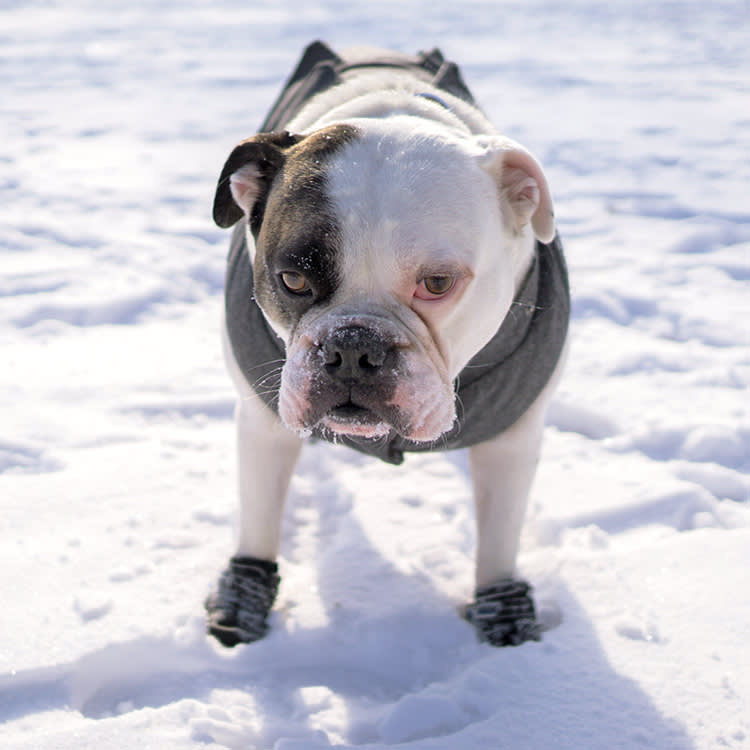
You know the video. The boots go on, and the dog turns into a marionette. Legs come up like they are wading through invisible syrup. Sometimes they just freeze, one paw aloft, staring at you with an expression of profound betrayal.
It is genuinely funny. It is also a fairly precise description of what happens when you interfere with an animal’s proprioception, and once you understand the mechanism, the training fix stops being guesswork.
Because here is the thing everybody gets wrong. The dog is not confused by the idea of shoes. The dog has lost a sense.
The paw is a sensor, not just a foot
A dog’s paw is packed with sensory receptors. They report pressure, texture, temperature, and, critically, the position of the limb in space. That last one is proprioception, the sense that lets you touch your nose with your eyes shut, and dogs get a huge amount of theirs from direct contact between paw pad and ground.
Wrap the paw and you mute the feed. The dog is still getting some information, but it is dulled, delayed, and wrong, so they compensate the only way they can: by lifting the foot higher than necessary and putting it down deliberately, checking whether the floor is still where it was. That is the high-step. It is not clownishness. It is an animal navigating with a downgraded instrument.
Boots also change the mechanics. They alter how the joints move and how pressure distributes across the foot. So the dogs who struggle most are the ones with the least margin: puppies, seniors, dogs with arthritis, and dogs with any neurological sensitivity. Some stumble. Some fall. Some simply refuse to move, which stops being funny when it is 15°F, the ground is covered in road salt, and your dog needs to pee.
The wobble tells you the boot is working, in a sense: it is doing exactly what it is designed to do, which is get between the paw and the world. Our job is to give the dog enough repetitions to trust the new information. That takes days, not one hilarious evening.
First, decide whether you need them at all
Plenty of dogs never need boots. Before you commit to the training, be honest about your climate.
Winter. Once the thermometer falls below roughly 20°F, a coat and boots become genuinely protective gear, and outings should be short: five to 10 minutes is the usual guidance. Temperature aside, salt and de-icer deserve their own worry. They irritate and can burn the pads, and a dog who licks their feet clean afterward is swallowing the stuff. In a heavily salted city, boots are less about the cold and more about the chemistry.
Summer. Hot pavement is the underrated hazard. The test is your own hand: hold the back of it against the surface for seven to 10 seconds. If you cannot, neither can your dog.
And the numbers behind that test are worse than people assume. Classic burn research found that at just 87°F air temperature, asphalt reached 143°F. Work out of Maricopa County, Arizona, documented that pavement in that range can produce second-degree burns in about 35 seconds of contact. Human skin can be destroyed in 60 seconds on black pavement at 125°F. That is not a long walk. That is a trip to the mailbox.
Train the sensation, not the shoe
The core mistake is doing all four boots at once, on a cold night, because you need to be outside in ten minutes. That gives your dog a single overwhelming experience and no reason to trust the next one.
Start with the paws themselves. If your dog pulls their foot away when you reach for it, that is your first project, not the boots. A dog yanking a paw back is communicating clearly, and pushing through that is how you get a dog who escalates. Spend a week paying them for calm paw handling: touch, treat. Hold for a second, treat. Build.
Cooperative care helps here more than restraint does. If you can teach your dog to offer the paw, you never have to hold it, and holding or restraining a foot is often the actual thing they hate, not the boot.
Then one boot, indoors, for a short period. Let them wander around with a single boot on carpet while the other three feet still report normally. Feed treats while it goes on and comes off. Keep the session short and end it while they are still happy.
Build slowly to four. Brief, relaxed, well-paid sessions. Practice around the house before you practice on the street.
Then go somewhere great. The first real outing should be a familiar route or a place your dog loves. Distraction does most of the work here: once a dog is busy smelling things and looking at other dogs, they largely forget about their feet, and the gait normalizes on its own.
And do all of this in the fall, not on the first hard freeze. The single most common reason bootie training fails is that it was started on the day the boots became mandatory.
If your dog truly hates them
Some dogs are not going to get there, or not fast enough. The aversion can run deeper than balance: anxious dogs sometimes object to the sound of the boot on the ground, or the sensation at the ankle, and dogs who dislike having their feet handled start from a hole.
You have real alternatives.
Paw balms and waxes (Musher’s Secret is the classic) coat the pad in a film that holds off ice, road salt, and cold for the length of a walk, while leaving the pad still touching the ground, which sidesteps the entire proprioception problem. They wear off and need reapplying, which is the trade. If you use one, trim the excess fur between the pads, since that fur is what ice balls up in.
Full-leg protective gear sounds more cumbersome and often works better. Because the pressure is distributed up the leg rather than concentrated as a cuff at the ankle, some dogs find it far less constricting than a boot.
Or shorten the exposure. Shorter walks in the worst conditions, rinsing paws immediately after a salted route, and choosing grass over sidewalk are all legitimate strategies for a dog who will not wear anything.
Fit, because bad fit is half the problem
A boot that is too big rotates, and a rotating boot is a dog stepping on a moving surface, which makes the balance problem permanent. A boot that is too tight is uncomfortable and will get chewed off. Measure the paw, size to the measurement rather than to the dog’s weight, and check the fastener actually holds without cutting in.
If your dog seemed to be improving and then regressed, check the fit before you blame the training.
What’s new since this was written
The idea that has moved from rehab practice into general training in the last few years is cooperative care, and boots are one of its best use cases. Rather than restraining a dog to get equipment on, you teach them a behavior that means “I am ready,” a chin rest, a paw lift, a stationing behavior, and you stop the moment they break it. The dog gets a say. Compliance goes up, and so does what they will tolerate.
It sounds soft. It is actually the more efficient route, because a dog who has never been forced through paw handling does not develop the avoidance that makes boots a fight in the first place. Start there, and the wobble becomes a weekend, rather than a war.
References
- Berens, J. J. (1970). Thermal contact burns from streets and highways. JAMA, 214(11), 2025–2027.
- Harris, C. R., & Ruiz, R. (1995). Pavement temperature and contact burns. Maricopa County, Arizona, burn-injury research.
- VCA Animal Hospitals. Cold Weather Safety Tips for Dogs.
- American Veterinary Medical Association. Cold Weather Animal Safety.
- Washington State University College of Veterinary Medicine. Protect Your Pet’s Feet From Heat and Burns.
- Fear Free Pets / cooperative care literature. Deldalle, S., & Gaunet, F. (2014). Effects of 2 training methods on stress-related behaviors of the dog. Journal of Veterinary Behavior, 9(2), 58–65.
Common questions
What if my dog absolutely refuses?
Paw balms and waxes are a legitimate alternative, and so is full-leg protective gear, which some dogs tolerate better than boots. A dog who will not wear boots is not a training failure. They are a dog who needs a different tool.
How do I know if the pavement is too hot?
Put the back of your hand flat on the surface for seven to 10 seconds. If you cannot hold it there, your dog cannot stand on it. At 87°F air temperature, asphalt has been measured at 143°F.
Dr. Kohl is a board-certified veterinary dentist with a particular interest in preventive oral care. She reviews all dental health content at The Pet Times and contributes practical guides on home dental routines, professional cleaning, and oral disease prevention.
Meet our experts ↗Keep reading
 TrainingThe Viral 'Run Away From Your Dog' Trick Works. You Get to Use It Once.Dr. Mara Chen · 7 min
 TrainingThe 'Gentle Leader' Isn't Automatically Gentle. Read This Before You Buy One.Dr. Ravi Mehta · 7 min
 Product PicksDog Shoes Don't Fail Because They're Ugly. They Fail Because They Fall Off.Sasha Ford · 5 min
 Product PicksRescue Workers Swear by This Collar. Most People Use It Wrong.Dr. Nina Kohl · 7 min
 Product PicksYour Dog Can't Walk Out. A Pocket-Sized Sling Can Carry Them.Tom Hadley · 4 min
 Health & WellnessAn ER Vet on Why Walking Your Dog by the Collar Is a Quiet GambleDr. Amara Solis · 6 min