Every dog gear debate eventually lands on the same question: collar or harness? Plenty of people never think about it at all. They clip the leash to the ring on the collar, the same ring that holds the ID and rabies tags, and head out the door. It works fine, most days, for most dogs. But “most days” is doing a lot of quiet work in that sentence, and as an emergency vet, I think about the other days.
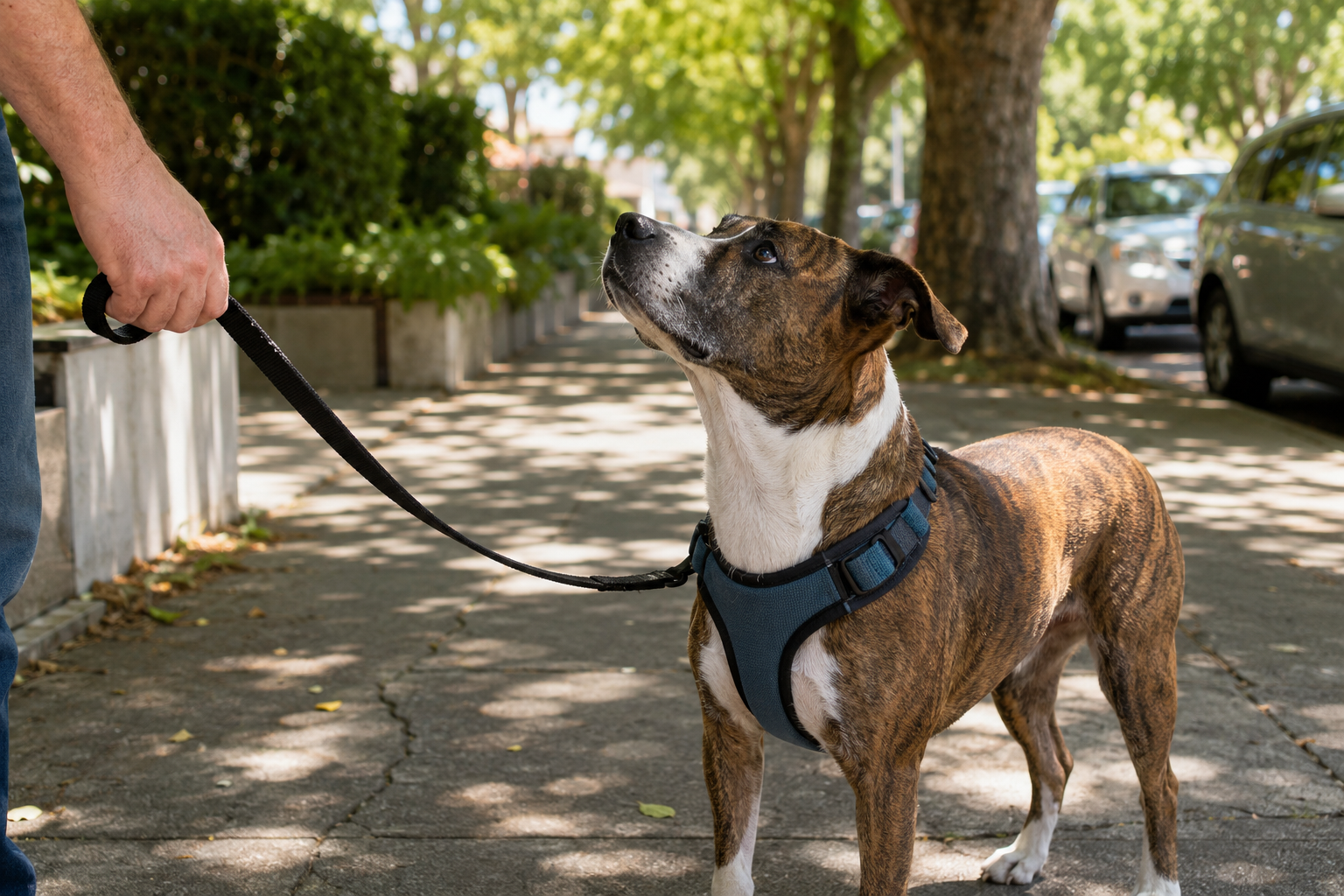
So let me reframe the whole argument. This is not really about judging anyone, and it is definitely not about your dog needing to look a certain way on a walk. It is about one blunt piece of anatomy: a collar concentrates every pull, lunge, and sudden stop onto the narrowest, most fragile part of your dog, the neck and the windpipe running through it. A harness takes that same force and spreads it across the broad, sturdy plate of the chest. Once you see the walk in terms of where the force goes, the collar starts to look less like a default and more like a gamble you are taking without meaning to.
What a collar actually does to a pulling dog
Here is the mechanics. When a dog on a collar hits the end of the leash, whether they lunged at a squirrel or you both stopped short at a curb, all of that energy loads directly onto the throat. Do it once and most dogs are fine. Do it repeatedly, day after day, and you are putting steady trauma on the trachea and the soft tissue of the neck.
In an ER, we see the sharp end of this. Choking injuries in dogs who yanked hard against a neck collar. Dogs whose existing neck pain flared badly after weeks of pulling. Dogs with intervertebral disc disease (IVDD) in the neck whose condition worsened under repeated strain that a harness would have absorbed. None of these dogs woke up sick. They were walked, normally, on a collar, by owners who had no idea the gear was part of the problem.
“The dogs I worry about are not the dramatic emergencies, they’re the slow ones,” says Dr. Amara Solis. “A little pressure on the windpipe, over and over, on every walk, for years. By the time a dog is coughing or guarding their neck, the damage has been quietly accumulating. A harness is the cheapest insurance policy in the pet aisle, and I wish more people bought it before they needed it.”
The three things a harness does better
Beyond protecting the neck, a harness wins on the practical stuff too.
Control. Even a small, generally well-behaved dog can bolt toward something irresistible, and a sudden tug from the neck can pull you both off course. A harness gives you steering over the whole body, which makes it far easier to keep an excited or distractible dog on track and out of trouble.
Security. A dog who panics and tries to back out of their gear has a much harder time escaping a snug harness than a neck collar that is even slightly loose. If your dog is between sizes, and sizing varies wildly between brands, the harness is simply the safer bet against a loose-dog emergency.
Comfort. Most dogs do not much care what they wear as long as a walk is on the other end of it. But pressure across the chest is genuinely more comfortable than pressure on the throat, and dogs who have only ever been walked on a harness often visibly dislike the feel of a leash on the neck when you try it.
Which dogs are not optional
For some dogs, this stops being a preference and becomes a real recommendation. Reach for a harness if your dog checks any of these boxes:
- Is big and strong enough to drag you the moment something grabs their focus
- Is still learning the basics of walking on a leash
- Has ever shown aggression, even toward particular dogs or people, since you want the most body control possible
- Carries any history of neck pain or a prior muscle injury in that area
- Has ever been diagnosed with a collapsing trachea
- Is a flat-faced (brachycephalic) breed already working with limited airflow
If your dog fits any of those, treat the harness as standard equipment, not a debate.
If you’re keeping the collar, do it right
Walking a calm, trained dog on a collar is not automatically a red flag. If that is your dog, a few rules keep it safe.
Fit it properly. A collar should be snug enough that your dog can’t slip it, loose enough for two fingers to fit underneath. Two fingers with a struggle means too tight; two fingers with room to spare means too loose. And mind your dog’s shape: Greyhounds and Whippets have heads narrower than their necks, so an ordinary collar slides right off. They need a martingale, which distributes pressure evenly and only tightens when the dog pulls, making it safer for any dog, honestly.
Pick a comfortable one. Leather, nylon, and neoprene all work well when fitted right; the choice is mostly style. Skip skinny collars on bigger dogs, the wider the dog, the wider the collar should be. And skip prong and “choke” collars entirely. They work by causing discomfort to stop pulling, and there are kinder, more effective tools. Use a comfortable collar plus positive reinforcement instead.
Train the walk. The real fix for pulling is not gear, it is teaching loose-leash walking and solid recall so your dog comes back even with distractions around. Think of the collar walk as something a dog graduates to once they have learned to keep slack in the leash and stay near you, not the starting point.
One more thing, whichever camp you land in: please do not use a retractable leash. That is a rant for another day, but the short version is that they teach pulling, give you almost no control in an emergency, and cause a startling number of injuries. Clip a fixed leash to a well-fitted harness, and you have quietly removed most of the ways a walk can go wrong.
What newer research adds
Harness design has gotten smarter, and the current advice goes a step beyond “harness good, collar bad.” For dogs who pull, trainers increasingly favor a well-fitted front-clip or dual-clip no-pull harness, which redirects a lunging dog sideways rather than letting them lean into the pressure the way they can with a back-clip model or a collar. Fit still matters more than brand: a harness that rubs the armpits or restricts the shoulders can affect a dog’s gait, so look for one shaped to sit clear of the joints and check it as your dog grows or changes weight. The throughline has not changed, though. Keep steady force off your dog’s neck, match the tool to your individual dog, and when in doubt about airway or neck issues, let your vet make the call.
References
- American Kennel Club. “Dog Harness vs. Collar: Which Is Better?” AKC Expert Advice.
- American College of Veterinary Surgeons. “Tracheal Collapse in Dogs.” ACVS Animal Health.