Grooming is one of the only things we hand our dogs over for, walk away from, and never watch. And it is one of the only pet services in America where the person doing it is not required to prove they know how.
That is not an exaggeration. As of 2026, no US state requires a license to practice pet grooming. Certification programs exist, and good groomers pursue them, but they are voluntary. The salon down the block can open with a business permit and a pair of clippers. That gap is the actual story behind the small number of dogs who go in for a bath and do not come home.
The good news is that the gap is easy to close from your side of the counter, and it mostly comes down to one piece of equipment.
How often does this actually go wrong? Rarely, and the number is worth holding onto so you can keep your head. Reporting on the industry documented close to 50 cases between 2008 and 2018 in which families said their dog died immediately after a grooming appointment. Across tens of millions of grooms, that is a vanishingly small share, and the overwhelming majority of groomers are careful people who love dogs. The problem is that “rare” is no comfort at all when it is your dog, and the cases that do happen are strikingly preventable. It took a celebrity’s Chihuahua dying after a routine appointment in 2024 for most people to learn that nobody was checking the salon’s credentials, because there were no credentials to check.
The dryer is the question, not the haircut
When people vet a groomer, they look at the cut. They should be looking at the drying.
Cage drying means the dog goes into a kennel and a blower forces air into the enclosure while the groomer works on the next dog. It is fast, it is cheap, and it removes the one safeguard that matters: a person standing there. A dog in a dryer cage cannot leave, cannot be read, and cannot tell anyone that the air is too hot or that they have been in there too long. Heat builds. So does panic. The two feed each other.
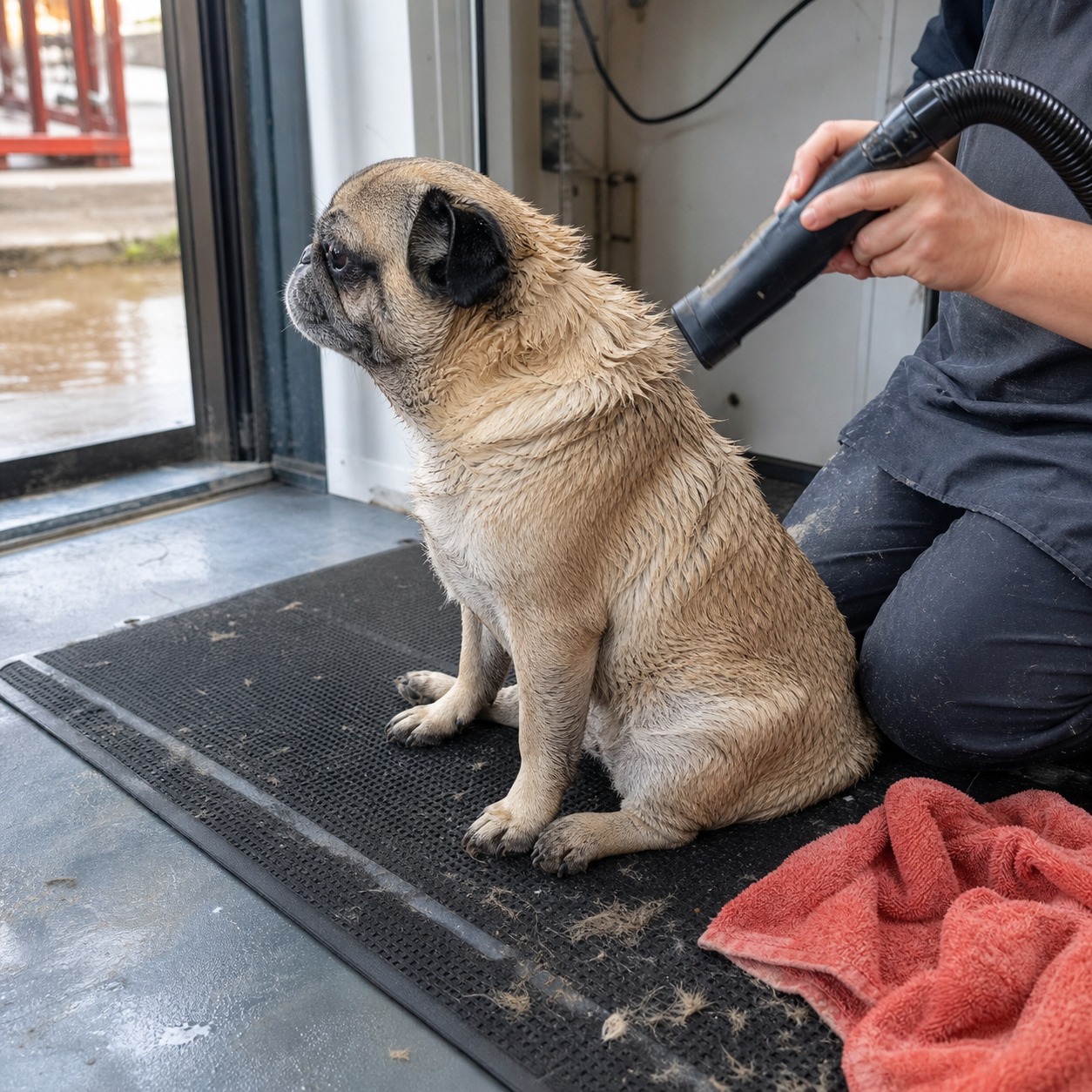
Hand drying is the alternative, and it is not a luxury upgrade. It means a person is holding the dog, feeling the coat, watching the breathing, and stopping the second something looks wrong.
“The dryer cage is where the margin for error disappears,” says Dr. Mara Chen. “A dog in trouble in a cage looks like a dog who is a little worked up, right up until they are in real distress. If a person’s hands are on that dog instead, you catch it three minutes earlier, and three minutes is usually the whole difference.”
So the first question is not “how long have you been doing this?” It is: do you hand dry, every dog, every time? A shop that says yes has already told you a great deal about how it thinks.
The four questions that actually screen a salon
Skip the small talk and ask these before you book:
- How do you dry? Hand drying only is the answer you want. If they cage dry “only for nervous dogs,” that is backwards. The nervous dog is the one who most needs a person there.
- Is my dog ever alone? Ask what happens between the bath and the table, and during the wait for pickup. “Never unattended” is the answer.
- What do you do if a dog panics? You are listening for a plan (stop, put the dog down, call you) rather than a reassurance. Good groomers have a stopping point. Bad ones push through.
- Have you worked with my dog’s breed, and what do you watch for? A groomer who handles Bulldogs should immediately bring up breathing and heat without being prompted.
Then use your eyes. Dirty floors, a chaotic back room, staff who will not let you see where the dogs are kept, or a price that badly undercuts everyone else in town are all data. Good grooming is skilled physical labor, and skilled labor is not cheap. A groomer who charges properly is a groomer who knows what the work is worth.
Reviews matter too, but read them for pattern, not for tone. One angry review about a bad bang trim is noise. Three separate reviews describing a dog who came home limping, panting, or terrified is a signal.
The dogs who cannot afford a mediocre groomer
Post-grooming deaths are rare. They are also not random. The dogs who turn up in these cases skew heavily toward one group: flat-faced breeds.
French Bulldogs, English Bulldogs, Pugs, Boston Terriers, Shih Tzus, and Brussels Griffons have been bred into airways that are structurally too small for the amount of air they need. Add heat, add stress, add restraint, and a dog who breathes with difficulty on a good day is suddenly a dog who cannot breathe at all. Very small dogs such as Chihuahuas are vulnerable for a related reason: less body mass, faster heat gain, less room for error. Seniors, dogs with heart disease, and dogs with a collapsing trachea belong on the same list.
If your dog is on that list, the standards go up, not sideways. Hand drying is non-negotiable. Ask to be called when the dog is ready rather than leaving them to wait in a crate. Ask for the earliest appointment of the day, when the shop is cooler and calmer. And be blunt: tell the groomer your dog is a breathing risk. A competent one will thank you for it.
Start young, and go often for nothing
The single best thing you can do for a dog’s lifelong grooming safety has nothing to do with vetting a salon. It is making grooming boring.
A dog who meets a groomer for the first time at eighteen months, matted and overdue, is a dog who arrives frightened. A dog who has been dropped in for a five-minute bath, a nail trim, or literally just a cookie and a walk back out, every couple of weeks since puppyhood, arrives bored. Bored dogs do not spike. They do not fight the table. They do not need to be held down.
Ask a groomer if you can book short, low-stakes visits while your puppy is young. The ones who say yes are the ones building the relationship you want.
“I would rather see a puppy ten times for nothing than once for everything,” says Dr. Mara Chen. “The dog who has learned that this building is a boring place where somebody scratches their chin is a dog who will still be safe to groom at twelve, when they actually need it.”
When to intervene, and what to watch after
You are not being difficult if you call mid-appointment to check in. And you should watch your dog for the rest of the day after any groom, particularly the first one at a new shop.
Get to a vet immediately if, in the hours after grooming, your dog shows:
- Labored, noisy, or open-mouthed breathing that does not settle within a few minutes
- Gums that look pale, grey, or bluish
- Collapse, wobbliness, or extreme lethargy
- Vomiting, or a temperature that feels alarmingly high
- Cuts, clipper burn, or a nick that keeps bleeding
Breathing trouble after a grooming appointment is an emergency, not a wait-and-see. That is true for any dog, and it is doubly true for the flat-faced ones.
What’s new since this was written
The regulatory picture has not moved, and it is worth knowing that. New Jersey has repeatedly tried to become the first state to license groomers, through a bill known as Bijou’s Law, named for a Shih Tzu who died after a salon visit. It has been introduced across multiple legislative sessions since 2014, including reintroductions in recent years, and it still has not been enacted. If it ever passes, New Jersey would be the only state in the country requiring a grooming license. Today, none do.
That leaves the screening to you, and it makes voluntary credentials more meaningful than they would otherwise be. The AKC’s S.A.F.E. Grooming Program is one of the few structured safety programs a shop can point to, and a groomer who has done it is a groomer who chose to be held to a standard nobody forced on them.
In the absence of a law, “how do you dry my dog?” is the closest thing pet owners have to an inspection.
References
- AKC S.A.F.E. Grooming Program — American Kennel Club
- New Jersey A3097: Pet Groomer Licensing Act (“Bijou’s Law”) — New Jersey Legislature
- Do Dog Groomers Need To Be Licensed? — The Academy of Pet Careers (state-by-state licensing status)
- Brachycephalic Obstructive Airway Syndrome — American College of Veterinary Surgeons