


Your Female Dog Humps. It's Normal, and It's Usually Not About Sex
Female dogs hump too, and it's rarely about dominance or mating. Here's what's actually driving the behavior, when it's harmless, how to redirect it, and the signs that mean it's time to call the vet.

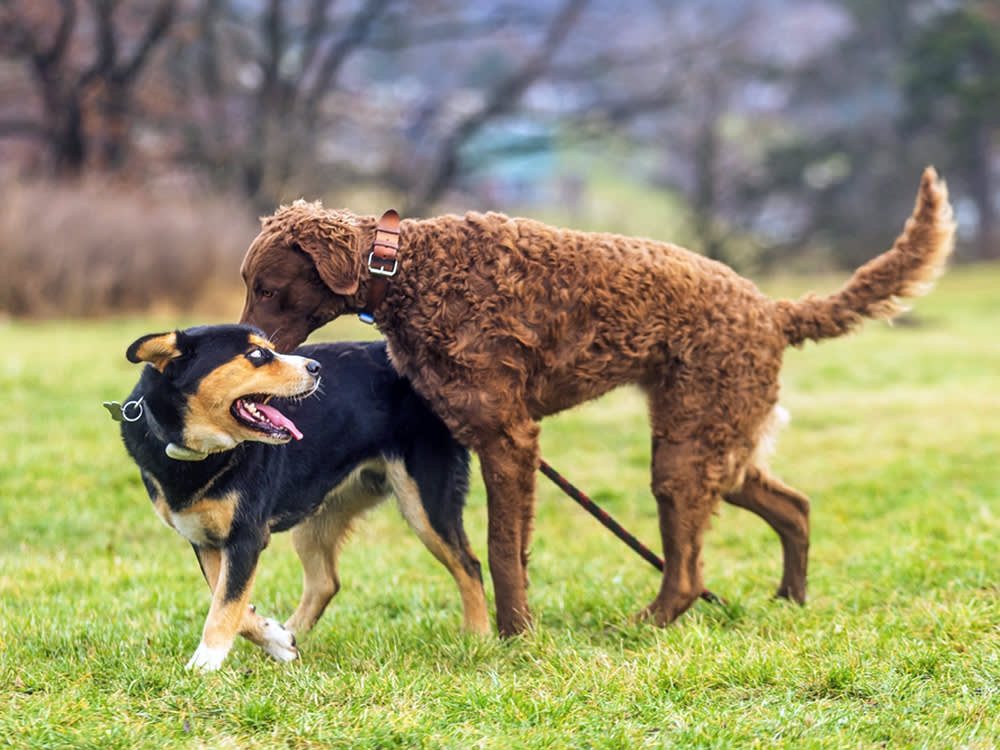
Picture the scene: you finally have guests over, everyone is settling in, and your female dog trots up and starts enthusiastically humping someone’s leg. If your instinct is to gasp, shove her off, and hiss her name, you are in good company. Almost everyone reacts that way. Almost everyone is also misreading what just happened.
Here is the part that surprises people: female dogs hump, it is a completely normal thing for a dog to do, and it is very rarely about the two things we assume — sex or dominance. Understanding what is actually going on changes your response from embarrassed reprimand to something far more useful. Let’s get into it.
Yes, this is normal
Mounting and humping — a person, another dog, a toy, a cushion — is ordinary canine behavior, and it is not reserved for males. It may be socially mortifying to us, but your dog is simply doing something dogs do. The behavior almost always has a trigger, and the single most important skill you can build is reading the situation she is in when it happens. That context is what tells you the real cause, and the cause is what tells you whether to shrug it off or do something about it.
Six reasons your female dog is humping
She’s overexcited during play
This is the big one. Humping shows up constantly in the middle of play, especially in younger dogs still figuring out social rules. When play ramps up and a dog gets flooded with excitement, humping becomes a pressure-release valve or a bit of clumsy communication, right alongside wrestling and chasing. It is almost never a problem. It is a dog who got a little too amped.
She’s relieving stress or anxiety
Humping can also be a self-soothing behavior. A dog who is uneasy, overwhelmed, or overstimulated may hump to discharge that nervous energy, the same way a person might jiggle a leg or bite a nail. If it tends to happen when the house is chaotic or a play session gets too intense, stress is a likely driver.
It’s instinct and hormones
An intact female is, at bottom, acting on instinct. And spaying does not flip an instant switch — residual hormones can circulate for up to roughly three months after the surgery, so humping can continue during that window even after she is spayed.
She’s seeking attention, or it’s just a habit
Dogs are excellent at noticing what gets a reaction. If humping reliably makes you leap up, raise your voice, and focus entirely on her, you have accidentally taught her that it works — negative attention is still attention. Over time it can harden into a plain old habit that persists on its own.
She’s asserting control (rarely)
Despite its reputation, humping is only occasionally about status. It can happen in group play where a dog is angling for control, but this is one of the least common explanations, not the default. If you have been assuming dominance, you have almost certainly been assuming wrong.
There’s an underlying medical issue
Uncommon, but real. Conditions such as a urinary tract infection or a hormonal imbalance can prompt humping. The tell is that medically driven humping tends to be constant or obsessive and comes packaged with other signs — licking at the genitals, swelling, or obvious physical discomfort.
The myths worth throwing out
Three misconceptions keep people stuck, because they lead you to the wrong fix.
“Humping is always sexual.” It is not. The most common trigger by far is excitement and non-sexual overstimulation, not mating drive.
“Humping is always about dominance.” Also false. Dominance is one of the rarest reasons on the list, not the headline. Reaching for it first means you will usually misdiagnose the behavior.
“Spaying will make it stop.” Sometimes, but not reliably. Between lingering hormones for up to three months and the fact that humping can become a learned habit, plenty of spayed dogs keep at it. Breaking an entrenched pattern can take deliberate training, and occasionally a professional’s help.
How to redirect it, if you want to
Once you know most of this is harmless, you may decide to let it go. But if you would rather curb it, work with the behavior instead of against it.
Interrupt calmly and redirect her to a toy, an activity, or a known cue the instant it starts, rather than physically pushing her away, which many dogs read as a fun game. A reliable “leave it” gives you a clean way to break the moment. Keep play from boiling over into frantic overexcitement, since that is where a lot of humping lives. Pour energy into enrichment — puzzle toys, chews, sniff walks, real exercise — so there is less restless fuel to burn. If she is intact, spaying may help, with the caveat that it is no guarantee. And if the humping is excessive or comes with other symptoms, loop in your vet before assuming it is purely behavioral. If your own efforts stall, a qualified trainer can help you build a plan.
People get mortified and want the behavior gone yesterday, so they punish it, and punishment usually backfires because it adds stress, and stress is one of the things that triggers humping in the first place. I’d rather owners get curious than embarrassed. Ask what set her off. Nine times out of ten it’s an over-the-top play session or a bored dog, and both of those have gentle fixes.
When it’s time to call the vet
Occasional humping is nothing to worry about. But certain patterns warrant a call. If she’s mounting to an excessive or obsessive degree, or if it comes alongside licking at her genitals, straining to urinate, swelling, or signs of discomfort, treat that as a medical flag rather than a behavior quirk. A urinary tract infection or a hormonal imbalance can be behind it, and both are worth ruling out promptly.
The bottom line
For most female dogs, humping is a normal, harmless way to blow off excitement, soothe stress, or communicate — not a sign of a dominance problem or a dog “acting out.” It can look strange and land at the worst possible moment, but the behavior itself is usually fine. Read the context, redirect if you like, and save the worry for the specific signs that point to a medical cause.
References
- American Veterinary Society of Animal Behavior (AVSAB). Position statements on canine behavior and punishment. https://avsab.org/resources/position-statements/
- Overall, K. L. Manual of Clinical Behavioral Medicine for Dogs and Cats. Elsevier.
- ASPCA. Mounting and masturbation in dogs. https://www.aspca.org/pet-care/dog-care/common-dog-behavior-issues
Common questions
Why does my female dog hump another female dog?
Usually overexcited play. It can occasionally be a bid for control in a group, or tied to hormones, stress, or a medical issue, but excitement during play is by far the most common reason.
Why does my female dog hump me or my guests?
Often overstimulation, stress relief, or attention-seeking. Since even a scolding is attention, reacting dramatically can accidentally reinforce it. Calm redirection works better.
Do female dogs still hump after being spayed?
They can. Residual hormones can linger for up to about three months after surgery, and if humping has become a learned habit it may continue well beyond that. Spaying may reduce it but is not a guaranteed off-switch.
Dr. Park is a board-certified emergency and critical care specialist. She reviews our health and safety content for clinical accuracy and contributes guides on recognising urgent conditions. Her focus is helping owners act quickly and correctly when it matters most.
Meet our experts ↗Keep reading
 Health & WellnessYour Dog's Lip Lick Means Nausea or 'Please Back Off.' Learn to Tell.Dr. Priya Nair · 7 min
 TrainingA Shelter Dog Predicted a Stranger's Seizure With No Training. How?Dr. Lena Park · 6 min
 TrainingYour Dog's Sad Face Is a Muscle Wolves Don't Have. It Evolved to Work on You.Dr. Ravi Mehta · 8 min
 TrainingYour Dog Isn't Having a Seizure. Say Their Name.Dr. Ravi Mehta · 7 min
 Health & WellnessYour Dog's Sleep-Twitching Is Almost Always a Dream. Here's When It Isn't.Dr. Ravi Mehta · 6 min
 Health & WellnessWhen One Dog Dies, the Other One Changes. Science Finally Has Numbers on It.Dr. Mara Chen · 7 min