


Your Dog's Sad Face Is a Muscle Wolves Don't Have. It Evolved to Work on You.
That heartbreaking look isn't sadness. Dogs grew a specific eyebrow muscle in 33,000 years because humans reward it. Here's how to tell the manipulation from the real thing, and the signs that mean something is genuinely wrong.

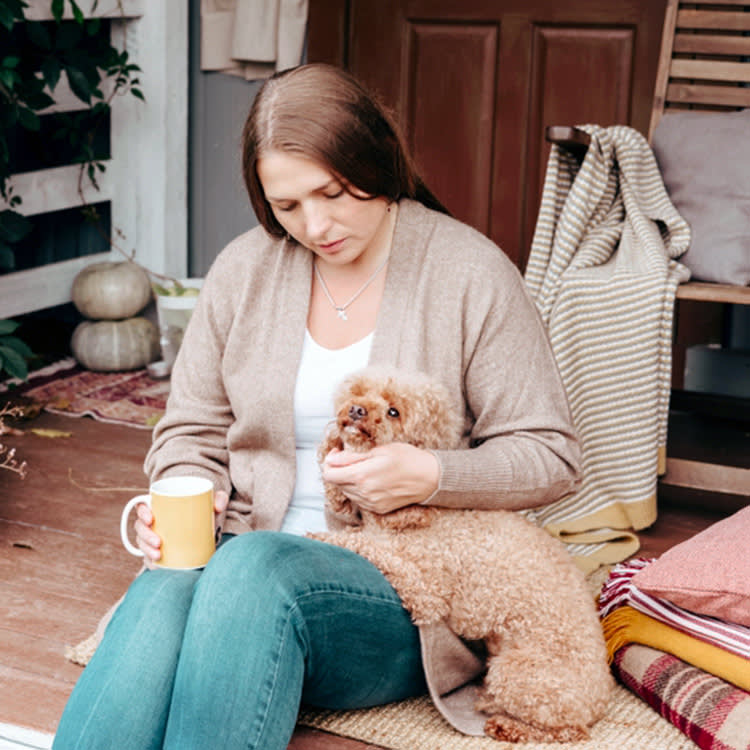
You come home, something is chewed, and there it is: the ears go back, the head drops, and those inner eyebrows lift into an expression so mournful you cannot even be angry.
Here is what is actually happening in that face. Your dog is contracting a muscle called the levator anguli oculi medialis, which raises the inner corner of the eyebrow. Wolves do not have it. Not properly, anyway. In grey wolves the muscle is typically present only as a few scattered fibers in a mass of connective tissue. In dogs it is a routine, fully formed muscle.
That difference appeared in roughly 33,000 years of domestication, and it did not appear by accident. It appeared because we kept choosing the dogs that could do it.
Your dog’s sad face is not a window into your dog’s soul. It is a piece of hardware that evolved to open a door in yours.
The evidence is unusually clean
The study, led by Juliane Kaminski and published in the Proceedings of the National Academy of Sciences in 2019, did two things.
First, the anatomy: dissections found the muscle reliably present in dogs and essentially absent in wolves.
Second, the behavior: when dogs and wolves were observed with people, dogs produced the eyebrow raise significantly more often and more intensely than wolves did. The highest-intensity versions were produced by dogs and by dogs only.
The mechanism the researchers propose is uncomfortable and elegant. Raising the inner brow makes the eyes look bigger and more infant-like, and it closely mimics the movement human faces make when we are sad. It hits two of our hardest-wired buttons at once: protect the baby, comfort the sad one.
We did not train this. We selected for it, one appealing puppy at a time, for tens of thousands of years, without ever knowing we were doing it.
I tell people this not to make them cynical, but to make them more accurate. That face is a communication tool, and it is a wildly effective one. But it is not a symptom. If you want to know whether your dog is actually unwell or unhappy, the face is the least reliable place to look. Look at what the dog does when nobody is asking anything of them.
Some dogs just have that face
Before you diagnose anything, rule out architecture.
Certain dogs simply look sad. Deep-set eyes, droopy lids, heavy brows, loose facial skin. A Basset Hound at the peak of joy still looks like it has received difficult news. This is genetic, and it is not a small thing: a dog with a naturally mournful face gets more attention, more sympathy, and, in the way of these things, more treats.
Which is exactly the loop the eyebrow muscle sits inside. Sad-looking dogs do well. That is why the trait spread.
So the first question about a sad-looking dog is not “what’s wrong” but “is this just their face.”
And sometimes they are simply resting
The second false positive, and the more common one: your dog is fine, and lying down, and looking at you.
A relaxed dog at rest, chin on paws, eyes half-lidded, tracking you across the room, is a dog having a nice time. We read the stillness as dejection because we would only be that still if something were wrong. Dogs sleep and rest for a very large fraction of the day. Not every quiet moment is a mood.
The guilty look is not guilt
This one deserves to be said plainly, because it changes how people treat their dogs.
The full display, ears back, head lowered, eyes averted or wide with the whites showing, body low, tail tucked, is an appeasement signal. It is a dog trying to prevent conflict. And the thing that reliably triggers it is not a chewed shoe. It is your face, your posture, and your voice.
The dog is not remembering what it did an hour ago and feeling remorse. It is reading a human who has gone tense and loud, and it is broadcasting please don’t.
If you see this look often, the useful intervention is not a training plan for the dog. It is examining what you are doing right before it appears.
When the face means something real
Now the part that matters. A sad expression on its own is weak evidence. A sad expression plus a change in behavior is a signal worth acting on.
Pain and illness come first, always. Dogs are stoic and they hide discomfort, so it leaks out sideways. Arthritis, dental disease, and chronic illness all show up as mood before they show up as a limp. The pattern to watch for is a dog that has gone quiet and slow, and that has stopped asking for the things it used to love. Add house-soiling in a previously reliable dog, new destructive behavior, sudden clinginess, or restlessness at night. Older dogs are more prone to all of this and deserve a lower threshold for a vet visit.
Dental pain in particular is chronically missed. A dog with a painful mouth does not usually cry. It just becomes a quieter, sadder dog.
Then the emotional causes. Dogs are creatures of routine, and change destabilizes them. A move, a new baby, a new pet, a child leaving for college, a divorce, the death of a family member or another animal. Grief in dogs is real, and it presents as withdrawal, pacing, whining, and appetite loss.
Weather counts too. Thunderstorms and high winds produce genuine distress in a lot of dogs, and it is not always the dramatic hiding-in-the-bathroom version. Some dogs simply go flat.
And boredom, which is the most common and the most fixable. A dog that is not getting enough physical exercise and, crucially, enough mental work becomes restless, then bored, then withdrawn. Long hours alone with nothing to do produce emotional flatness in a social animal. This is not a mysterious condition. It is under-stimulation, and it responds to being fixed.
What to actually do
Rule out the body first. This is not a formality. If the sad demeanor is persistent, the single highest-value action is a vet exam. Pain is the most common cause of a genuine mood change, and it is treatable.
Then rebuild the day. A long walk where the dog is allowed to sniff as much as it wants is worth more than a short brisk one. Scent work, training sessions, food puzzles, and confidence-building activities like parkour or agility all give a dog something to be good at, which is closer to what dogs need than affection is.
Then add company. A dog left alone for long stretches without interaction withdraws. A dog sitter, a friend at midday, a play date, or another dog in the household can change the picture entirely.
And check yourself. Dogs are extremely responsive to human distress. If you have been sad, your dog may well be mirroring you, sitting close, nudging, offering those uncanny looks of understanding. Accept it gratefully. Never direct strong emotion at them, because that produces appeasement, which is the thing that looks most like sadness and is actually fear.
What newer research adds
Two threads are worth knowing.
The first extends the Kaminski work: research since has looked at other canids and found that the picture is more graded than a clean dogs-versus-wolves split. Coyotes, it turns out, have more of the relevant facial musculature than expected. The core finding holds, dogs express the movement far more and far more intensely, and the anatomy in dogs is more developed, but the story is less “dogs invented a muscle” and more “domestication amplified and reliably fixed something that was faintly there.”
The second is more useful day to day. A growing body of work finds that humans are poor at reading dogs’ negative emotions specifically. We are good at spotting a happy dog and unreliable at spotting fear and frustration. A 2025 study out of Arizona State went further and found that people judge a dog’s emotional state largely from the situation surrounding the dog rather than from the dog itself.
Put those together and you get the practical instruction this whole article is really about. The face your dog makes is the part you are worst at interpreting, and it is also the part evolution optimized to move you. So stop reading the face.
Read the appetite. Read the sleep. Read whether they still want the walk.
References
- Kaminski, J., Waller, B. M., Diogo, R., Hartstone-Rose, A., and Burrows, A. M. “Evolution of facial muscle anatomy in dogs.” Proceedings of the National Academy of Sciences, vol. 116, no. 29, 2019. https://www.pnas.org/doi/10.1073/pnas.1820653116
- Burrows, A. M., et al. “Coyotes can do ‘puppy dog eyes’ too: comparing interspecific variation in Canis facial expression muscles.” Royal Society Open Science, 2024. https://pmc.ncbi.nlm.nih.gov/articles/PMC11444785/
- Molinaro, H. G., and Wynne, C. D. L. “Barking up the wrong tree: Human perception of dog emotions is influenced by extraneous factors.” Anthrozoös, 2025. https://www.tandfonline.com/journals/rfan20
- Hecht, J., Miklósi, Á., and Gácsi, M. “Behavioral assessment and owner perceptions of behaviors associated with guilt in dogs.” Applied Animal Behaviour Science, vol. 139, 2012. https://www.sciencedirect.com/science/article/abs/pii/S0168159112000937
- Cornell Richard P. Riney Canine Health Center. “Anxious behavior: How to help your dog cope with unsettling situations.” https://www.vet.cornell.edu/departments-centers-and-institutes/riney-canine-health-center/canine-health-information/anxious-behavior-how-help-your-dog-cope-unsettling-situations
Common questions
Can dogs get depressed?
Yes. Dogs withdraw after a move, a new baby, a household member leaving, or the death of a person or another pet. Grief is real in dogs. Rule out medical causes first, because pain looks almost identical.
When should I worry about a sad-looking dog?
When the expression comes with other changes: lethargy, appetite change, avoiding activities they used to enjoy, house-soiling, destructive behavior, clinginess, or restlessness at night. A face alone is weak evidence. A face plus a behavior change is a vet visit.
Does my dog look sad because they feel guilty?
No. The 'guilty look' is an appeasement display, usually triggered by your tone, posture, or facial expression. The dog is trying to defuse conflict, not confess. If you see it a lot, the thing to examine is your own behavior.
Dr. Mehta is a board-certified veterinary nutritionist who evaluates pet food formulations, ingredient quality, and the science behind dietary trends. He writes and reviews all nutrition content at The Pet Times, including our food rankings and feeding guides.
Meet our experts ↗Keep reading
 Health & WellnessThat Cute Snorting Noise Has a Name. So Do the Two That Aren't Cute.Dr. Mara Chen · 7 min
 Health & WellnessA Quiet Dog Is Fine. A Newly Quiet Dog Is a Symptom.Dr. Ravi Mehta · 7 min
 TrainingA Shelter Dog Predicted a Stranger's Seizure With No Training. How?Dr. Lena Park · 6 min
 TrainingYour Female Dog Humps. It's Normal, and It's Usually Not About SexDr. Lena Park · 7 min
 Health & WellnessYour Old Dog Staring at the Wall Is Veterinary Medicine's Most Missed DiagnosisDr. Nina Kohl · 8 min
 Health & WellnessYour Dog's Lip Lick Means Nausea or 'Please Back Off.' Learn to Tell.Dr. Priya Nair · 7 min