


Your Dog Sleeps Pressed Against You. The Night That Changes Is the One to Notice.
The warmth, the pack instinct, the trust — all of that is true and none of it is news. The useful thing about where your dog sleeps is what happens when they suddenly need more of you than they used to.

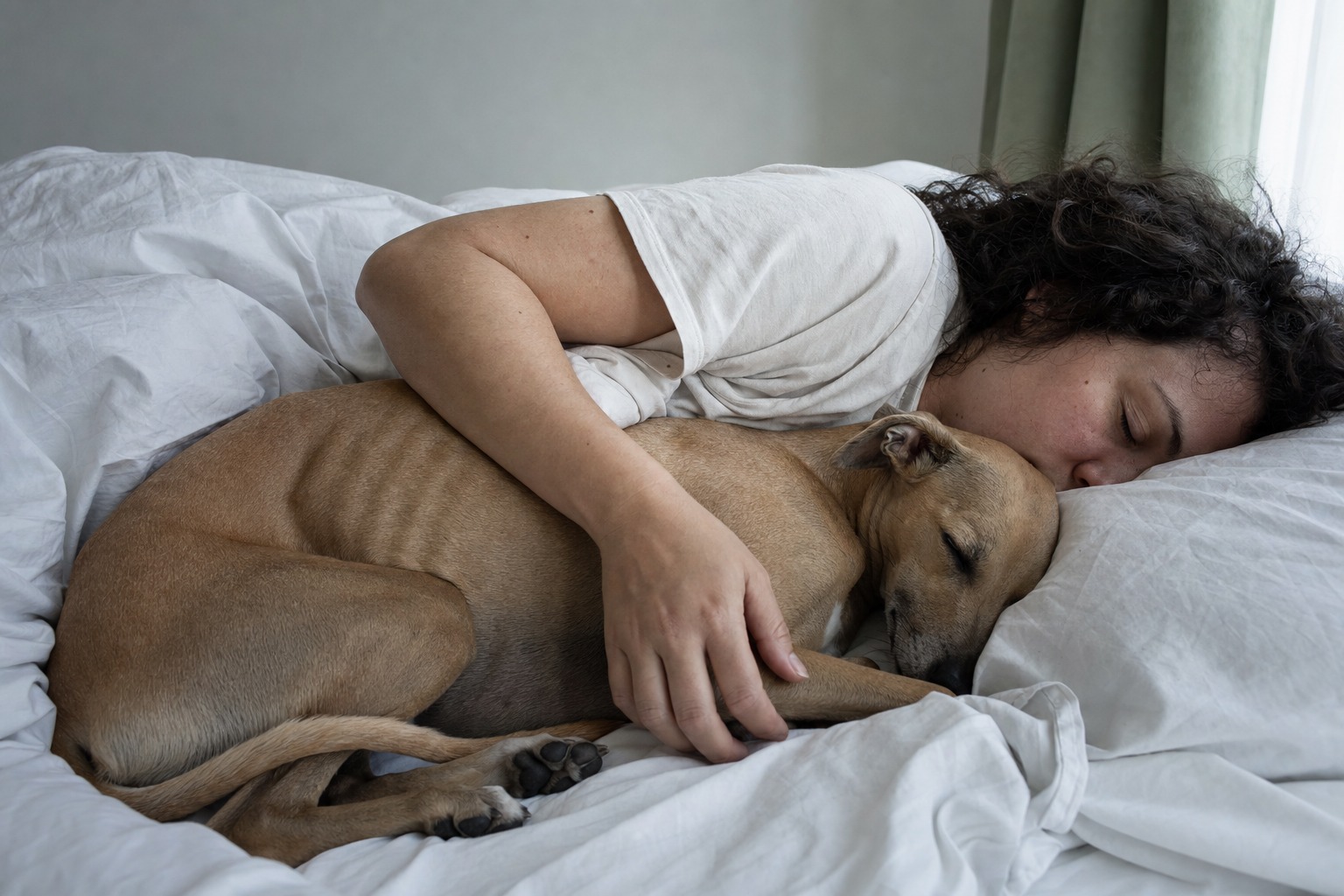
At some point in the night, your dog stops being a dog and becomes a hot, immovable weight wedged against your spine. You cannot roll over. You have half a pillow. You would not change it.
Nearly everything written about this behavior is the same list, and the list is not wrong: warmth, pack instinct, trust, the memory of a puppy pile. Fine. All of that is true, and none of it is going to tell you anything you did not already suspect.
The thing worth knowing is different. Where your dog chooses to sleep is a slow, honest read on how secure they feel, and the moment that choice changes, it is telling you something. Most owners never notice, because they are too busy being flattered.
What the contact is actually made of
Three ordinary things, stacked.
You are warm. A dog seeking heat is not sentimental about it. You are the best radiator in the house, and a dog with a thin coat, a low body weight, or a few years on the clock will find you and stay there. This is why the pressing intensifies in winter and eases in August.
They spent their first weeks in a pile. For roughly the first eight to twelve weeks of life, your dog slept in a heap of siblings against their mother. That is not a metaphor, it is the actual sensory baseline for sleep. Contact and sleep got wired together before your dog ever met you.
Sleep is when a social animal is most exposed. This is the interesting one. Choosing to go fully unconscious while pressed against a much larger animal is not a small decision for a body built by evolution to worry about predators. A dog who sleeps hard against you has decided you are the safe part of the room.
A dog will sleep near what they trust and away from what they do not. So the honest way to read your dog pinning you to the mattress is not that they love you more than the dog down the street loves its owner. It is that they have concluded nothing bad is going to happen here.
The signal hiding inside the habit
Here is the reframe that makes this article worth your time.
The behavior itself is not information. Your dog has always done it. The change is the information.
Ask yourself: is this new? Is there more of it than there was six months ago? Because a sudden increase in night-time clinginess, restlessness, or the need for physical contact is one of the ways dogs tell you something is wrong.
The three usual explanations for a change:
Pain. A dog who is uncomfortable seeks reassurance and warmth. Arthritis, dental pain, an aching gut, and early disease all show up in adult dogs as a vague behavioral shift long before they show up as anything obvious. If your seven-year-old suddenly needs to be touching you all night and never used to, that is a vet visit.
Anxiety. New environment, new person, new dog, a change in your hours, a bad storm season. Anxiety drives dogs toward their attachment figure, and night is when there is least else going on to distract from it.
Cognitive decline. In a senior dog, night-time restlessness, pacing, and a sudden change in sleeping arrangements can be canine cognitive dysfunction, which is treatable and manageable but not by ignoring it.
The rule is not complicated. New behavior in an adult dog is data. Take it seriously and it is one of the cheapest early-warning systems you own.
The good part, which is real
None of this means you should stop.
Co-sleeping with a dog is, for most people, a net positive: it lowers arousal, it makes an anxious dog easier to settle, and it is one of the few interactions with your dog that requires nothing from you at all. For an anxious dog specifically, being able to sleep in contact with their person is genuinely therapeutic, not indulgent.
And the accumulated trust runs both ways. There are dogs who wake their people out of a bad sleeping position, who notice apnea and snoring, who move at the sound of a change in breathing. Some of those stories are coincidence dressed up in retrospect. Some of them are not. What is certain is that a dog sleeping in contact with you is paying attention to you all night, which is more than most of us can say about anyone else in the house.
The costs, honestly stated
Not every dog belongs in the bed, and not every person should have one there.
- Restless dogs make restless nights. Dogs do not sleep in one long block the way we do. They cycle through waking and sleeping all night, which means a dog in your bed will be getting up, turning around, and resettling while you are trying to stay under. Some dogs are simply too active for shared sleep.
- Dirt, fur, allergens, and ticks. A dog who has been in long grass or on a muddy walk brings all of it to the duvet. If you live somewhere with ticks, a nightly check is not optional and the bed is a good reason to take it seriously.
- Guarding. A small number of dogs get possessive about the bed, and the bed is a bad place to have that argument. This is worth working on with a professional rather than tolerating.
- Independence. A dog who cannot rest without you is a dog who will find being alone harder. If you also have separation issues, blanket co-sleeping is not helping.
And a fair caveat that gets lost: the idea that letting a dog on the bed causes behavior problems does not hold up. Correlation is not causation. It is very unlikely that the bed is why your dog is difficult.
Moving them out, if you need to
Not with a door slammed. With a better offer.
- Give them a bed worth having. Supportive, sized properly, and placed in your bedroom, not exiled to the hallway. Most failed bed transitions fail because the alternative was worse.
- Build a bedtime routine. The same sequence every night. Dogs settle on predictability far more than on comfort.
- Pay for the right choice. High-value reward for going to their spot and staying there. Not for lying down once, for staying.
- Be consistent, and be warm about it. Redirect every time, without giving in once, and without any sternness. One inconsistent night resets a week of work, and a scolded dog is a more anxious dog, which makes them want to be near you more.
- Consider a crate, if your dog already likes theirs. For a lot of dogs a crate is not a cage, it is a bedroom, and it makes the whole thing easy.
- Steps or a ramp, if you are keeping them in the bed. Small dogs, long-backed dogs, and older dogs should not be jumping off a mattress at 2 a.m.
And be prepared for the possibility that your dog wants nothing to do with your bed and never did. Some dogs would genuinely rather sprawl on cool floorboards, alone, with their own space. That is not a rejection either. It is a preference, and it deserves the same respect as the pressing.
What newer research adds
The most reassuring finding of the last few years is that the folk wisdom about dogs ruining human sleep has held up poorly. Research out of the Mayo Clinic Center for Sleep Medicine found that adults sharing a bedroom with a dog maintained good sleep efficiency, and the presence of a dog in the room was, if anything, associated with better sleep than no dog at all. Sleeping in the bed itself was a slightly rougher deal than sleeping beside it, which is exactly what anyone who has been kicked in the kidneys at 4 a.m. would predict.
Veterinary sleep medicine has also moved toward treating changes in sleep behavior as a genuine clinical sign, not a quirk. Night-time restlessness, new pacing, and altered sleeping location are now standard screening questions for pain and cognitive dysfunction in older dogs. The dog who has started sleeping on you differently is worth a conversation.
The bottom line
Let them press against you. It is warm, it is ancient, and it is a decent measure of a life your dog feels safe in.
Just notice the night it changes.
References
- Cummings School of Veterinary Medicine at Tufts University. “Sleeping With Dogs.” August 19, 2021. vet.tufts.edu
- Patel, Salma I., et al. “The Effect of Dogs on Human Sleep in the Home Sleep Environment.” Mayo Clinic Proceedings, vol. 92, no. 9, 2017. mayoclinicproceedings.org
- American Kennel Club Canine Health Foundation. “Canine Cognitive Dysfunction.” akcchf.org
Common questions
Is it bad to let my dog sleep in my bed?
For most healthy adults and most healthy dogs, no. The real costs are practical: fur, allergens, dirt, and a restless sleeper waking you at 3 a.m. Reconsider it if you or anyone in the bed is immunocompromised, if the dog has resource-guarding issues around the bed, or if your own sleep is genuinely suffering.
My dog never used to sleep against me and now they always do. Should I worry?
That is the question worth asking. A sudden increase in night-time clinginess can be pain, anxiety, or cognitive decline in an older dog. New behavior in an adult dog is data. Get them checked.
How do I move my dog out of the bed without making them miserable?
Give them somewhere genuinely better and pay them to use it. A supportive bed, placed in your room, plus a consistent bedtime routine and a reward for settling there. Redirect every single time without giving in, and stay warm about it. Consistency does the work, not sternness.
Dr. Solis is a board-certified veterinary dermatologist with over twelve years of clinical experience. She advises on skin conditions, allergies, and grooming practices that affect coat and skin health. All dermatology and allergy content at The Pet Times is reviewed by her team before publication.
Meet our experts ↗Keep reading
 Health & WellnessNobody Prepares You for Your Dog Getting Old. Start Here.Dr. Lena Park · 8 min
 Health & WellnessThe Alzheimer's Drugs Did Nothing. Playtime Grew Their Brains.Dr. Ravi Mehta · 4 min
 LivingLabradoodle vs. Goldendoodle: You're Asking the Wrong QuestionDr. Ravi Mehta · 8 min
 Health & WellnessYour Old Dog Doesn't Want to Rest. Their Brain Wants a Puzzle.Dr. Nina Kohl · 6 min
 LivingThe Doodle Was Sold to You on Three Promises. The Data Backs None of ThemDr. Mara Chen · 9 min
 TrainingSix Weeks of Crate Rest Will Break You Both. Give the Dog a Job Instead.Dr. Nina Kohl · 8 min