Stand near the fence at any busy dog park for ten minutes and you will collect a small library of confident advice. Some of it is genuinely good. A lot of it is folklore that has been passed dog-to-dog for decades, and a few pieces of it are the kind of thing that gets a small dog hurt. The problem is that they all sound equally sure of themselves.
So here is a different way to spend that ten minutes. Instead of memorizing rules, learn to read the two or three things that actually predict whether play stays play. Once you can see those signals, most of the park chatter sorts itself into “true,” “half true,” and “please stop saying that.” Everything below is organized around what a real interaction is telling you, not around a checklist someone shouted over a latte.
The single most useful skill: watching for pauses
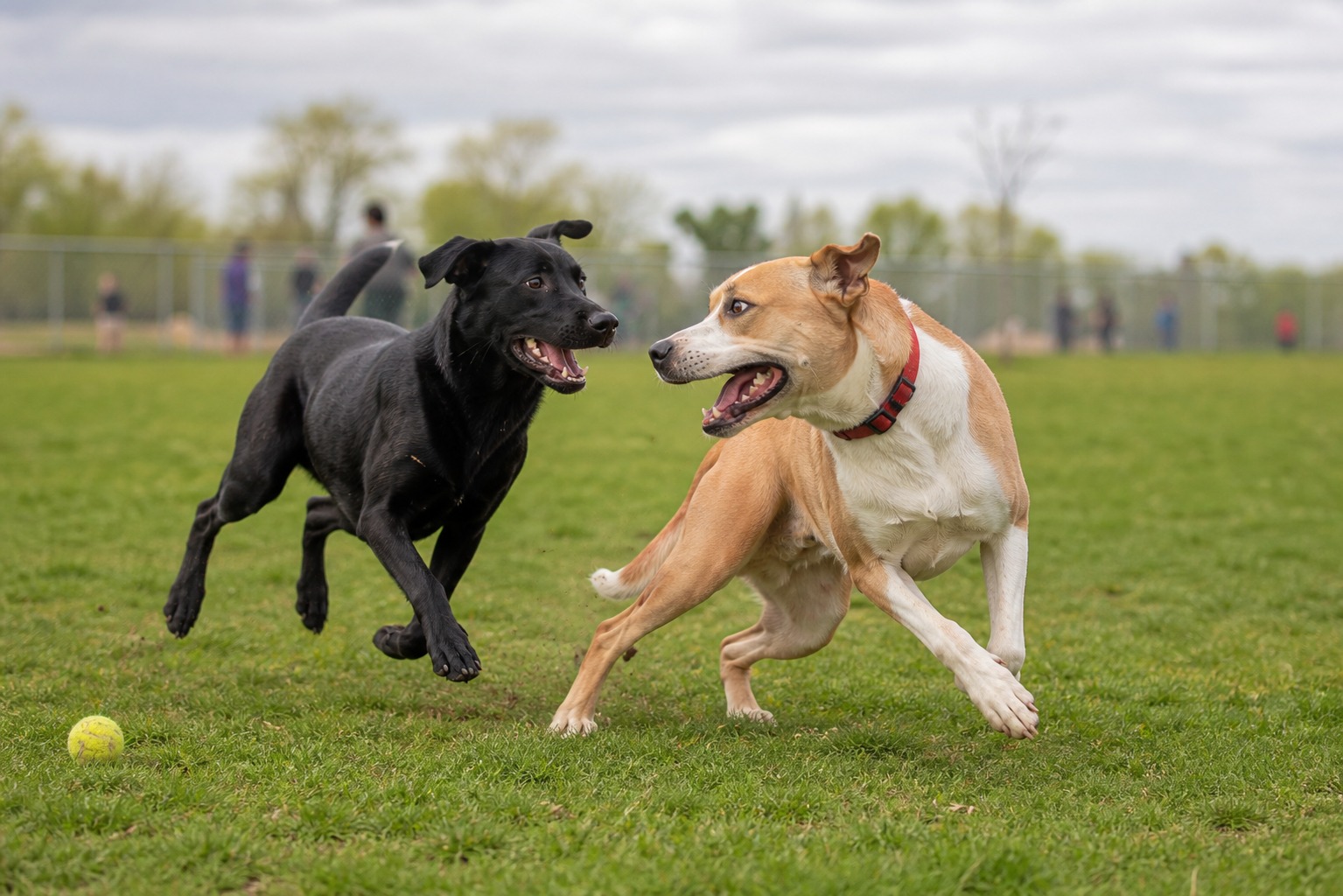
If you take one idea home, make it this one. Healthy play has a rhythm. Two dogs wrestle, chase, or body-slam for a few seconds, and then something interrupts it. One dog stops. One shakes off. One drops into a play bow, glances away, or trots a few feet in the other direction before diving back in. Those breaks can be half a second long, and they should keep happening.
Pauses are not a lull in the fun. They are the fun working correctly. A dog who can interrupt their own arousal to check in is a dog who still has the brakes on. When play runs and runs with no breaks, no shake-offs, and no role changes, arousal climbs with nothing to bleed it off, and that is when a wrestling match tips into a real scuffle. You do not need to count anything. You just need to notice whether the action ever stops on its own. If it does, breathe. If it does not, that is your cue to call your dog out for a water break and reset.
This is also the honest answer to the eternal question of whether rough play is a problem. Big, loud, mouthy, full-body play is completely normal between well-matched dogs. Growling, chest-bumping, and mock-biting are part of the vocabulary. The volume is not the warning sign. The absence of pauses is.
”They’ll work it out” is the phrase that scares me most
Of everything I hear at parks, this one causes the most damage. It sounds generous, even wise, like you are respecting some natural canine diplomacy. Dogs are not holding a negotiation. When one dog is overwhelmed, cornered, or being pursued by another dog who will not quit, waiting for them to reach an understanding usually means waiting for someone to get frightened or bitten.
Stepping in is not helicopter parenting. If the tension turns out to be nothing, calling both dogs away and letting them shake off costs you nothing. If it was about to escalate, you just prevented an injury and, just as importantly, prevented a bad memory that can make a dog reactive at the next ten parks. Interrupting early is cheap. Interrupting late is not. You are the one who has to break the spell, and the dogs are entitled to expect it of you, whether that means cheerfully calling them to follow you, walking away so they disengage, or physically separating them if it has already gone past words.
“The owners who tell me their dogs will sort it out are usually the ones watching a problem in slow motion,” says Dr. Nina Kohl. “I would rather you break up a hundred harmless moments than miss the one that mattered. Calling your dog away from good play never hurt anybody, and it buys you the reflex you will need on the day it isn’t good play.”
Movement solves problems that standing still creates
Here is a piece of park wisdom that is simply correct: keep walking. A remarkable number of squabbles happen in a knot of dogs and people clustered around the entrance gate, everybody standing still while the energy pools. Dogs tense up when a group gathers and nobody moves. Take the pressure off by strolling. Drift away from the gate, keep your feet going, and watch how many potential problems never form. Loose bodies follow loose movement. Some of the most reliable “my dog gets into it at the park” cases resolve entirely when the human stops planting themselves in one spot to chat.
The myths that are backwards
A few beliefs are not just half true; they get the situation exactly wrong. These are the ones worth unlearning on purpose.
“He’s just got a high prey drive, don’t worry about it.” This is offered as reassurance and it should be the opposite. When a dog chases another dog with the flat, locked-on intensity of hunting, that is precisely the moment to interrupt, not relax. Playful chasers treat each other as partners: they trade roles, they let themselves be caught, they keep leaving those little openings for the other dog to turn the game around. A dog running down another dog like quarry is not playing, and the label “prey drive” does not make it safe. The tell is simple. Watch the dog being chased. If they keep circling back, bouncing, and inviting more, the chase is mutual and fine. If they are flattening, tucking, and trying to peel off toward their owner, the game is over for them, and it is time to end it.
“Growling means aggression.” Growling is communication, not a verdict. Plenty of perfectly friendly dogs growl during play, a rumbly running soundtrack to a good wrestling match rather than a threat of one. Some growl to tell another dog to ease off, which is a dog defusing a situation rather than starting one. A growl is always worth reading in context, but treating every growl as a threat teaches dogs that honest communication gets punished, and a dog who learns to skip the growl is far more dangerous than one who uses it.
“Dogs have to be the same size to play together.” Compatibility is about matched energy and matched style, not matched dimensions. Many big dogs are gorgeous with tiny friends, flopping onto their backs and gentling their movements to keep it fair. Watch closely when there is a real size gap, because momentum can hurt a small dog by accident, but a size difference is not a disqualifier. What actually wrecks a play session is a style mismatch: one dog only wants to wrestle while the other only wants to chase, a pairing about as harmonious as sitting someone down to a quiet board game when they came ready for a game of tag. And no, that mismatch does not track with breed. There is no single play style that every member of a breed shares, so “they can only play with their own kind” is nonsense. Good buddies come in every combination of shape and background.
The alpha myth refuses to die, so let’s bury it again
For decades, nearly every canine behavior problem got blamed on a dog scheming to dominate people or other dogs. We now know that framework was wrong, and worse, that acting on it made dogs’ lives measurably harder. Reading ordinary behavior as a bid for status pushed people toward confrontational, punishing handling, which damaged trust and inflamed the very problems it claimed to fix.
This is not just my opinion. The American Veterinary Society of Animal Behavior’s position is that dominance theory should not guide how we train or interpret dogs, and that reward-based methods are the standard of care. Their guidance goes as far as advising veterinarians not to refer clients to trainers who sell the pack-hierarchy story, because there is no evidence that aversive, “show him who’s boss” methods work better than reward-based ones, and good evidence that they harm welfare and the human-dog bond. If you take one label out of your vocabulary at the park, make it “he’s being dominant.” It explains nothing and it costs your dog something.
What replaces it is less dramatic and far more useful: reinforcement drives behavior. Whatever you reward, you get more of. Reward the calm check-in, the recall away from a tense moment, the soft loose play, and those are the behaviors that grow. It is not glamorous, but it is the actual mechanism, and it works on your dog exactly the way it works on every other animal, including the ones reading this.
The two questions the park can’t answer for you
Two more myths deserve a flat correction, because they concern the dogs least able to speak up.
Plenty of dogs simply do not belong at one, and that is not a failure. For plenty of dogs, the off-leash park is a joyful open field of sniffing and running. For plenty of others, it is a gauntlet: overwhelming crowds, unpredictable strangers, and the occasional genuinely aggressive dog. Some dogs love it, some tolerate it, and some experience it as a small war. Loving your dog does not obligate you to bring them somewhere they dread. If your dog spends the visit pinned to your leg or frantically avoiding contact, the park is giving you an answer.
Do not bring a young puppy to the dog park to “socialize” them. This one is well-intentioned and genuinely risky. Real socialization means many small, positive, controlled exposures during a puppy’s sensitive window. The dog park offers the opposite: no control over which dogs approach, and a real chance your puppy gets barked at, bowled over, pinned, or swarmed. A single bad experience at that age can teach a puppy that other dogs are frightening, which is the exact reverse of what you were going for. Socialize your puppy deliberately, with dogs you have chosen for their gentleness, and save the open park for when your dog is older and steadier.
What newer research adds
The science has kept moving in one clear direction, and it is worth knowing where it landed. The professional consensus against dominance-based training is not a fringe position or a passing trend; it is the current, actively maintained standard from the field’s leading behavior organizations, who now recommend reward-based methods as the default for both everyday training and serious behavior problems. The reason is not sentiment. Studies comparing methods keep finding that aversive, confrontation-based training does not outperform reward-based training, and does come with a measurable cost to a dog’s stress levels and their relationship with their person.
The practical takeaway for the park is small but real. When you feel the pull to “correct” your dog into behaving, or to read a scuffle as a ranking dispute you need to settle, the evidence says the more effective move is almost always the calmer one: interrupt, redirect, reward the behavior you want, and set the environment up so the good choice is the easy one. Less drama, better dogs.
The short version
You do not need to memorize a dozen rules. Watch for pauses, and trust play that keeps interrupting itself. Keep moving instead of clustering at the gate. Step in early and cheerfully rather than waiting for dogs to “work it out.” Read the dog being chased, not the one doing the chasing. And retire the alpha story for good. Do those few things and you will be the calmest, most useful person at the fence, which is exactly the person the dogs need you to be.