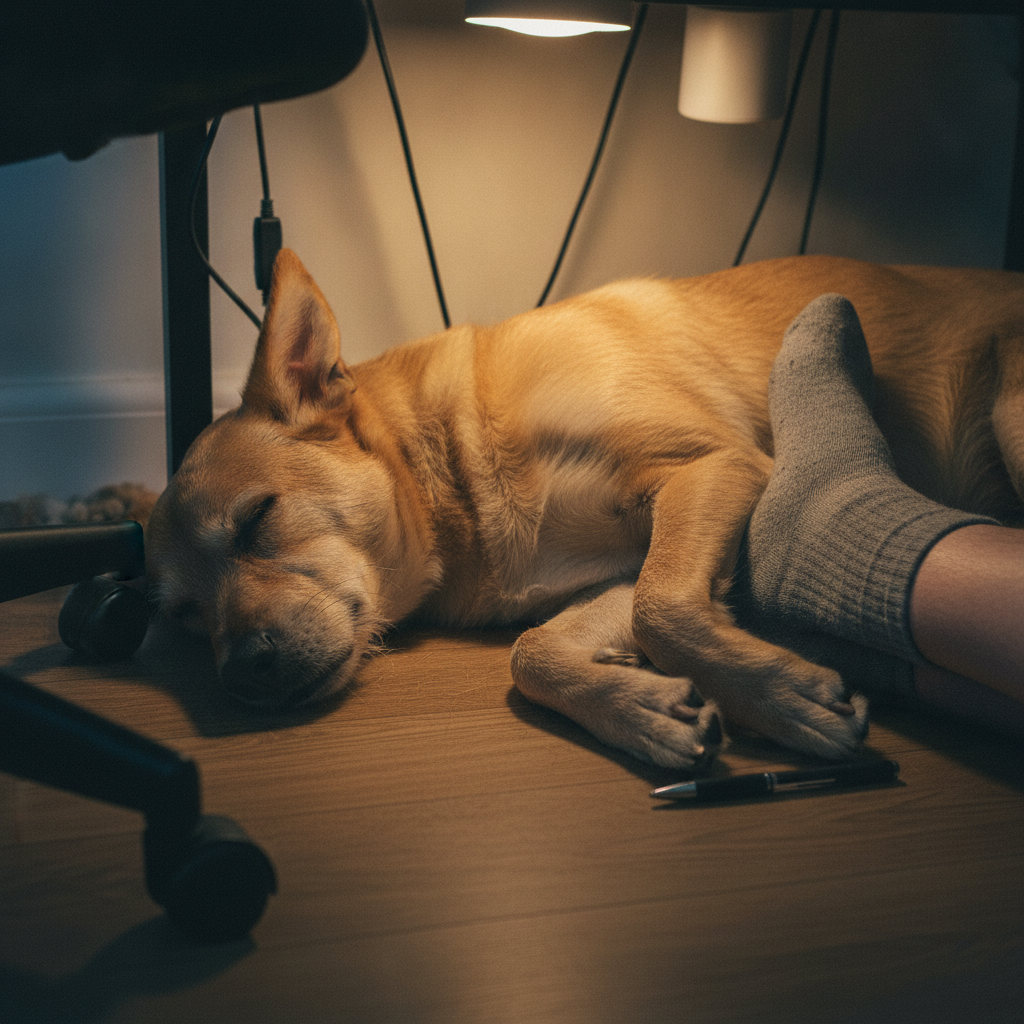
Your dog crosses the room, flops down across your feet, and settles their full weight there like a sandbag. It happens under the desk, on the sofa, at the end of the bed.
Search the question and you will hit a list. Affection. Warmth. Security. Dominance.
That last one is on nearly every list, and it should not be. It is a leftover from a model of dog behavior that veterinary behavior science has spent two decades dismantling, and it is worth being blunt: a dog lying on your feet is not making a statement about rank. They are not “showing you who’s in charge.” Nothing about the posture of lying down and putting their body against yours does the work that word implies.
The reason to care is not pedantry. It is that once you read a behavior as a status challenge, you start responding to it as a challenge, and that path leads to confrontation with an animal who was, in fact, just trying to lean on you.
So let us do the actual explanations, then the one variant that is a genuine problem, because that one exists and it gets buried under all the dominance talk.
The dominance thing, dispatched
The old model held that dogs live in rigid hierarchies and are constantly probing for opportunities to rise in them, so any behavior that could be construed as pushy, going through a door first, sleeping on furniture, resting on you, was a bid for status that needed to be corrected.
It came from studies of unrelated captive wolves thrown together in enclosures, which turned out to be a poor model of both wild wolves and domestic dogs. Wild wolf packs are mostly families, with the “alpha” pair being, straightforwardly, the parents. And dogs are not wolves; they are a separate species shaped by thousands of years of living alongside us.
The American Veterinary Society of Animal Behavior has a standing position statement against using dominance theory in behavior modification, on the grounds that it misdescribes what dogs are doing and produces training methods that increase fear and aggression. That is where the professional consensus sits.
A dog on your feet is not climbing a ladder. There is no ladder.
What is actually going on
You are a secure base
This is the strongest explanation, and it has real evidence behind it.
Dogs form attachment relationships with their people that look, structurally, like the ones human infants form with caregivers. In a well-known experiment, dogs worked on a manipulative problem-solving task under different conditions, and they performed better and persisted longer when their owner was present than when the owner was absent or replaced by a stranger. The technical name for this is the secure base effect: the presence of the attachment figure makes the animal more confident about engaging with the world.
Physical contact is the strongest possible version of “my person is present.” A dog lying across your feet has, in effect, plugged themselves into their anchor. They can sleep now, because the monitoring is handled.
This also explains a pattern owners notice constantly: the feet-lying gets more intense in new places, at the vet, in a busy park, at someone else’s house. That is not coincidence. That is the secure base working exactly as advertised.
The chemistry is real
The bond is not metaphorical. Mutual gazing and physical contact between dogs and their people are associated with oxytocin release, the same neurochemical involved in mammalian caregiving bonds, and dogs’ sensitivity to this system is one of the things that separates them from wolves. A dog leaning on you and a person absent-mindedly stroking a dog’s head are, at a chemical level, doing the same thing to each other.
You are warm
The least romantic explanation and a genuinely large part of it. Dogs carry less insulating body fat than we tend to assume and shed heat faster, and you are a large, reliable, 98-degree radiator. Feet and legs are also easy to get under.
If you have a small, thin, or short-coated dog who seems to seek warmth constantly, and who shivers in cold months, that is worth acting on: a coat or sweater is not a costume, it is thermal support for a dog who is genuinely cold.
It works
Never underestimate this one. If lying on your feet reliably produces absent-minded scratching behind the ears, the behavior is being paid every single time.
The one version that is a problem
Buried under all the sweetness is a real thing to watch for, and it is the reason the dominance framing is not just wrong but actively harmful, because it causes people to look for status challenges instead of looking for this.
Resource guarding, with you as the resource.
Dogs guard things they value: food, toys, sleeping spots, and, sometimes, people. A dog who is lying on you and growls, stiffens, freezes, curls a lip, snaps, or lunges when another dog, a cat, a partner, or a child approaches you is not being protective in a charming way. They are guarding an item they consider theirs, and the item is you.
Signs to take seriously:
- Growling or a hard stare when someone comes near while your dog is touching you
- Stiffening or freezing as another animal approaches
- Getting between you and another household member
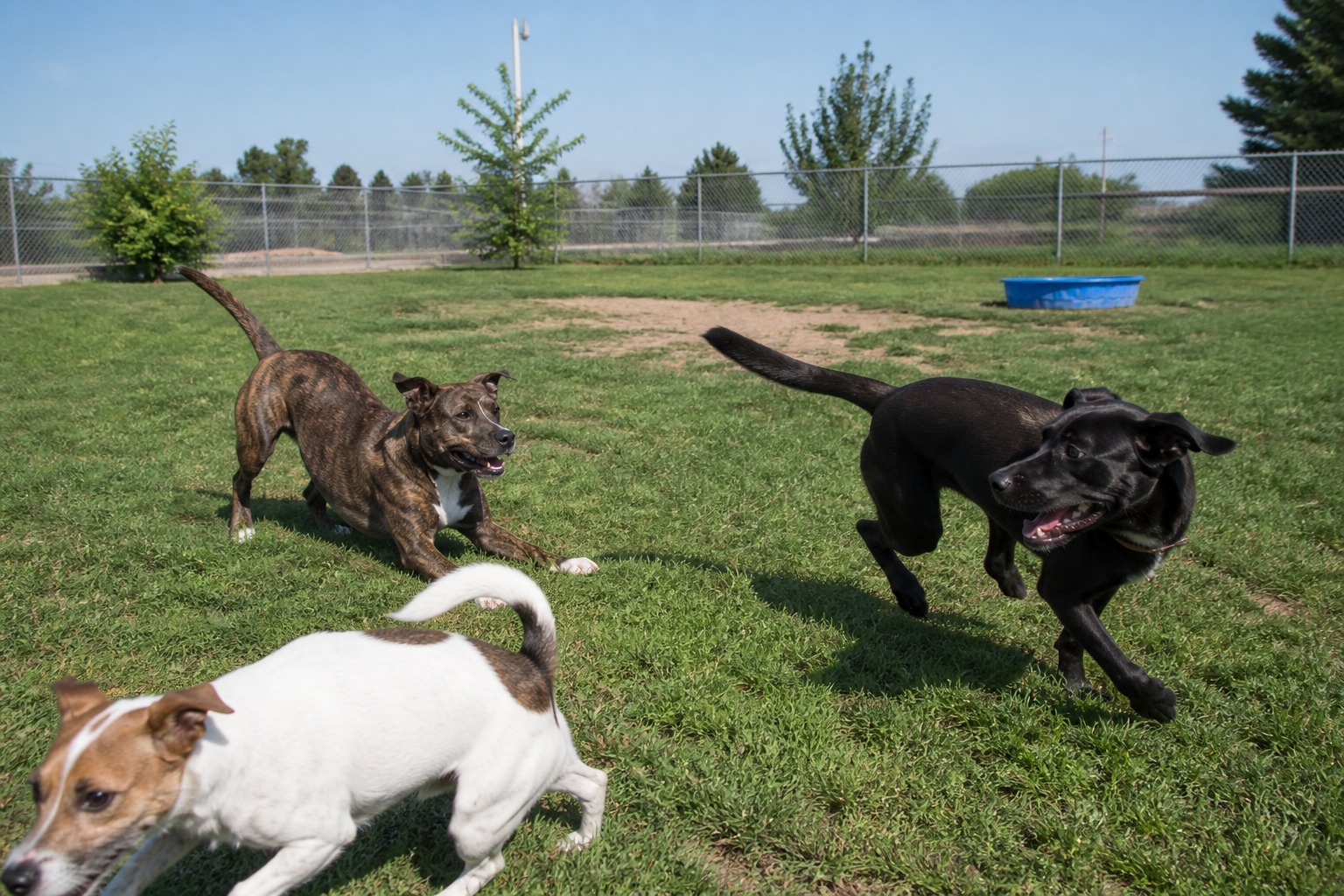
- Multiple dogs in the house competing, escalating, or fighting over who is at your feet
Do not punish this. Punishing a growl teaches a dog to skip the growl, which removes the warning without removing the feeling, and you end up with a dog who bites without notice. Guarding responds well to counterconditioning, and it is a job for a qualified trainer or a veterinary behaviorist. Get help early, before the household has learned to walk around it.
“The word people reach for is ‘protective,’ and it sounds like a compliment,” says Dr. Ravi Mehta. “But a dog who has decided a person is a resource worth defending is a dog under pressure. That is not a dog enjoying themselves.”
Should you let them do it?
Yes, if you like it. It is not a behavior problem, it does not create one, and there is no version of this where allowing your dog to lie on your feet “gives them ideas.”
If it genuinely is a nuisance, a dog constantly underfoot in a small kitchen is a legitimate trip hazard, do not correct it. Replace it. Teach a solid settle on a mat placed near where you stand or sit, and pay them for using it. You are not denying the need to be near you. You are moving where “near” happens.
And if the behavior is new, especially in an older dog, and especially if it arrives alongside clinginess, pacing, restlessness, or anxiety, treat that as a signal rather than a compliment. Sudden increases in attachment behavior can accompany pain, sensory decline, or cognitive change. Mention it at your next vet visit.
What newer research adds
Two things have hardened up.
The first is the rejection of dominance as an explanatory frame for ordinary dog behavior. This is no longer a debate at the level of professional bodies. Behavior that used to be labeled dominant, resting on you, going through doors first, getting on the sofa, is now understood in terms of attachment, learning history, and reinforcement, and behavior modification built on confrontation is understood to increase the risk of aggression rather than reduce it.
The second is how solid the attachment picture has become. Dogs meet the technical criteria for attachment bonds with their humans, show the secure base effect, and are physiologically wired into a caregiving system that we normally reserve for our own young. That is a big claim, and it holds.
Which puts the whole question in a different light. Your dog is not on your feet because they are angling for a promotion. They are on your feet because you are the thing that makes the room safe, and being in contact with you is the most efficient way to confirm you have not left.
References
- Horn, L., Huber, L., & Range, F. (2013). The Importance of the Secure Base Effect for Domestic Dogs — Evidence from a Manipulative Problem-Solving Task. PLOS ONE.
- Nagasawa, M., Mitsui, S., En, S., et al. (2015). Oxytocin-gaze positive loop and the coevolution of human-dog bonds. Science.
- American Veterinary Society of Animal Behavior. Position Statement on the Use of Dominance Theory in Behavior Modification of Animals.
- Mech, L. D. (1999). Alpha status, dominance, and division of labor in wolf packs. Canadian Journal of Zoology.
- Jacobs, J. A., Coe, J. B., Pearl, D. L., et al. (2018). Factors associated with canine resource guarding behaviour in the presence of people. Preventive Veterinary Medicine.