


Your Dog Isn't Holding a Grudge. Their Fear Memory Just Works Differently
Dogs don't keep a running tally of every scary moment, but some fears lodge deep and resurface for years. Here's what decides whether a bad moment sticks, and how to help your dog let it go.


There is a specific kind of guilt that comes from watching your dog fall apart over something you didn’t even notice. One second you’re strolling along, and the next your dog is frozen, trembling, ears pinned, staring at a patch of sidewalk like it betrayed them. A week later they brace at the exact same spot. You never heard the leaf blower that set it off. They did, and they remembered.
So the question every worried owner eventually asks is some version of: does my dog remember everything bad that has ever happened to them? The reassuring answer is no. Your dog is not keeping a ledger. They have almost certainly forgotten the time you dropped a pan, tripped over them, or sneezed too loud. But fear is not filed away like ordinary memory, and that is the real point worth understanding. A frightening moment can burrow in and stay for years, while a hundred boring ones evaporate by dinner. What separates the two isn’t how you’d expect, and once you know the pattern, you stop treating your dog like they’re being dramatic and start treating them like they’re doing exactly what a mammal’s brain is built to do.
Fear isn’t a memory of an event. It’s a learned association.
Here is the reframe that changes how you handle all of this: your dog usually isn’t remembering the thing that scared them so much as everything that happened to be nearby when it did. Their brain links the fright to whatever else was in the room, and later, one of those bystander details is enough to trip the whole alarm.
Dogs learn by connection, not by narrative. A dog scared by fireworks might later panic in the dark, not because darkness is dangerous, but because it was there when the sky exploded. The brain grabs whatever’s handy and files it under ‘danger.’ That’s why a fear can show up somewhere that makes no sense to us at all.
Behaviorists call the result a conditioned emotional response: the original threat is long gone, but a stand-in cue keeps pulling the trigger. It’s the same wiring that makes a person flinch at a song that was playing during a bad breakup. Understanding this is oddly freeing, because it means the fear isn’t proof your dog is broken or that you failed. It’s proof their learning system works.
Why one dog shrugs it off and another never does
Two dogs can live through the identical scare and come out completely differently. Whether a moment leaves a mark comes down to a handful of factors, and most of them are worth knowing before the scary thing ever happens.
Temperament and genetics. Some dogs are built bombproof. A crash, a dropped bowl, a stranger in a hat, and they barely blink. Others are wired to notice and hold onto everything. Neither is a training failure; it’s largely who the dog is. A naturally cautious dog simply needs more careful handling around anything startling.
How intense, and how sudden. A fright you can see coming is easier to metabolize than one that ambushes you. A dog who rounds a corner into a snarling stranger dog, with zero warning, is far more likely to be marked than one who watched the situation build. Surprise amplifies fear because there was no chance to brace for it.
Your reaction. This is the lever you actually control. When something startling happens and you stay loose and matter-of-fact, you tell your dog the event was survivable. When you gasp, tense the leash, and rush to scoop them up, you confirm the emergency. Your calm is data to them.
Whether it has happened before. Fear compounds. A dog who once had a close call with a kid on a skateboard is primed to react bigger the next time wheels roll by. Every repeat of the same trigger etches the groove deeper, which is exactly why early, gentle intervention matters more than people think.
Socialization, or the lack of it. A dog’s early exposure to the world acts like insulation against later fears. Puppies who meet cars, vacuums, vet tables, umbrellas, kids, and other animals in a positive way tend to grow into adults who can face the unexpected. The window is narrow: the critical socialization period runs from about three to 14 weeks, with a sensitive stretch around 12 to 14 weeks and a secondary fear period near six to eight months. Good associations built then tend to hold. So do bad ones, which is why this is not a phase to wing.
What a fear memory actually does to a dog’s life
When a scary memory really takes hold, it doesn’t stay politely in one lane. It leaks into how your dog moves through the world.
You’ll see conditioned fears, where the leftover associations reshape everyday behavior around avoiding a repeat. You’ll see avoidance, the dog who suddenly balks at a doorway, a room, or a person, sometimes for years, because something bad once happened there; a baby gate that toppled onto a puppy can turn into a lifelong hesitation at that threshold. Chronic fear can even show up in the body, contributing to stress-driven conditions like colitis and inflammatory bowel flare-ups, over-grooming that turns into raw lick sores, a dinged immune system, and slower healing. And it can look like reactivity: the lunging, barking dog on the leash is usually not a confident dog, but a frightened one shouting to make the scary thing go away.
That last one is the most misread. It is easy to label a reactive dog as aggressive or dominant. Far more often, you are watching fear wearing a loud costume.
How to help a frightened dog, without making it worse
The instinct to fix fear fast is exactly the instinct to fight. Nearly everything that helps is slow.
Learn to read your dog’s body first. Before you can help, you have to catch the stress early, when it’s a lip lick, a half-moon of white in the eye, a freeze, or a low tail, not once it has boiled over into a bark or a bite. Tail position alone tells you almost nothing; the whole body does.
Manage the environment. If you already know what sets your dog off, you don’t have to keep proving it to them. Rearrange walks, close blinds during storms, give a wide berth to the trigger. Every scary rep you prevent is one you don’t have to undo later.
Never flood them. Flooding is the deep-end approach: dragging a dog toward the thing they fear, or trapping them in it, and expecting them to just get over it. They can’t, and it usually makes the fear worse and adds a new one on top. If your dog is refusing, that refusal is information, not defiance.
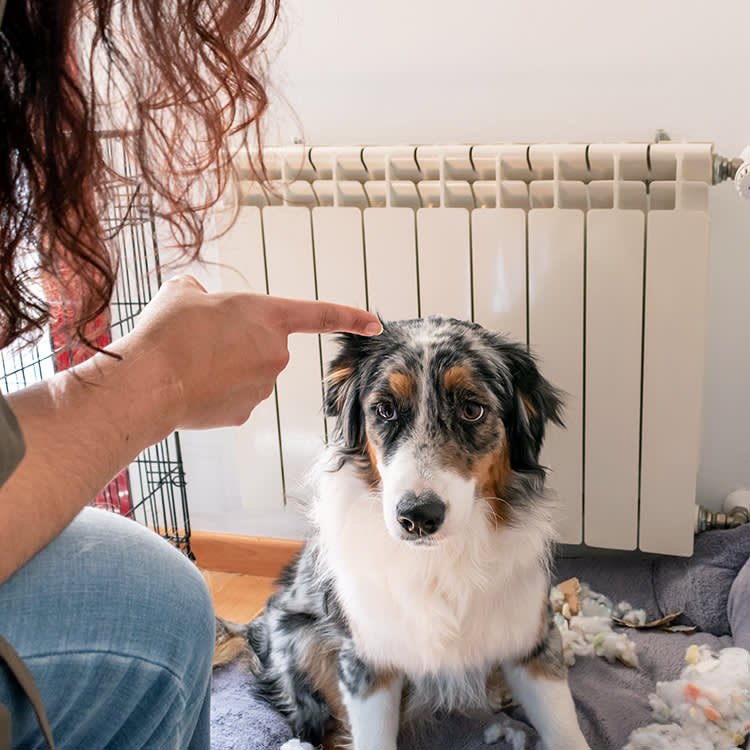
Don’t punish fear. A frightened dog who won’t cooperate is not being stubborn; they are having a physiological response they cannot switch off. Yelling, jerking, or forcing erodes the one thing you most need, which is their trust that you keep them safe.
Rebuild slowly with desensitization and counterconditioning. This is the actual cure, and it has two moving parts that work together. Desensitization means exposing your dog to the scary thing at an intensity so low it doesn’t trigger fear at all, then inching that intensity up over many sessions. Counterconditioning means pairing the scary thing with something wonderful, usually high-value food, so the association slowly flips from “danger” to “good things happen when that appears.” Keep treats or a favorite toy on hand, and the moment the trigger shows up at a manageable distance, start paying out. If your dog is too scared to eat, you’ve moved too close, too fast. Back up and make it easier.
When to bring in a vet
If your dog seems genuinely traumatized, don’t wait it out. Fear that goes untreated tends to grow, and the deeper it gets, the longer it takes to reverse. A veterinarian or a veterinary behaviorist can build a real plan, and for some dogs, medication makes the behavior work possible in the first place. That might be a situational anti-anxiety med for specific triggers like storms or fireworks, or a daily medication to lower the baseline hum of stress so your dog can actually learn.
“The goal of treating fear isn’t to teach the dog a command,” says Dr. Solis. “It’s to change how the dog feels, so they believe they’re safe again. Cues are the easy part. Rewriting the emotion underneath is the real work, and it’s absolutely doable.”
What newer research adds
If you’ve ever suspected that noise-related fears are especially common, the research backs you up: fear of loud or sudden sounds is now considered one of the most frequent behavior problems in pet dogs, in part because those sounds are unpredictable and impossible for a dog to make sense of. That unpredictability is the same thing that makes an ambush scarier than a slow build.
The encouraging news is how well the slow method holds up under scrutiny. Desensitization and counterconditioning is still regarded as the best-supported behavioral treatment for sound fears, and one controlled study found that a structured four-week desensitization-and-counterconditioning program measurably reduced dogs’ pre-existing fear at the vet. Reviews of the current evidence also point to something you can act on today: creating calm, positive associations with sudden noises early, before a fear takes root, is one of the most effective forms of prevention there is. In other words, the leash-side treat pouch isn’t a gimmick. It’s the most science-backed tool you have.
References
- Stellato, A. C., et al. “Effect of a Standardized Four-Week Desensitization and Counter-Conditioning Training Program on Pre-Existing Veterinary Fear in Companion Dogs.” Animals, vol. 9, no. 10, 2019, p. 767. Link
- Riemer, Stefanie, et al. “Therapy and Prevention of Noise Fears in Dogs—A Review of the Current Evidence for Practitioners.” Animals, vol. 13, no. 23, 2023, p. 3664. Link
- American Veterinary Society of Animal Behavior. “Position Statement on Humane Dog Training.” Link
Dr. Solis is a board-certified veterinary dermatologist with over twelve years of clinical experience. She advises on skin conditions, allergies, and grooming practices that affect coat and skin health. All dermatology and allergy content at The Pet Times is reviewed by her team before publication.
Meet our experts ↗Keep reading
 TrainingYour Dog Isn't Shy at Your Party. Six Signs They Want Out.Dr. Lena Park · 8 min
 TrainingNever Punish a Dog for Showing Teeth. It's the Warning You Want.Dr. Nina Kohl · 8 min
 TrainingHow to Say Sorry to Your Dog (Put the Tearful Hug Away)Dr. Amara Solis · 6 min
 TrainingThat Friendly On-Leash Hello Is Teaching Your Dog to Melt DownDr. Amara Solis · 6 min
 TrainingYelling at Your Dog Lands in Their Body, Not Just Their EarsDr. Mara Chen · 5 min
 TrainingStop Telling Yourself Your Dog Was AbusedDr. Nina Kohl · 8 min