


Agility Training Starts With a Cardboard Box, Not a Course
The weave poles and A-frames you see at Westminster are the last thing that matters. Real agility is a confidence-and-communication system you build at home, and any dog can do it. Here's where to start.

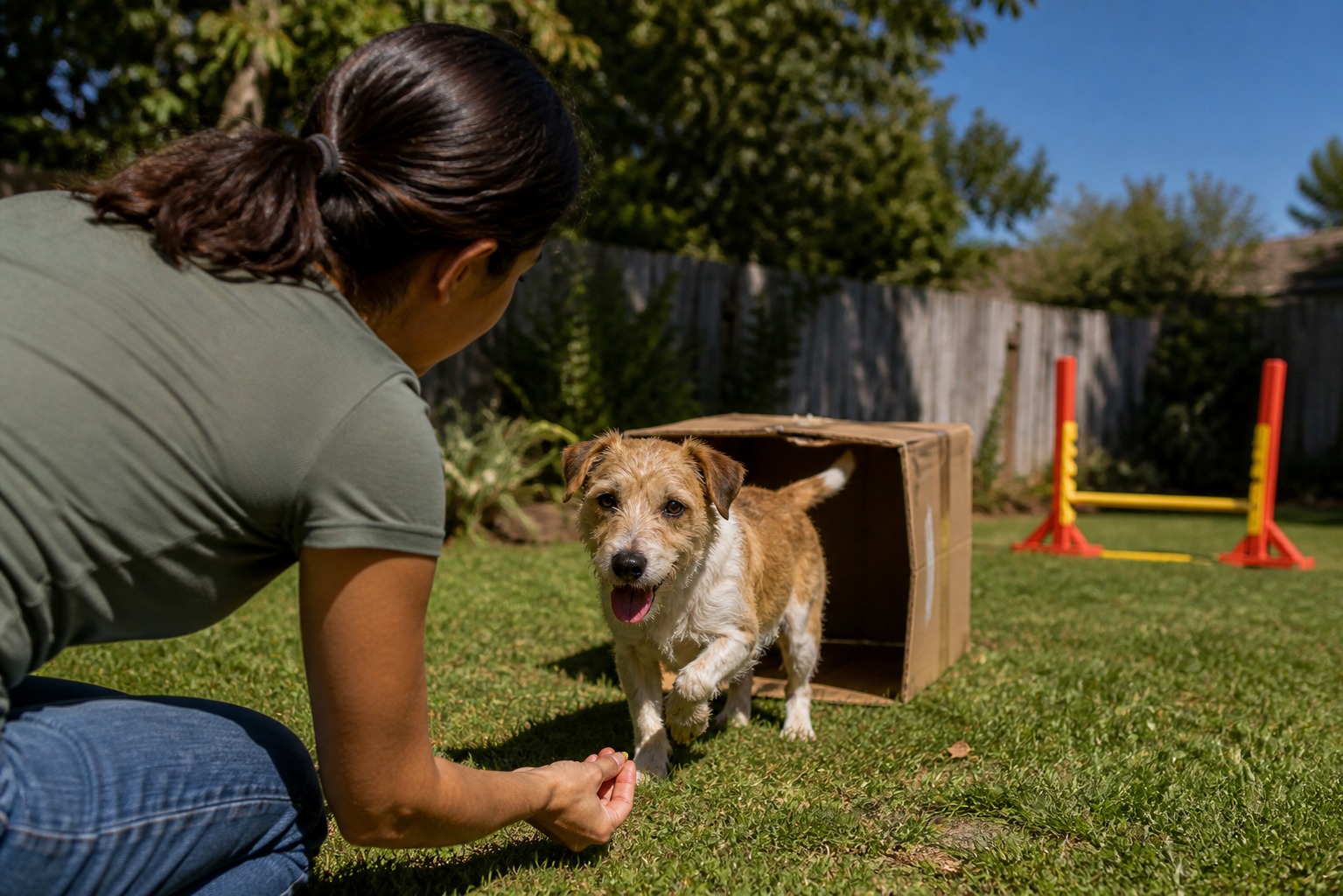
Somebody watches the agility rounds at a televised dog show, sees a border collie fly through weave poles, and thinks: not my dog. Too slow, too nervous, too whatever. That is the great misunderstanding about agility. The equipment is not the point, and the competition is optional. Underneath all of it, agility is a system for building confidence, focus, and two-way communication between you and your dog, and you can start it this afternoon with a cardboard box and a handful of treats. Any dog, any size, any temperament, can do a version of it.
In fact, the nervous dog is often the one who benefits most. Agility gives a shy or fearful dog a series of small, winnable challenges that teach them the world is not out to get them, and it gives an anxious dog a job that channels energy into something structured instead of destructive.
What agility actually trains
Agility works several skills at once. It sharpens off-leash responsiveness, it teaches a dog to approach and navigate new obstacles calmly, and it drills directional cues so your dog learns to read your movement. The through-line is the relationship. Every rep is a tiny conversation, and over time your dog gets better at understanding your cues and you get better at reading your dog. That is why people who try it for fun so often get hooked: the obstacles are just the excuse to build the connection.
Before you start, two housekeeping items. Get some basic obedience in place first, since your dog will progress faster if they already understand positive reinforcement and cues like sit, down, stay, and come; many agility classes require this. And if your dog has any health concerns or is not used to exercise, clear it with your vet before you begin, because agility asks the body to move in ways daily life does not.
The at-home building blocks
You do not need to buy anything to start most of these. You need household objects, patience, and a treat pouch.
Build flexibility first. Just like a person should warm up before a workout, your dog should too. Agility involves twisting and stretching that a couch-and-yard life never demands, so ask your vet for a few safe stretches to keep your dog limber and lower the risk of the strains that come from cold muscles doing new things.
Teach the tunnel with a box. A tunnel is scary because it often curves, hiding the exit. Start small: find a box that opens at both ends, tape the flaps open, and make sure your dog can walk through comfortably. Drop a treat just inside the opening and let your dog dip their head in for it a handful of times. Work the treats progressively deeper, and eventually lob one all the way through to the far side, circling around to call your dog if they hesitate, and paying out a reward for every success. To level up, connect a second box to lengthen the “tunnel.” If you get serious, a real agility tunnel can be introduced a few feet at a time and later bent into a curve.
Practice jumping. Look around for safe things to hop over, starting about five inches off the ground. The full sequence is worth doing right, so it lives in the step-by-step above. One safety rule overrides the fun: jumping loads the joints, and jumping too often or too high can injure your dog, so let age, breed, and any health history dictate how high and how much. When in doubt, keep it low.
Grow their attention span. Because agility rewards reading your smallest movements, it naturally builds impulse control and focus. Over weeks you will notice your dog checking in with you more, tuning to your body language, and wanting to work as a team.
Build body awareness. Dogs do not naturally think about their back legs and front legs as separate tools, and agility requires that they do. Teach it with a target: cut a cardboard disc roughly eight to ten inches across and color it yellow, a shade dogs pick out easily. Reward your dog first for looking at the circle, then for moving toward or sniffing it, then for landing their front paws on it, marking the moment with a “yes” and a treat and taking play breaks as needed. Once they are reliably hitting the target, add a cue like “paws” just before contact, and eventually the cue alone will do the job.
Teach left and right. Dogs really can learn directions, which pays off on trails and crowded sidewalks as much as on a course. Start by luring your dog’s nose toward their tail so their body curves, releasing the treat while they are still turned, and repeating until the movement is comfortable. Build the curve into a full 360-degree spin, rewarding each rotation, then attach a cue like “left” and gradually shrink your hand motion until a small swipe and the word produce the circle on their own. Do not overdo the spins in one session, or you will have a dizzy dog. Once one side is solid, teach the other.
Add tricks and moving surfaces. Simple tricks, touching an object, hopping through a hula hoop, jumping a low bar, build confidence and sharpen your timing on rewards. And to prep for the seesaw, one of the scariest pieces of equipment because it drops as the dog crosses the middle, get your dog comfortable with things that shift underfoot. Find safe, slightly unstable surfaces, like a couch cushion set over a ball, and heavily reward your dog, especially a nervous one, each time the surface moves, raising the difficulty only as their confidence grows.
“The one thing I want owners thinking about is warm-up and honest limits,” says Dr. Ravi Mehta. “A cold dog asked to jump high and turn hard is a dog you might see in my exam room. Loosen them up first, keep the bar low for young or older dogs, and treat any new limp as a stop sign, not something to push through.”
When to bring in a pro
Agility scales from your living room to a full facility. If you want to keep it at home, plenty of obstacles can be built from PVC or wood, or bought in backyard-sized versions. But if you and your dog catch the bug, a class is worth it: a good instructor teaches the safest technique, catches bad habits early, and gives you equipment to practice on, which matters a lot if competing ever tempts you.
What newer research adds
Two things are worth knowing if you are starting today. First, the sport has gotten far more inclusive: the major registries now welcome mixed-breed dogs to compete, so the old assumption that agility is a purebred border collie’s game is out of date. Your rescue mutt is eligible. Second, research on competition-level agility dogs points hard at conditioning and warm-up as injury prevention, reinforcing what the best trainers already preach, that the stretching and slow build are not busywork but the thing that keeps your dog sound. Start low, go at your dog’s pace, and the fancy equipment can wait.
References
- Inkilä, L. et al. “Part I of Finnish Agility Dog Survey: Training and Management of Competition-Level Agility Dogs.” Animals, vol. 12, no. 2, 2022. doi.org/10.3390/ani12020212
- American Kennel Club. “Getting Started in AKC Agility.” akc.org/sports/agility/getting-started/
- Virginia-Maryland College of Veterinary Medicine. “Tips for Successful Dog Training.” vetmed.vt.edu
- Pechette Markley, A. et al. “Factors associated with injury in agility dogs.” Journal of the American Veterinary Medical Association.
Marcus Webb writes about the gear, gadgets, and everyday choices that make life with a pet easier. His coverage runs from product picks to training and the causes worth paying attention to, always with an eye on what actually earns a place in your home.
Meet our experts ↗Keep reading
 First DaysYour Puppy Isn't Regressing. They're in a Fear PeriodJordan Ellis · 8 min
 TrainingYour Dog Doesn't Need a Muzzle. Train Them for One Anyway.Dr. Mara Chen · 7 min
 TrainingThe One Dog Sport Where the Anxious Dog WinsDr. Ravi Mehta · 7 min
 TrainingYour Dog Isn't Reading Your Face. They're Reading Your Hand on the Leash.Dr. Lena Park · 8 min
 TrainingScent Work Isn't a Party Trick. It Measurably Makes Your Dog More Optimistic.Dr. Nina Kohl · 8 min
 TrainingYour Rescue Dog Isn't Being Difficult. They're Decompressing.Dr. Mara Chen · 8 min